Business Visualizations
Find the Places in the U.S. Where People Are Most Eager to Find a Job

Job searching is stressful and the current employment market isn’t the strongest. The Bureau of Labor Statistics (BLS) says that the average job search lasts 23.3 weeks. That’s a long haul. The World Economic Forum does see the market becoming more dynamic soon with new and emerging job opportunities. Qualtrics added to this top with a new map showing where we’ll find the most active job seekers in the U.S. They drew on data from the BLS’s American Time Use Survey.
Click below to zoom.
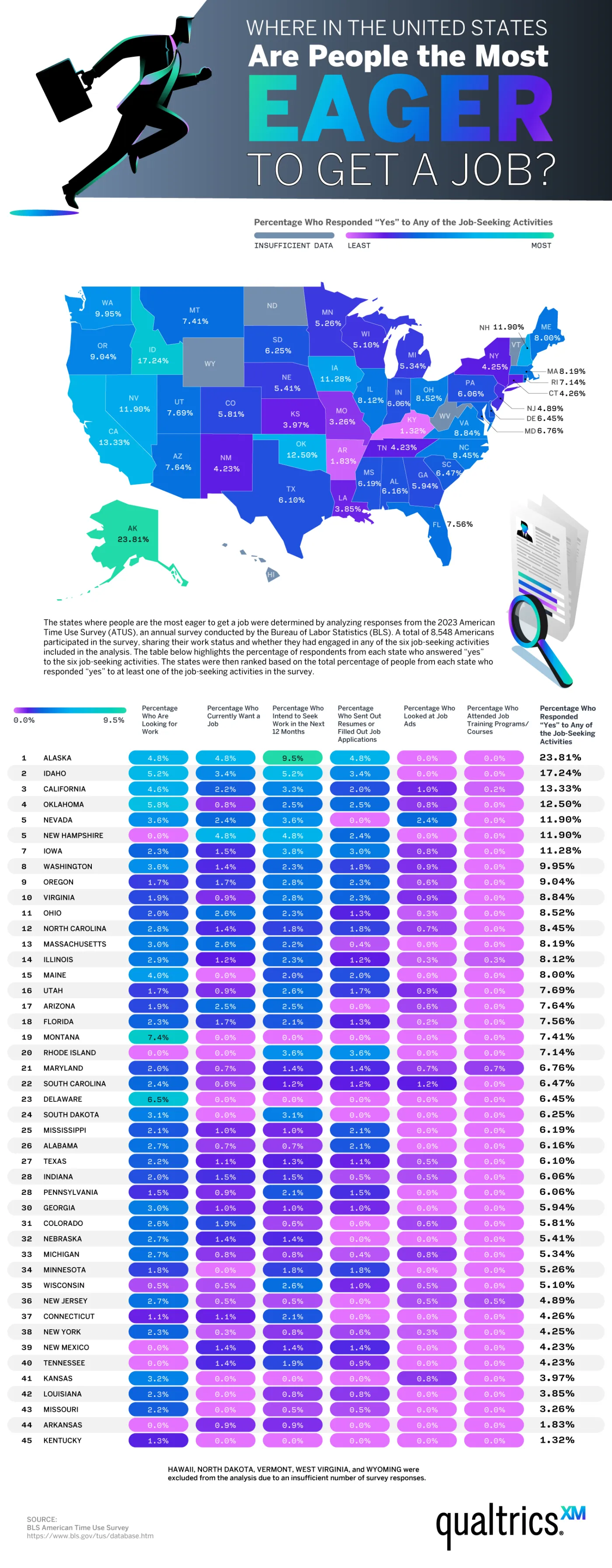
The team’s main visual for their data is a color-coded map of the 50 states, ranked by the percentage of residents who reported engaging in job-seeking activities. These could include looking for work, wanting a job, submitting applications, intending to seek work soon, looking at job ads, or attending job training. Five states had to be excluded from the ranking because of insufficient survey data. This included Hawaii, Vermont, North Dakota, West Virginia, and Wyoming.
These states were found to have the most people wanting new jobs:
- Alaska — 23.81% (standout leader)
- Idaho — 17.24%
- California — 13.33%
- Oklahoma — 12.5%
- Nevada & New Hampshire — tied at 11.9%
- Iowa — 11.28%
- Washington — 9.95%
- Oregon — 9.04%
- Virginia — 8.84%
This list shows Western and Pacific states dominating the top. Alaska as a standout leader might come as a surprise because it’s not due to a job shortage. There is actually a workforce shortage in Alaska. In 2024, Alaska created 5,400 new jobs with more expected in 2025. $20 billion in infrastructure development is expected to generate 20,000 more jobs by 2030. So, Alaska’s high job-seeking activity reflects a growing, dynamic economy with ample room for pivots and career changes.
States with the lowest rankings were Kentucky (1.32%), Arkansas (1.83%), and Missouri (3.26%). These states may have lower unemployment rates, different market conditions, or demographic factors that influenced their ranking. The data make it clear that job-seeking activity varies widely by state, tied to local economic conditions, perhaps more so than national trends. Job seekers should take advantage of training programs, the federal jobs board, and role-specific job search sites. It also shows that securing talent is only one step toward building a loyal, long-term workforce. Only 42% of workers feel engaged, which is a major reason they may seek new jobs.
Beyond a snapshot of where Americans are currently looking for work, these data points to a bigger reality: labor-market “energy” is uneven, and high job-seeking activity can signal opportunity as much as instability. In states like Alaska, movement may reflect an expanding, restructuring economy in which workers feel empowered (or required) to pivot as new roles and industries emerge. For job seekers, the practical takeaway is to align search strategy with local conditions. Prioritize skills-building and credentials that travel across employers, use targeted boards and training pipelines, and treat mobility as a long-term advantage rather than a short-term disruption. Organizations and individuals that read these regional signals early and invest accordingly will be best positioned to thrive as the economy continues to evolve.