Business Visualizations
Research Uncovers the Industries with the Highest Turnover Rates in the U.S.
The Qualtrics research team examined the employee turnover rates across American industries to identify which sectors struggle the most with workforce retention and which offer the greatest stability. The team defined a turnover rate as the percentage of hires, layoffs, and quits among an industry’s workforce. Turnover rates can vary widely across industries and can indicate a range of conditions for workers, from economic instability to dangerous jobs with high injury rates. High turnover can also be very costly for the businesses within those industries.
Click below to zoom.
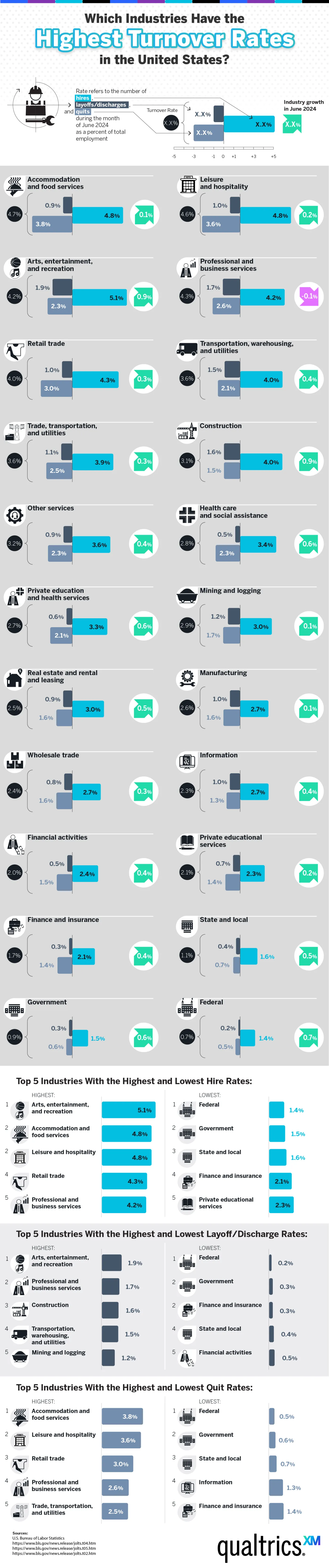
The team created a chart to visualize data from the Bureau of Labor Statistics. They measured hire rates, layoff/discharge rates, and quit rates. Here are the top 5 results from each category:
The highest hiring rates: Arts, entertainment, and recreation; accommodation and food services; leisure and hospitality; retail trade; and professional and business services.
The highest layoff/discharge rates: Arts, entertainment, and recreation; professional and business services; construction; transportation, warehousing, and utilities; and mining and logging.
The highest quit rates: Accommodation and food services; leisure and hospitality; retail trade; professional and business services; trade, transportation, and utilities.
Arts and entertainment stand out as a highly unstable industry with high hiring and layoff rates, meaning it has by far the highest turnover. On the low end of these measures, we find the federal government and finance sectors.
High turnover rates should concern more than employees. They don’t favor businesses either. Hiring new workers can be very expensive, as the business must cover job advertising, recruitment agency fees, training costs, and other onboarding expenses. According to Cornell University, it costs an average of $5,864 to replace an employee. If we examine the high-turnover food service industry, we find that a restaurant with 50 employees would need to replace two employees per month at a 4.7% turnover rate. Over the course of the year, replacing two employees a month would cost the restaurant $150,000. Setting aside the costs, high turnover can disrupt workflow and add workload and stress for staff, lowering morale, quality, and brand reputation. We saw this happen in another high-turnover industry. Both the Screen Actors’ Guild and the Writers’ Guild have made headlines for massive strikes that delayed film projects for years.
The team pointed out that a report from the Society for Human Resource Management identified the top three reasons for turnover as employee dissatisfaction with compensation, lack of career development, and workplace inflexibility. These are all common factors in the industries with the highest rates. Industries like food service, retail, and hospitality all have high levels of burnout, employees who feel they’re in stagnant careers, and demanding schedules that require work on weekends and holidays. These factors create unsatisfied workers who don’t stick around in the industry.
The COVID-19 pandemic led many people to consider the importance of workplace safety and a work culture that makes employees feel the company takes their health seriously. There were high turnover rates during this time across industries, and we learned that many companies fell short in protecting workers from illness. The Qualtrics study is packed full of data points with far-reaching implications like these.