Business Visualizations
Map Displays Unemployment Rates Around the World
The unemployment rate is a percentage that reflects the number of people in the labor force who are without a job. This is calculated by dividing the number of unemployed people by the labor force and multiplying by 100. Because unemployment can have a drastic impact on a nation’s economy, the team at Qualtrics examined global patterns and mapped unemployment rates. To be considered unemployed for this study means a person doesn’t have a job but is available for work. That means people who are retired, disabled, or laid off don’t count in the figures.
Click below to zoom.
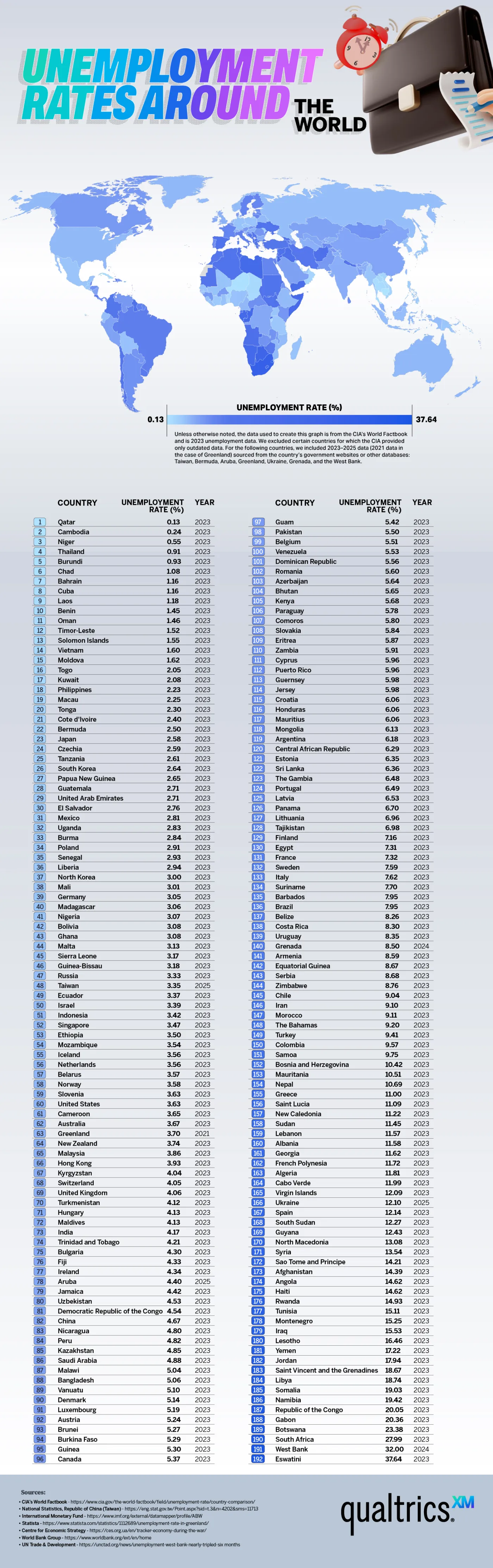
According to the team’s data, the country with the highest employment rate is Eswatini at 37.64%. This is a landlocked nation in Southern Africa, formerly known as Swaziland. This is one of the world’s last absolute monarchies, and it suffers economically like many of its neighbors, including South Africa, Botswana, and the Republic of the Congo. In particular, the youth of Eswatini are unemployed. The unemployment crisis is attributed to skill gaps in eligible workers.
It’s good to be at the low end of the unemployment spectrum. The nation Qatar has the lowest unemployment rate in the world at .13%. This comes as no surprise from a nation rich in petroleum and natural gas. Qatar has valuable real estate and has long been a haven for the wealthy, which lends itself to a booming economy with plenty of employment opportunities. Other nations that aren’t struggling with unemployment are Cambodia, Niger, and Thailand, due to high manufacturing production and/or a bustling tourism industry.
These countries have the lowest unemployment rates:
- Qatar
- Cambodia
- Niger
- Thailand
- Burundi
- Chad
- Bahrain
- Cuba
- Laos
- Benin
We see a very wide gap between the countries with the highest and lowest unemployment rates. Many factors can affect unemployment, but one of the biggest is changes in the size of the labor force. A struggling economy doesn’t necessarily indicate a high unemployment rate. If it’s difficult enough to find a job, people will give up, and they’ll no longer be counted in the unemployment numbers. That said, the unemployment rate does tend to increase in hard times. Global unemployment peaked in 2009 during the financial crisis.
In summary, unemployment rates reveal much about the economic health and social dynamics of countries worldwide. While nations like Eswatini face challenges due to skill gaps and limited job opportunities, others, such as Qatar, benefit from abundant resources and thriving industries. The disparity highlights how factors such as labor force size, economic stability, and industry growth affect employment levels. Understanding these global patterns is essential for policymakers and organizations aiming to address unemployment and foster sustainable growth. By analyzing the causes and consequences, we can better support individuals and communities striving for economic security and opportunity.