
Business Visualizations
America’s Most Valuable Companies Ranked by Profit per Employee

Ever wonder how much money major corporations make per employee? Profit Per Employee (PPE) is determined by dividing the company’s profit by the company’s quantity of full-time employees. The most profitable companies may not necessarily be the most profitable by number of employees—and vice versa. Whenever the economy is uncertain, this formula is usually one of the metrics companies will monitor to determine the efficiency and productivity of their staff. Using data over profit and company size from 2023, our team at The Chartistry has ranked the top 50 companies with the highest profit per worker.
Click below to zoom
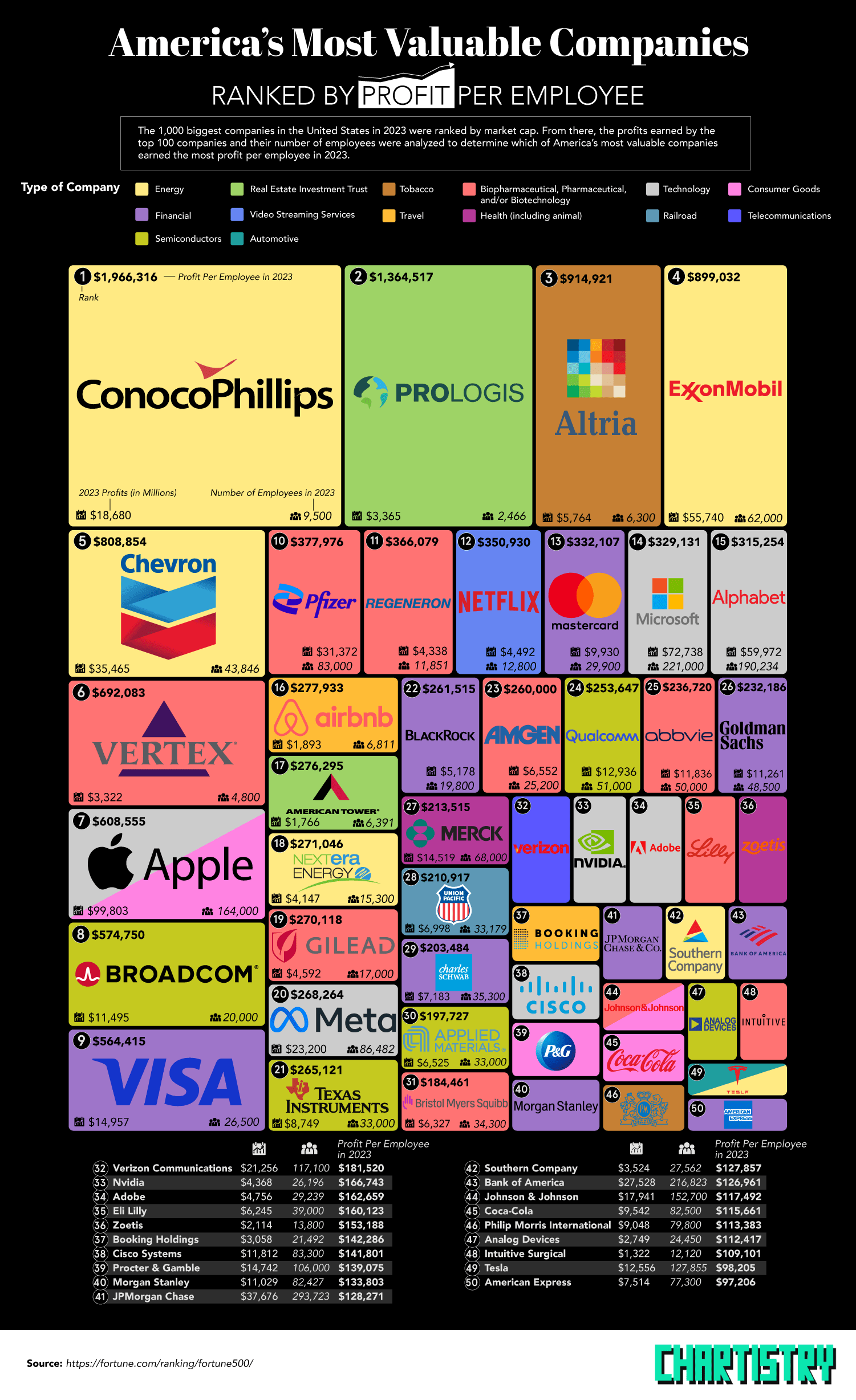
With a profit of nearly $2 million for each of their 9,500 employees, ConocoPhillips ranks first for highest profit per employee by quite the large margin. ConocoPhillips, an American oil and gas producer, saw a total profit almost $18.7 billion in 2023. Since oil and gas are two of the most valuable energy commodities in the world, it is not uncommon for an energy company to rank high in terms of PPE since their net profit is typically quite expansive. Of the top 50 companies with the highest profit for every employee, six of them can be categorized under the energy sector.
Coming in second place, Prologis is an investment trust company that saw a total profit of $3.4 billion in 2023. This profit was divided by their 2,466 employees to end with a profit of $1.36 million per employee.
In third, there is the tobacco company Altria Group. Altria Group’s 2023 profit of $5.8 billion was divided by 6,300 employees to result in a profit per employee of $915 thousand. Tobacco is yet another commodity product, with only one other tobacco company making the top 50 ranking.
Exxon Mobil is another oil and gas company with high profit per employee, coming in fourth place. Out of their profit of $55.7 million in 2023, their 62,000 employees averaged a profit of $899 thousand each.
Rounding out the top 5 companies is Chevron, the third oil and gas energy company in the top companies by profit per employee. With a total profit of $35.3 million, their PPE comes out to $809 thousand for each of their 43,846 employees.
Some companies land rank in both the most profitable in the world overall as well as in profit per worker. Apple, for example, brought in a 2023 profit of nearly a $100 billion. The company itself is valued at a total of $2.1 trillion. They managed a PPE of $609 thousand for their 164,000 employees, making them seventh among all companies.
Why is Profit per Employee Important?
For every company with an impressive profit per employee, there are tens, hundreds, even thousands of people working at the front line and behind the scenes to keep operations running as smoothly and efficiently as possible. PPE, not to be confused with Revenue per Employee, is a way for the company to measure the performance and productivity of the average employee in any given workforce to judge their added value. In other words, a way to know if their investment in hiring, retaining, and training their employees returned desirable results. Of course, it isn’t and shouldn’t be the only method to judge the value of an employee. When used in combination with other metrics, however, it can be a helpful tool to see the what employees have brought to the company.
For the majority of situations, a healthy profit per employee will be a good indicator of the health of the company at large. It shows that the business is properly maximizing the streamlining of their operations and utilizing the talent of each employee. This performance can mean that an underwhelming PPE may lead to cost-cutting measures for the company. Oftentimes, this is in the form of employee layoffs in areas that may not be contributing to the overall profit.
Did You Enjoy this Original Visualization by The Chartistry?
If you enjoyed this visualization and analysis by The Chartistry, check out the other original visualizations we’ve created. For even more great content, check out our collection of curated business and finance visualizations. If you love this visual content so much that you want your own, let us know; We design custom visual content for customers too!
The Profit per Employee of the Largest Companies in the U.S. By Market Cap (The Full List)
Which corporations have the highest revenue per employee? Companies that are able to do more with less:
| Rank | Name | Type of Company | 2023 Profits (in Millions) | Number of Employees in 2023 | Profit per Employee in 2023 |
| 1 | ConocoPhillips | Energy | $18,680 | 9,500 | $1,966,316 |
| 2 | Prologis | Real Estate Investment Trust | $3,364.9 | 2,466 | $1,364,517 |
| 3 | Altria Group | Tobacco | $5,764 | 6,300 | $914,921 |
| 4 | Exxon Mobil | Energy | $55,740 | 62,000 | $899,032 |
| 5 | Chevron | Energy | $35,465 | 43,846 | $808,854 |
| 6 | Vertex Pharmaceuticals | Biopharmaceutical, Pharmaceutical, and/or Biotechnology | $3,322 | 4,800 | $692,083 |
| 7 | Apple | Technology, Consumer Goods | $99,803 | 164,000 | $608,555 |
| 8 | Broadcom | Semiconductor | $11,495 | 20,000 | $574,750 |
| 9 | Visa | Financial | $14,957 | 26,500 | $564,415 |
| 10 | Pfizer | Biopharmaceutical, Pharmaceutical, and/or Biotechnology | $31,372 | 83,000 | $377,976 |
| 11 | Regeneron | Biopharmaceutical, Pharmaceutical, and/or Biotechnology | $4,338.4 | 11,851 | $366,079 |
| 12 | Netflix | Video Streaming Services | $4,491.9 | 12,800 | $350,930 |
| 13 | Mastercard | Financial | $9,930 | 29,900 | $332,107 |
| 14 | Microsoft | Technology | $72,738 | 221,000 | $329,131 |
| 15 | Alphabet | Technology | $59,972 | 190,234 | $315,254 |
| 16 | Airbnb | Travel | $1,893 | 6,811 | $277,933 |
| 17 | American Tower | Real Estate Investment Trust | $1,765.8 | 6,391 | $276,295 |
| 18 | NextEra Energy | Energy | $4,147 | 15,300 | $271,046 |
| 19 | Gilead Sciences | Biopharmaceutical, Pharmaceutical, and/or Biotechnology | $4,592 | 17,000 | $270,118 |
| 20 | Meta Platforms | Technology | $23,200 | 86,482 | $268,264 |
| 21 | Texas Instruments | Semiconductor | $8,749 | 33,000 | $265,121 |
| 22 | BlackRock | Financial | $5,178 | 19,800 | $261,515 |
| 23 | Amgen | Biopharmaceutical, Pharmaceutical, and/or Biotechnology | $6,552 | 25,200 | $260,000 |
| 24 | Qualcomm | Semiconductor | $12,936 | 51,000 | $253,647 |
| 25 | AbbVie | Biopharmaceutical, Pharmaceutical, and/or Biotechnology | $11,836 | 50,000 | $236,720 |
| 26 | Goldman Sachs Group | Financial | $11,261 | 48,500 | $232,186 |
| 27 | Merck | Health (Including Animals) | $14,519 | 68,000 | $213,515 |
| 28 | Union Pacific | Railroad | $6,998 | 33,179 | $210,917 |
| 29 | Charles Schwab | Financial | $7,183 | 35,300 | $203,484 |
| 30 | Applied Materials | Semiconductor | $6,525 | 33,000 | $197,727 |
| 31 | Bristol-Myers Squibb | Biopharmaceutical, Pharmaceutical, and/or Biotechnology | $6,327 | 34,300 | $184,461 |
| 32 | Verizon Communications | Telecommunications | $21,256 | 117,100 | $181,520 |
| 33 | Nvidia | Technology | $4,368 | 26,196 | $166,743 |
| 34 | Adobe | Technology | $4,756 | 29,239 | $162,659 |
| 35 | Eli Lilly | Biopharmaceutical, Pharmaceutical, and/or Biotechnology | $6,244.8 | 39,000 | $160,123 |
| 36 | Zoetis | Health (Including Animals) | $2,114 | 13,800 | $153,188 |
| 37 | Booking Holdings | Travel | $3,058 | 21,492 | $142,286 |
| 38 | Cisco Systems | Technology | $11,812 | 83,300 | $141,801 |
| 39 | Procter & Gamble | Consumer goods | $14,742 | 106,000 | $139,075 |
| 40 | Morgan Stanley | Financial | $11,029 | 82,427 | $133,803 |
| 41 | JPMorgan Chase | Financial | $37,676 | 293,723 | $128,271 |
| 42 | Southern Company | Energy | $3,524 | 27,562 | $127,857 |
| 43 | Bank of America | Financial | $27,528 | 216,823 | $126,961 |
| 44 | Johnson & Johnson | Biopharmaceutical, Pharmaceutical, and/or Biotechnology | $17,941 | 152,700 | $117,492 |
| 45 | Coca-Cola | Consumer Goods | $9,542 | 82,500 | $115,661 |
| 46 | Philip Morris International | Tobacco | $9,048 | 79,800 | $113,383 |
| 47 | Analog Devices | Semiconductor | $2,748.6 | 24,450 | $112,417 |
| 48 | Intuitive Surgical | Biopharmaceutical, Pharmaceutical, and/or Biotechnology | $1,322.3 | 12,120 | $109,101 |
| 49 | Tesla | Automotive, Energy | $12,556 | 127,855 | $98,205 |
| 50 | American Express | Financial | $7,514 | 77,300 | $97,206 |









Moving into a first apartment is a rite of passage, but the math behind making it a reality is becoming a bigger obstacle. The metros with the strongest job markets also have the steepest living costs, and over the past few years, rent in these areas has climbed faster than paychecks. Cheap rent isn’t the only solution, though. Thin wages and flat hiring shut young people out of many cities.
Rove Lab’s new analysis identifies the cities in the middle ground with the most to offer young people establishing their lives. The study examined the 100 most populous U.S. metro areas and scored each one on 10 different metrics grouped into three weighted categories.
Click below to zoom.
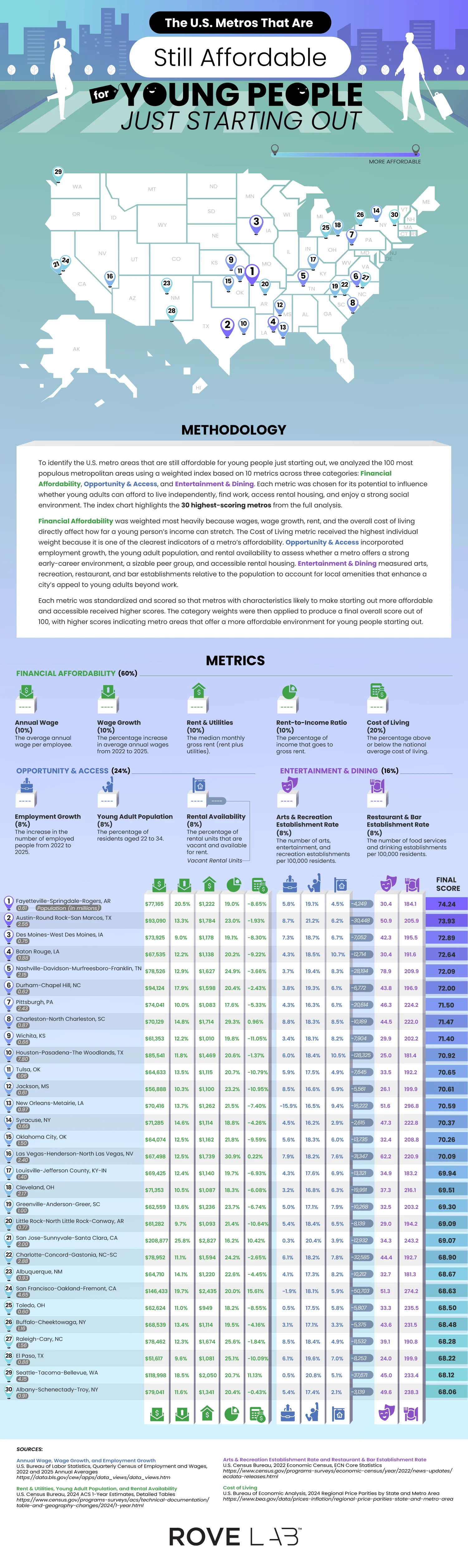
Financial affordability was the most important category, carrying 60% of the weight. This category covers average annual wage, wage growth, median rent and utility costs, rent-to-income ratio, and cost of living relative to the national average. Cost of living alone received 20% of the weight, the heaviest single metric in the study. Opportunity and access accounted for 24% and included employment growth, number of residents between 22 and 34, and amount of rental vacancy. The final 16% went to entertainment and dining, tracking the number of arts and recreation venues and restaurants and bars per 100,000 residents. Each metric was standardized, scored, and weighted into a final number out of 100.
The winning city was Fayetteville-Springdale-Rogers, Arkansas, with a score of 74.24. This isn’t an obvious winner until you look at the numbers. Wages increased by 20.5% from 2022 to 2025, with the average wage at $77,165 and a cost of living that’s 8.65% below the national average. This combination creates a rent-to-income ratio of 19%, leaving young people with money to save, potentially for the elusive dream of homeownership. Fortune 500 companies, Walmart, J.B. Hunt, and Tyson, have a home in the area and likely explain wage strength.
Austin-Round Rock-San Marcos followed with a 73.93 score, driven by a thriving tech sector that’s seen 8.7% employment growth, and the area offers 30,000 vacant rental units for newcomers. Des Moines, Baton Rouge, and Nashville round out the top five.
A few cities earned high rankings thanks to low housing costs. Pittsburgh was seventh overall with a rent-to-income ratio of 17.6%. Wichita, ranked ninth, has low rent and utilities and a low cost of living that’s 11.05% below average. Toledo, number 25 on the list, has the cheapest housing of all cities on the list, with an average of $949 a month.
The most surprising cities on the list are Californian. San Jose-Sunnyvale-Santa Clara ranks 21st, and San Francisco-Oakland-Fremont lands 24th, despite costs of living well above the national average. Salaries do the heavy lifting, averaging $208,877 and $146,433, respectively. This pulls down San Jose’s rent-to-income ratio to 16.2%, the lowest on the list.
If you were to ask the average American on the street to name the industries that power the national economy, they’ll likely reply “manufacturing” or “tech.” But the Bureau of Economic Analysis says otherwise. As Ooma’s study shows, real estate, rental, and leasing hold the biggest slice of the U.S. economy.
In 2024, the U.S. produced more than $29 trillion in economic output, which outstripped Germany, China, and Japan combined. Looking at how gross domestic product (GDP) breaks down by industry shows the value added by sector after subtracting the costs of the inputs that industry consumed. For example, a carmaker buys steel, rubber, and semiconductors. The value added is the difference between those purchases and the selling price of the finished car. Add up that gap, the value added across every industry in the country, and you arrive at the GDP.
Click below to zoom.
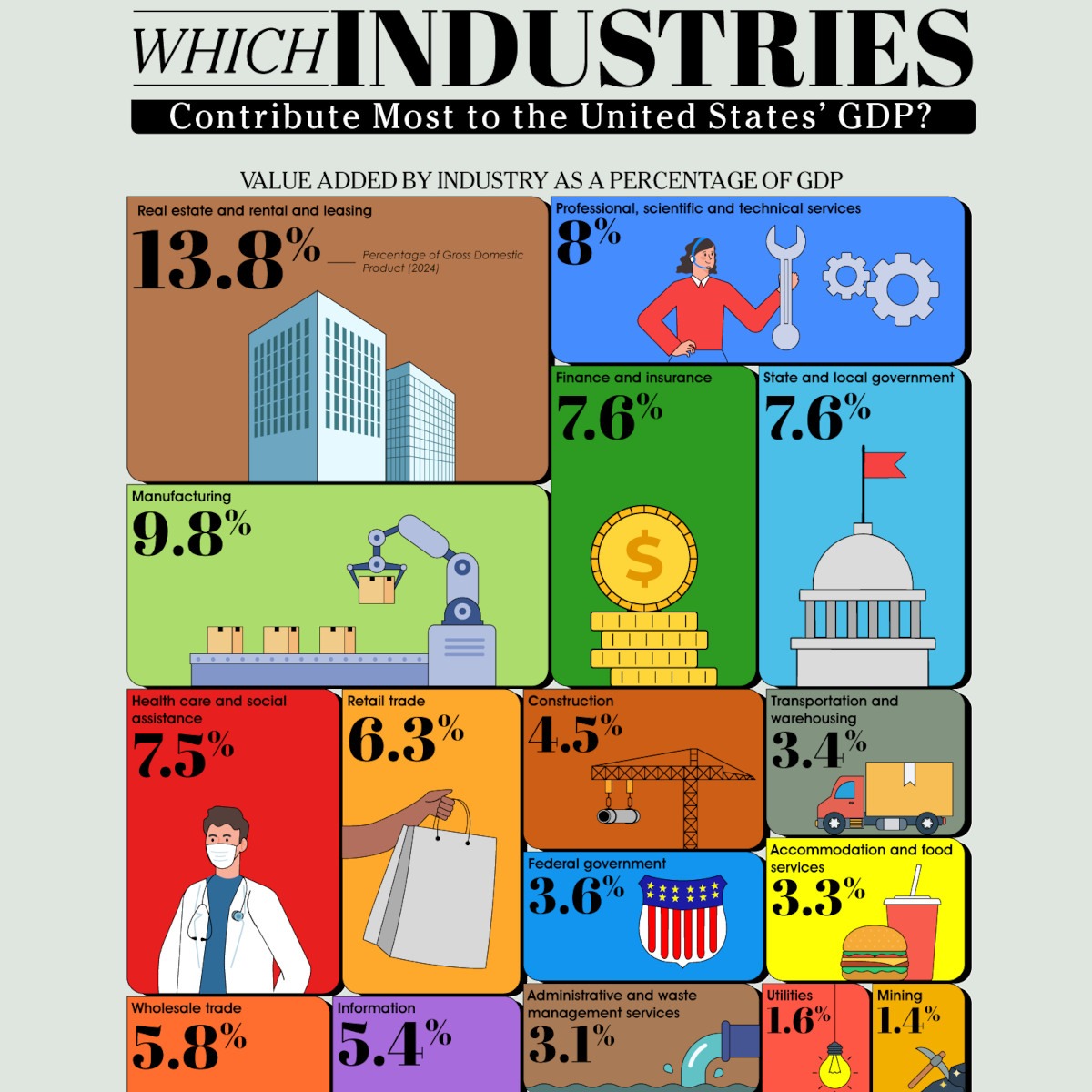
When Ooma ranked industries by their GDP, they found out that the money is concentrated in these industries:
Real estate, rental, and leasing – 13.8%: Real estate alone accounted for $3.68 trillion, the biggest of any sub-industry in the economy. Every mortgage payment, property tax bill, apartment lease, and commercial rent check pours into this sector. Rising home ownership costs over the past decade have pushed more citizens into renting, which has only inflated this industry.
Manufacturing – 9.8%: Factory employment has fallen for forty years due to automation and offshoring, but output hasn’t fallen. Chemical products created $554 billion, and computer and electronic products contributed $299.8 billion to the U.S. economy, helping keep the nation among the world’s top manufacturing nations despite a smaller workforce.
Professional, scientific, and technical services – 8.0%: This industry is made up of law firms, consultancies, engineering firms, and software developers. Legal services alone created $387.7 billion, and computer systems design added $552.2 billion to the American economy. This strongly shows how the American economy leans toward knowledge work.
Finance and insurance – 7.6%: Credit intermediation and Federal Reserve banks generated $1.01 trillion, insurance carriers contributed $791.8 billion, and securities and commodity contracts brought in $396.1 billion.
State and local government – 7.6%: Many rankings leave out these sectors, but government at the state and local level added $2.07 trillion, second only to real estate among all the sub-industries.
Health care and social assistance – 7.5%: Ambulatory care brought in $1.08 trillion and hospitals contributed $691.5 billion. This reflects genuine demand from an aging population and the fact that the U.S. spends more per capita on healthcare than any other developed nation.
Below these top-tier industries, retail trade, wholesale trade, information (Google, Meta, cloud providers, telecom), data processing, and internet publishing followed. Construction closed out the top ten industries at 4.5%, rising and falling in contributions with the real estate sector.
The largest components of American GDP aren’t the ones that produce a physical product. They’re the industries that manage property, deliver care, sell expertise, and move money.
Student Choice has published the 2026 updated version of its study, ranking the most popular college degrees by return on investment after five years in the workforce. The team’s premise is timely as they examine a hot topic: the cost of higher education. The average cost of college now exceeds $43,000 per year, so entering the workforce with these student loans became a high-stakes game. The analysis pairs the top 25 majors in 2026, based on a previous Student Choice study, with earnings data from the U.S. Bureau of Labor Statistics to calculate how much a graduate earns in their first five years relative to their four-year tuition investment. They illustrated their findings by ranking 20 degree types compared to 40 common occupations.
Click below to zoom.
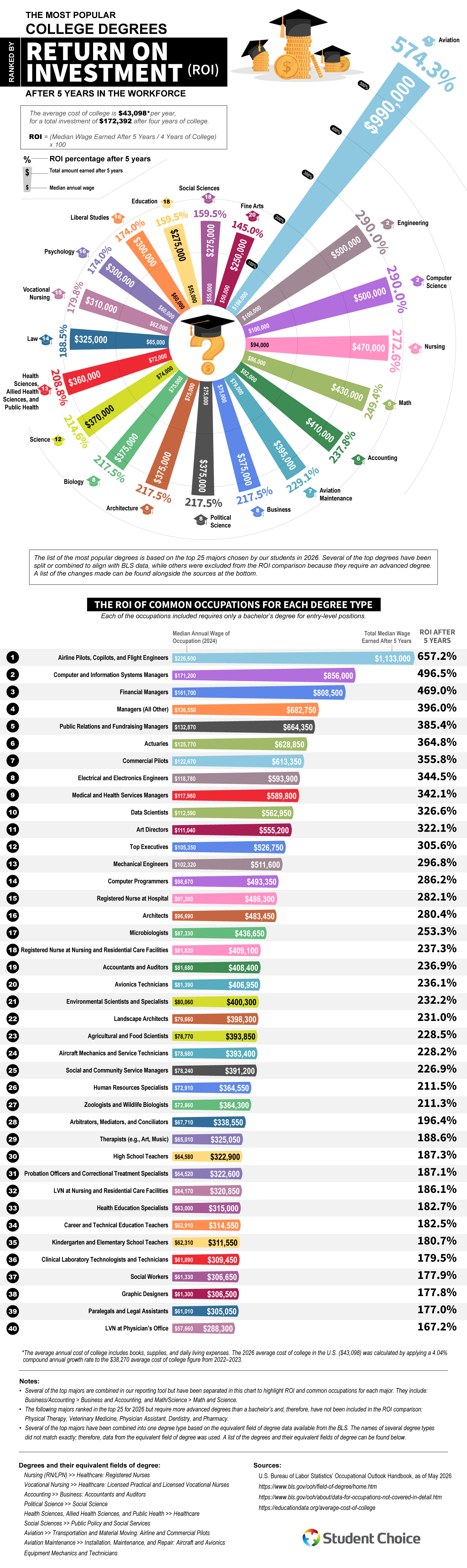
The team used a simple methodology. The average cost of college is $43,098 per year for a total investment of $172,392 for four years, with ROI calculated as median wages earned over five years divided by the four-year college cost. Majors that require advanced degrees like physical therapy, veterinary medicine, physician assistant, dentistry, and pharmacy were excluded from the ROI comparison even though these majors rank in the top 25.
Aviation tops the rankings chart, claiming the leading spot by a wide margin because of its astounding 574.3% ROI after five years, boosted by the median annual wage of $198,000. The field’s popularity is likely due to high pay and a looming pilot shortage as veteran airline workers retire. Engineering and computer science tied for second place at 290% each with median wages of $100,000 a year.
Healthcare and quantitative fields round out the upper tier. Nursing ranks fourth with an ROI of 272.6%, followed by math at 249.4% and accounting at 237.8%. Business, political science, architecture, and biology all tie for eighth at 217.5%, based on a $75,000 median wage. Education and social sciences sit near the bottom of the list at 159.5%, and fine arts at the bottom at 145%.
The study’s most helpful section might be the table that shows how career choice within a major can dramatically outperform the degree’s baseline. Aviation graduates who became airline pilots, copilots, or flight engineers reached a 652.7% return on a median wage of $226,600. Computer and information systems managers hit 496.5%, financial managers reached 469%, and public relations and fundraising managers reached 385.4%. Even lower-ranked majors can have exceptions. For example, fine arts majors who become art directors have a 322.1% return with a median salary of $111,040. Math majors working as actuaries earn 364.8%.
Overall, though, this study shows us that getting a degree pays off. Even accounting for student debt, the data suggests that degrees can double or triple the initial investment within five years. While most people will work for about four decades after student life, the returns will continue to compound. There is a growing preference for specialized, career-focused degrees with clear pathways into established professions so students can enjoy the ROIs we see here.
-
 Business Visualizations2 years ago
Everything Owned by Apple
-
 Business Visualizations2 years ago
The Biggest Fortune 500 Company in Every State
-
 Business Visualizations1 year ago
The Biggest Employers by Industry
-

 Charts2 years ago
Map Uncovers Countries with Most Powerful Passports
-
 Business Visualizations12 months ago
The Largest Companies in America That Are Still Run by the Person Who Founded Them
-

 Timelines2 years ago
Timeline Charts the Development of Communications Technology
-

 Timelines2 years ago
The Evolution of Baby Names: A Century of Trends
-

 Charts2 years ago
Study Highlights Disparity Between Homelessness Rates and Empty Housing