Business Visualizations
These States Have Been The Fastest to Adopt AI in the Workplace
AI is spreading rapidly, especially in the workplace. According to surveys, 46% of American workers have used AI a few times in the past year. As the AI industry rapidly expands, Ooma examined how quickly U.S. states are adopting artificial intelligence in the workplace with a data-driven snapshot of current usage and future expectations. Using U.S. Census Bureau survey data, the team’s work highlights geographic trends and broader implications for business as AI becomes more enmeshed in daily business dealings.
Click below to zoom.
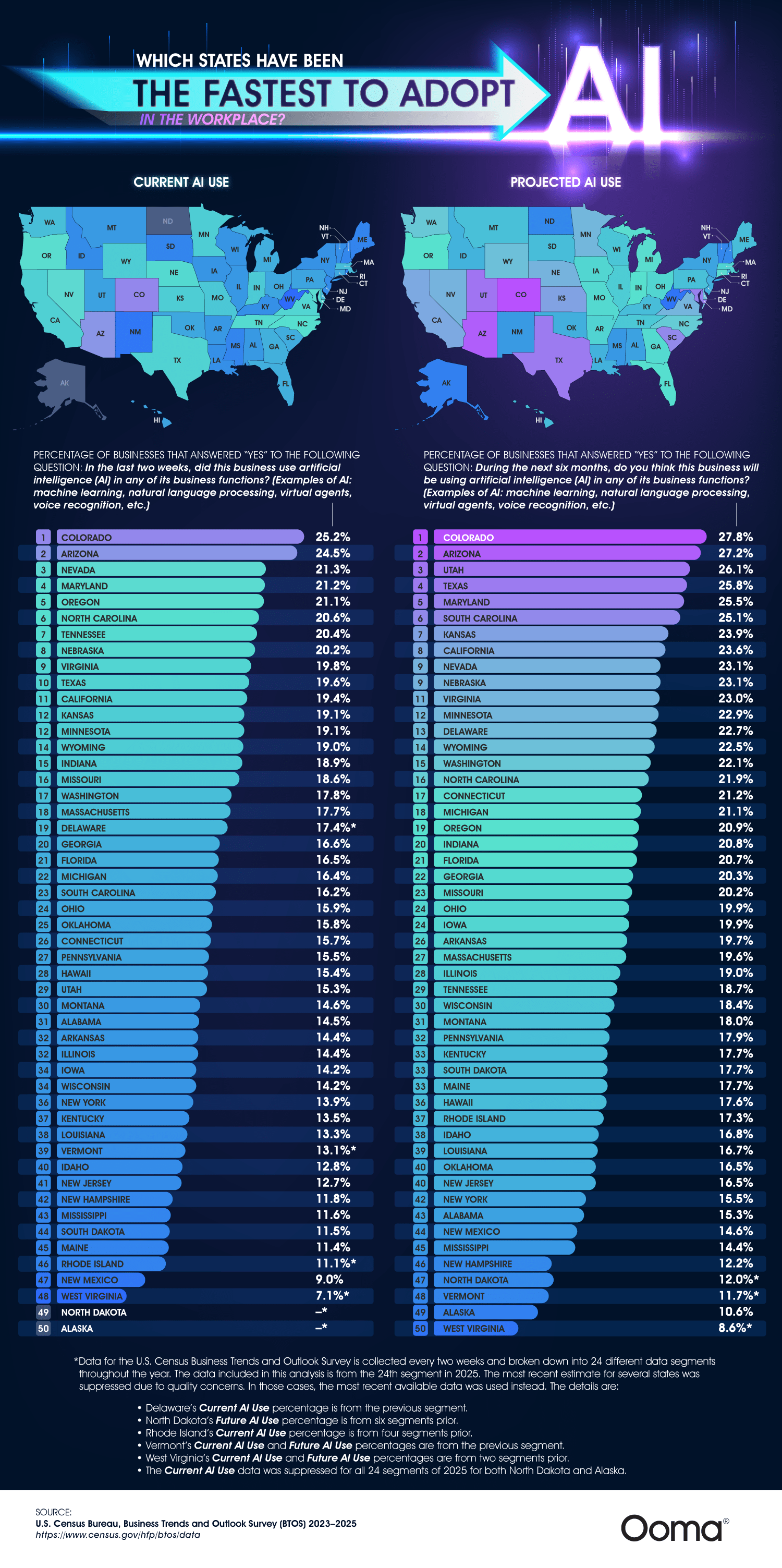
The team’s research ranks states on two key metrics: current AI adoption (whether businesses have recently used AI tools) and projected adoption (whether businesses expect to use AI in the near future). These combined elements allow us to see not only where AI is already in use, but where momentum is building. The infographic provides a visual way to compare states and identify these patterns.
One of the most striking findings is that Colorado, Arizona, and Nevada lead the way in the current AI usage. Over one-fifth of his businesses have recently adopted AI. Colorado stands out as a top state, with 25% of businesses already using AI in some capacity. These tools can include machine learning, virtual assistants, natural language processing, and other AI capabilities, supplementing everyday business tasks such as data analysis, communication, and customer service.
The map also reveals that the same states dominate in projections for future AI use. Colorado and Arizona take top rankings once again. This suggests that early adopters are more likely to keep investing in AI and remain in their leadership positions. States like Utah and Texas ranked highly in future projections, indicating these are emerging areas for AI growth.
We can see states on the opposite end of the spectrum, lagging behind the leaders. West Virginia, Alaska, and parts of the Northeast report much lower levels of current and anticipated use. Even though it’s an economically robust and influential state, New York ranks low for adoption, showing that size and economic power don’t always indicate rapid AI growth.
The team’s work suggests that differences might be influenced by factors like industry composition, workforce skills, and access to tech infrastructure. States with strong technology sectors and a growing startup economy are the most likely to adopt AI quickly, while states with more traditional economies and heavy reliance on physical labor might have slower transitions.
Remember that AI adoption is still in the early stages. Even in leading states, only one in four businesses reports using AI, so there’s still a lot of room for growth. This aligns with broader trends showing AI is expanding rapidly, but it hasn’t yet reached saturation.
The article paints a picture of a fragmented but rapidly spreading AI landscape in the U.S. While some states lead the charge, widespread adoption is still rolling out and could shake up these rankings a lot in the coming years.