Business Visualizations
A Guide to Cybersecurity for Small Business
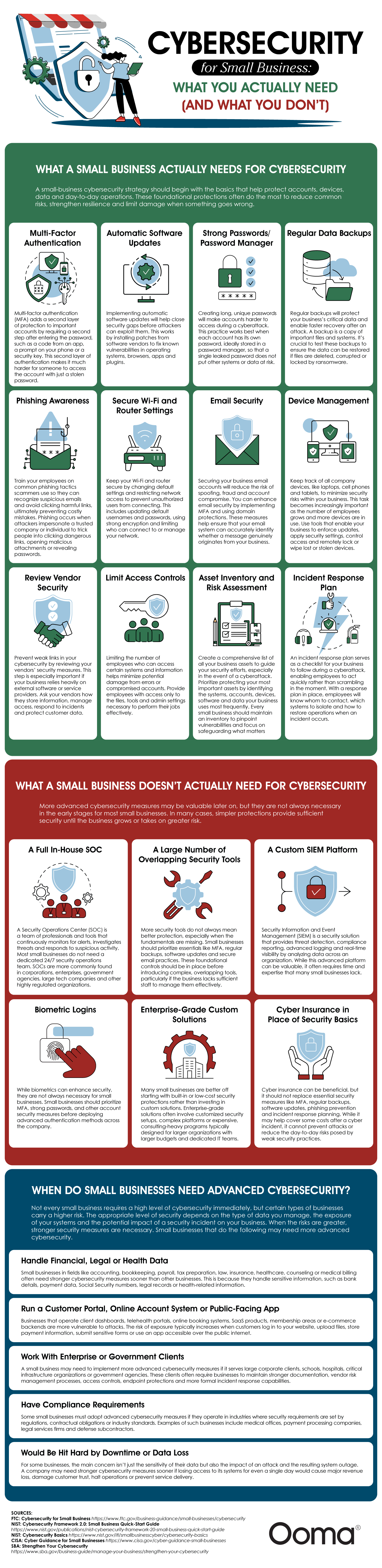
Small business owners wear many hats, but cybersecurity has slowly become one of the largest and flashiest hats. Ooma created a cybersecurity guide for small business owners, presented in a detailed chart that tackles a problem most owners face, but few know how to navigate. They struggle to figure out which protections really matter and which investments are simply expensive noise. The stakes are real. The team’s data show that 67% of businesses report more cyberattacks in 2024, and more than 40% of attacks target small businesses specifically. The team’s core message is one of hope: the basics of cybersecurity are far simpler than the security industry makes them seem.
Click below to zoom.
What Owners Really Need
The team’s suggestions are organized into a clear checklist. Multi-factor authentication tops the list as the single most effective tactic small businesses should use. It requires a second verification step after the typical password. From there, the list includes automatic software updates to patch security updates, strong passwords, and regular data backups that are tested so ransomware can’t hold operations hostage.
The human layer gets equal consideration. Training staff to spot phishing emails, limiting system access to only those who need it, and managing company devices with the ability to remotely lock them or wipe misplaced phones and laptops are all important guidelines. Rounding out the list are secure Wi-Fi and router settings, email protections, vendor security reviews, asset inventories, and a written incident response plan that guides employees on how to respond rather than scrambling during a cyberattack.
The Steps You Can Skip
The guide stands out from other security content in this section. It doesn’t shy away from naming the protections most small businesses are oversold. They name a full in-house Security Operations Center, custom SIEM platforms, and overlapping tools as the most unnecessary. Biometric logins and enterprise-grade custom solutions are labeled as answers to problems that don’t exist at the scale of a small business. Cyber insurance was a solid maybe that could be useful, but no substitute for backups and multi-factor authentication.
Situations That Call for Advanced Security
The article doesn’t label cybersecurity as one-size-fits-all. They list businesses in the financial, legal, and health data sectors as needing advanced cybersecurity, which could include customer portals, telehealth systems, and e-commerce backends. Not only are these data types subject to privacy laws, but when these systems go down, businesses can pay a heavy toll, so stronger defenses are worth the investment.
The team’s overall message is that cybersecurity isn’t all-or-nothing. Small businesses should build a solid foundation and scale up only when risk and growth push them to do so. Some of the guide’s authoritative sources include the FTC, NIST, CISA, and SBA. The guide makes cybersecurity feel manageable for small businesses by focusing on practical steps instead of expensive extras. Strong passwords, backups, training, and multi-factor authentication create a reliable foundation. As risks grow, businesses can add advanced protections, but the smartest first move is mastering the basics.