Misc Visuals
How to Avoid Scams in 2025
Americans will collectively lose over $2 billion to scams this year. As technology advances, scammers and fraudsters use more sophisticated tactics that are harder for victims to identify and avoid. The team at Ooma created a list of up-to-date tips and methods to prevent fraud and scams via email, text, phone, and Internet messages. With proper prevention and education, people can avoid falling into a scammer’s trap. One in three people who have reported fraud lost money as a result, so the team’s advice can help people avoid getting too far into a scammer’s trap if they don’t prevent them entirely.
Click below to zoom.
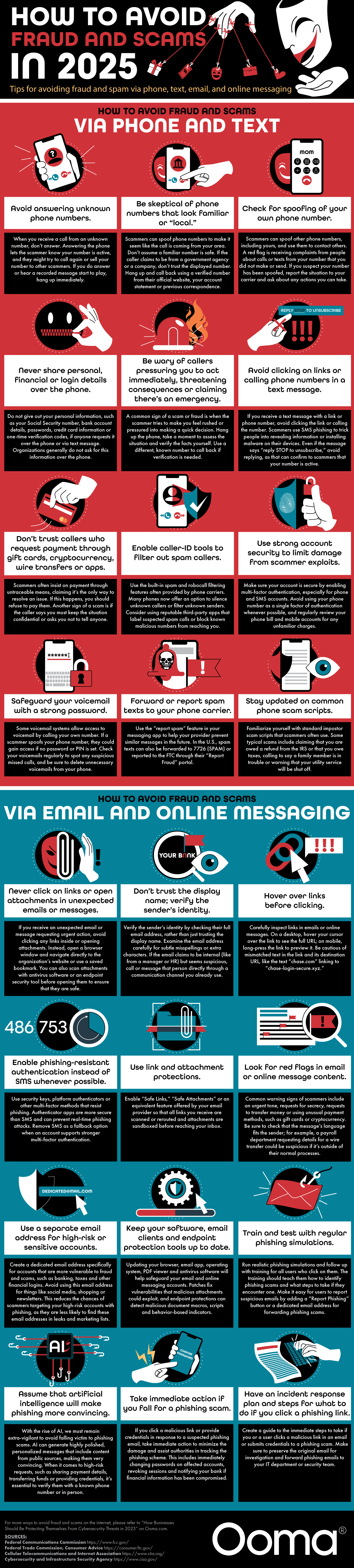
Phone calls and text messages can be very tricky. Many people have caught on to the practice of avoiding calls from unknown area codes. Lately, scammers have taken advantage of neighborhood spoofing. They use a familiar area code so the people they call are more likely to think it’s someone they know and answer.
Ooma offers these tips for avoiding and navigating scams via the phone:
- Despite number spoofing, you should still avoid answering unknown calls, as answering lets the scammer know your number is active.
- Never share sensitive information like your full Social Security number over the phone. A legitimate company will never request this.
- If the caller starts pressuring you to do something like send money or share information urgently, you can assume they’re a scammer and don’t feel guilty about hanging up the phone.
- Don’t click on links sent through text. It can lead to malware.
- Never act on requests to send money through unusual means like gift cards or cryptocurrency.
- Use spam filters and call-blockers to limit the messages you receive.
- Report spam numbers to your carrier.
Email scams can be just as malicious and difficult to detect, even after getting past malware protection and spam blockers. Here are some of the team’s tips for avoiding email scams:
- Go directly to a website’s domain rather than click on links in unsolicited emails.
- Check the sender’s full address and look out for signs that the address was spoofed.
- Hover your mouse over links to make sure they’re legitimate. Malware domains often include spammy nonsense in their names or names that don’t match the alleged sender.
- Use two-factor authentication on email and logins.
- Make sure your software’s malware protection is up to date.
- If you aren’t sure how to handle a phishing scheme once you’re ensnared, practice with emulators that can help you learn what to say and do.
- Be aware that scammers sound more legitimate these days thanks to the power of AI.
- Have a plan in place for what to do in the event of falling victim to a scam. You should change your passwords and contact your bank immediately.
Ooma’s steps can’t completely eliminate the possibility of fraud, but they are strong best practices to prevent encountering scammers and to deal with them if they contact you. If you follow these steps carefully, you’re very unlikely to lose money to a scam.