Charts
Key Takeaways from Preply’s Global Language Report
Language learning is experiencing a worldwide boom driven by curiosity, career ambitions, and digital access. The team at Preply conducts a Global Language Learning report every year or two, drawing on data from language learners in 180 countries and over 90 languages. Here we see them list key insights and analyses from that report.
Click below to zoom.
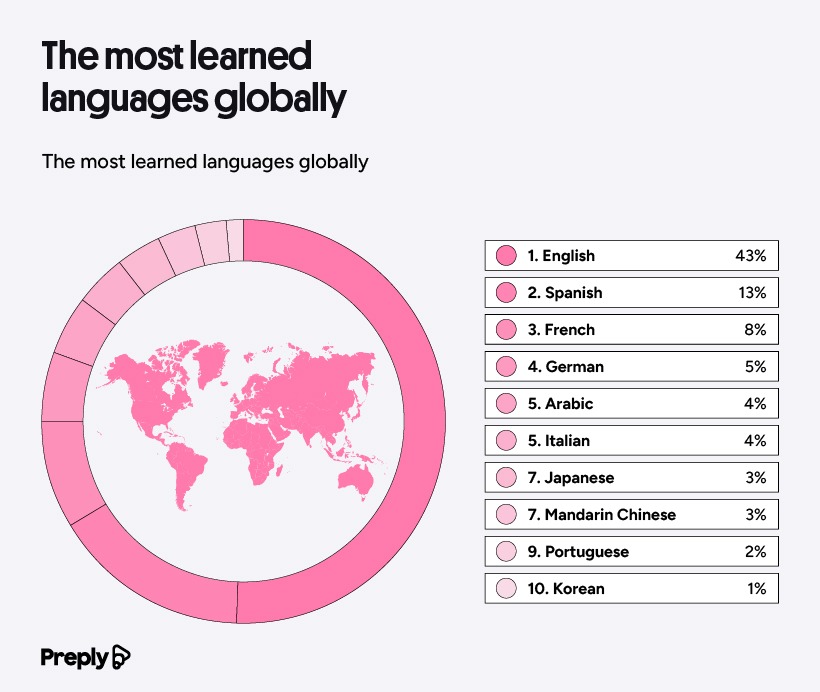
One of the most significant data points is that English remains the leading language worldwide, but the landscape is shifting. 43% of Preply’s language learners studied English. Spanish came in second at 13%, followed by French at 8% and German at 5%. There are regional differences too. In North America, Spanish was studied more than English by 1%, reflecting a demand for bilingual people in the workforce. English dominates as the most studied in Europe at 49%.
Click below to zoom.
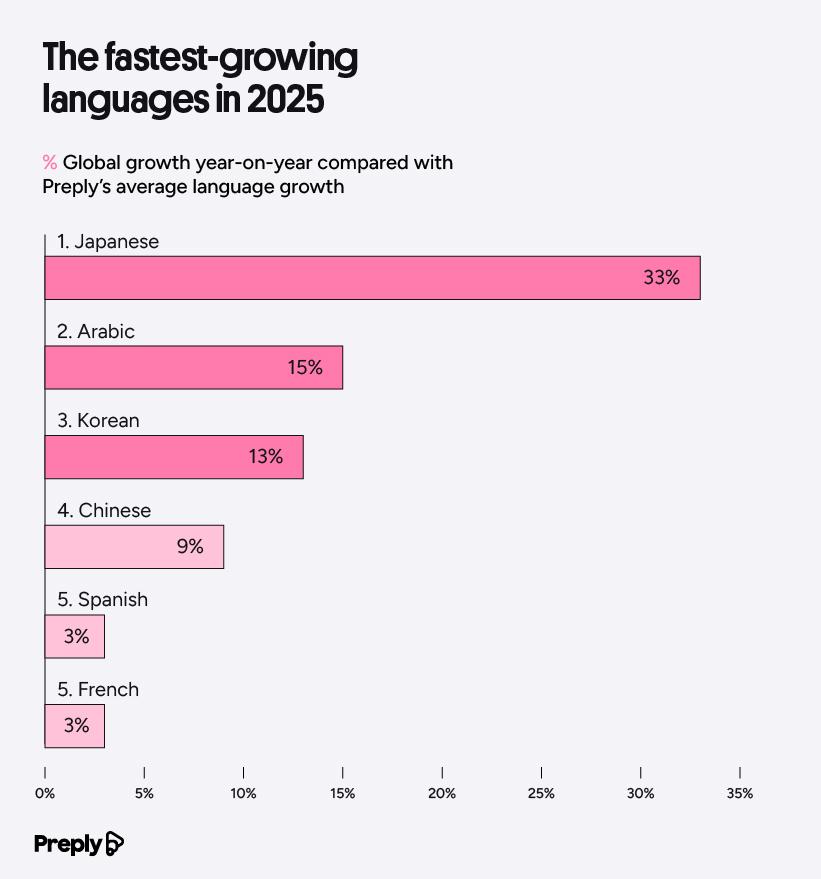
The team’s study also reflected the languages growing fastest. Japanese, Arabic, and Korean had the fastest growth on Preply. 33% of Preply learners chose to study Japanese, 15% studied Arabic, and 13% studied Korean. Cultural forces could drive this interest. K-pop, K-dramas, and anime have exploded in popularity, leading fans to have a natural interest in the Japanese and Korean languages. Arabic growth is likely tied to expanding global business ties with Arabic-speaking nations. Across languages, most learners are motivated to achieve fluency in another language for career advancement. 35% report learning a language to improve their job prospects. English learners are the most career-driven, with 52% studying for this reason. Hobbies and personal passions come in second at 31%, particularly for Italian, Japanese, and Arabic learners. People who studied Dutch, Portuguese, and German were likely to say they wanted to learn more about their heritage/family connections, or to prepare for relocation.
The economic stakes for language learning are high. The UK estimates that removing language barriers could bring in an estimated $19 billion per year. A Eurobarometer survey found that 33% of small and medium-sized enterprises exporting with the EU cite language and regulatory differences as their biggest obstacles. Health benefits emerge, too, with bilingual brains proving more resilient against dementia and Alzheimer’s disease.
The study also included some insight into AI’s impact on language learning. About 80% of students and recent graduates report using AI in their studies and it seems language learning is no exception. Despite this, 71% of Preply students said they would feel more confident speaking to a human tutor than relying on an AI app alone. This suggests that most students feel AI can complement their studies but doesn’t replace a human tutor.
One of the biggest themes in the report’s data is that language learning is not just a personal achievement but also an economic asset, a cognitive investment, and a cultural bridge. People are drawn to language learning for so many strong reasons. If you’re thinking about learning a language, there have never been more reasons to get started, whether you’re motivated by passion, your career, or traveling around the world.