Charts
Map Shows the Most Bilingual Cities in America
The United States is home to a diverse array of cultures, ethnicities, and languages. It attracts visitors and immigrants from all around the world, so it’s easy to find people who can speak another language in addition to English. Census Bureau statistics show that 21% of Americans are bilingual. The team at Preply took a deep dive into this data by determining which cities have the most and least bilingual residents.
Click below to zoom.
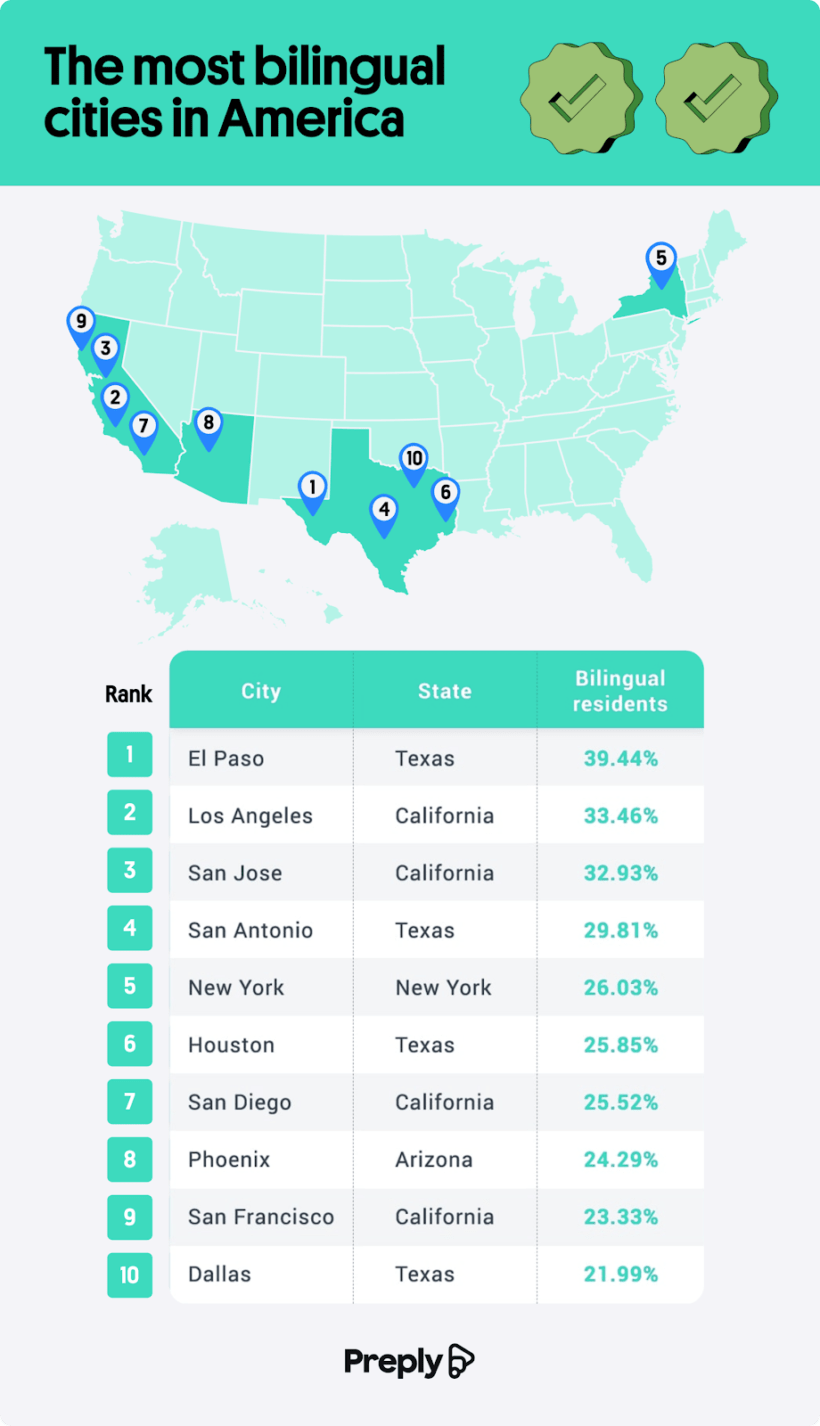 The team defined bilingual as people who report speaking both English and one additional language “very well,” which would mean functioning at a fluency level in two languages. They created two maps to show the results. According to the team’s data, these cities have the most bilingual people in America:
- El Paso, Texas
- Los Angeles, California
- San Jose, California
- San Antonio, Texas
- New York, New York
- Houston, Texas
- San Diego, California
- Phoenix, Arizona
- San Francisco, California
- Dallas, Texas
In El Paso, the majority of the population speaks Spanish, which has been the case since 1965. Seven out of ten residents speak a language other than English. El Paso is located very close to the Mexican border, resulting in a high presence of immigrants, visitors, and family ties with Mexico. The same is true in Los Angeles, where nearly half the population is of an ethnic group that speaks Spanish. Overall, the most common second language spoken in the U.S. is Spanish, although you’ll find a wide variety of languages across the country.
As for the least bilingual cities, the team found that these 10 cities take the top spots:
- Detroit, Michigan
- Indianapolis, Indiana
- Nashville, Tennessee
- Jacksonville, Florida
- Columbus, Ohio
- Washington, D.C.
- Charlotte, North Carolina
- Oklahoma City, Oklahoma
- Philadelphia, Pennsylvania
- Seattle, Washington
Detroit may have the fewest bilingual speakers due to its shrinking population. It’s difficult to have diversity of cultures and languages in a small population. As industries shift location, sometimes you see certain populations follow. Detroit is known for auto manufacturing, but that industry has shrunk considerably since the city’s heyday. These statistics suggest that economics can have an impact on bilingual populations.
After Spanish, common second languages include Asian languages like Mandarin or Korean. There are so many benefits to becoming bilingual. Beyond being useful in travel, it can help people in work and social situations. Approximately 43% of the world’s population is bilingual, with people from all over the world learning English online. If the team created a worldwide map of bilingual locations, they’d find that speaking two languages in daily life is common in Switzerland, where 42% of the population speaks two languages on a daily basis. In France, however, only 20% of the population speaks a language other than French. Typically, bilingual people can speak English and live in and around Paris.
Overall, the most widely spoken languages in the world are Chinese, English, and Spanish, making it beneficial for anyone to learn these languages. Bilingual people are known to be good listeners, and evidence suggests they’re more creative! It’s a valuable skill to employers, and it can improve your memory and attention span.