Business Visualizations
New Study Examines Language Used to Let Employees Go
Letting an employee go is an unpleasant experience for everyone involved, but language has the power to guide the emotions surrounding an interaction. While the right words won’t erase the bad side of being let go, they can help the employee in question understand why the situation is happening and make them feel seen and heard. Preply leaned into the language aspects in these situations with a study examining the most common phrases and words used when letting an employee go and how employers and employees felt about the situation.
Click below to zoom.
Overall, the team found that these were the most common phrases used:
- Letting you go
- Effective immediately
- Terminating your employment
- This isn’t working out
- No longer require services
- Parting ways
- Ending your employment
- No longer needed
- Relieved of duties
- Ending our working relationship
Managers and employees seem to agree that lack of empathy and responsibility were the most common complaints about the process. One in six managers say they regret the words they chose when firing someone, and 92% feel they need more training on how to handle such situations. Employees wanted their managers to focus on clarity, compassion, empathy, and honesty when firing an employee.
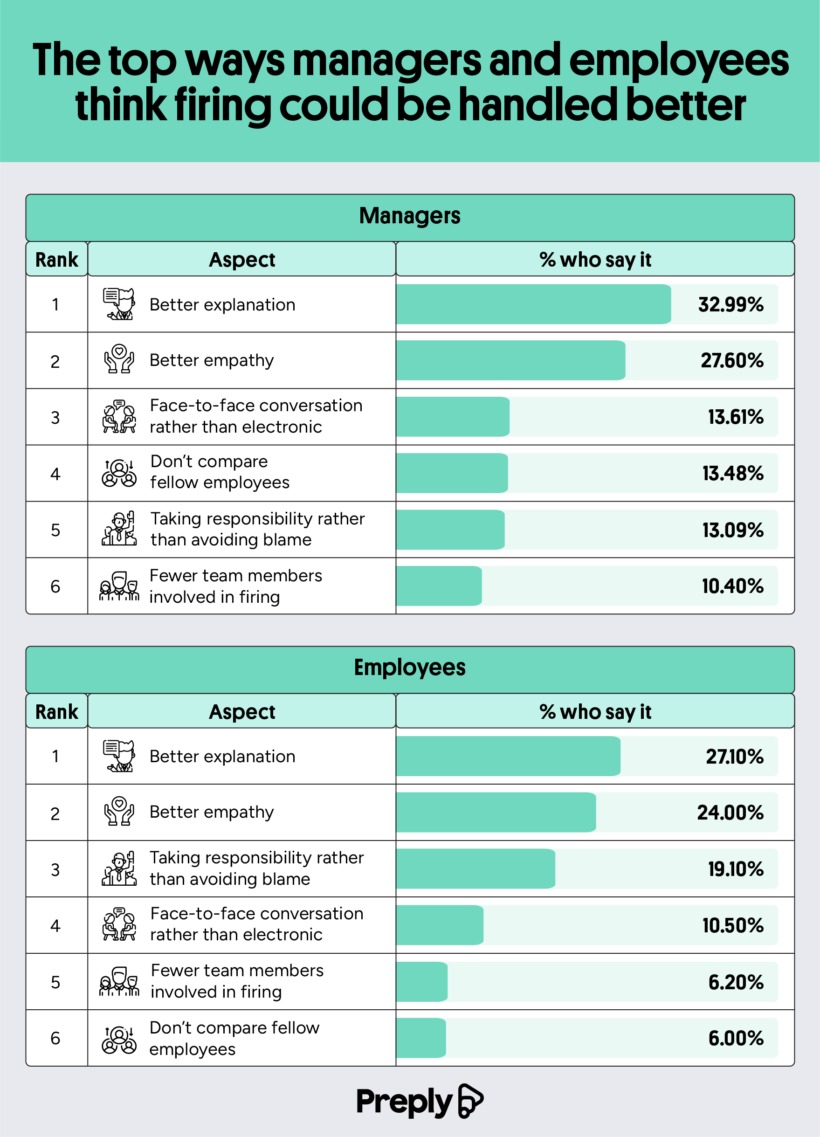
The team studied changes that both managers and employees would like to see in the firing process.
These are the six things employees want to see improved:
- Better explanation
- Better empathy
- Taking responsibility rather than avoiding blame
- Face-to-face conversation rather than electronic
- Fewer team members involved in the firing
- Don’t compare fellow employees
Here’s how that compares to changes managers would like to make to the process:
- Better explanation
- Better empathy
- Face-to-face conversation rather than electronic
- Don’t compare fellow employees
- Taking responsibility rather than avoiding blame
- Fewer team members involved in firing
These are similar answers, but we can see that the two groups ranked their importance differently. Overall, 92% of Americans think managers could benefit from some language training when it comes to firing someone. Empathy and honesty were high on the list of employee wishes, indicating that understanding can help give them closure on the job, and empathy softens the blow. Not many managers would prefer a face-to-face meeting. Only 1 in 6 prefer this to virtual meetings, which seem to be the most common option.
Only 55% of managers have received training on how to fire someone, and with many of them regretting their language choices, it seems that many managers would benefit from some education in business language and communication. Notice that many of the top phrases are more professional ways to say “fired,” like “letting you go,” “terminating,” and “no longer require.”
When managing a team, empathy and clear language are crucial. These skills can help managers excel at many tasks beyond having to let an employee go. But when a situation like firing someone is emotionally charged, the language used becomes more important than ever. Hopefully, the team’s study can help managers reflect on how they go about the process.