Charts
The U.S. Cities Where Renting Means Bracing for a Move
Moving consistently ranks among life’s most stressful experiences, behind only divorce and the death of a loved one. This difficulty isn’t even distributed by location. Some cities make a renter’s move dramatically more difficult than others. Rove Lab’s analysis of 55 major U.S. metro areas, scored across 13 factors including population density, rental housing, transportation, and weather, shows which cities make moving a logistical nightmare.
Click below to zoom.
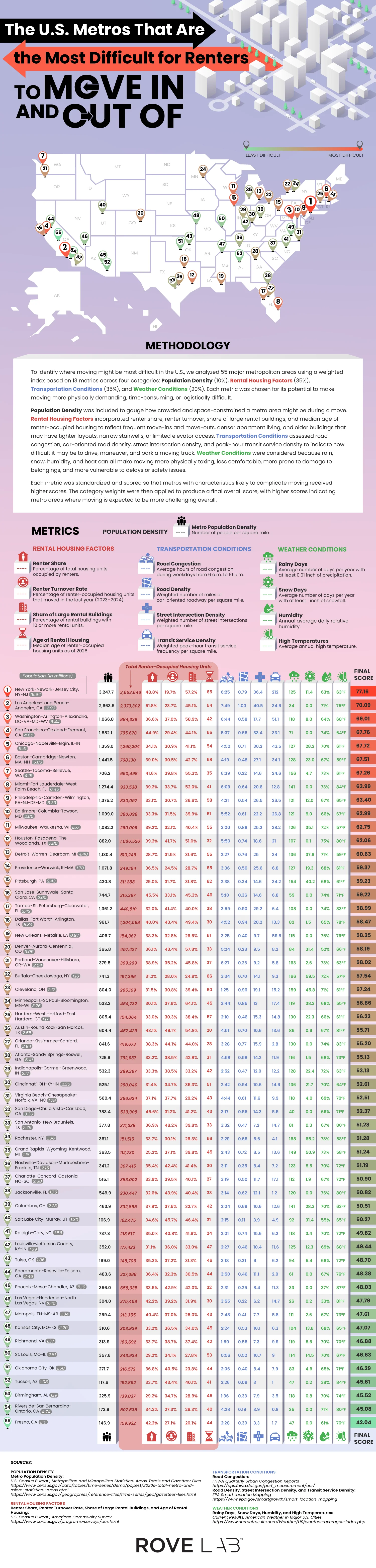
The New York-Newark-Jersey City metro area is the most difficult one to move from, with a score of 77.16. There are several reasons it’s so difficult. For one, it has the highest population density in the country, at 3,247.7 people per square mile. It also has the lowest renter turnover at 19.7%, indicating fierce competition for available units. 57.2% of rental properties are large buildings with more than 10 units, and the median building age is 65. This means these older buildings have narrow stairwells, slow elevators, and tight corners, a nightmare on moving day. On top of this, the transit density at peak hours is 212 vehicles per square mile. Trying to move out of an older building with narrow hallways, busy stairs and elevators, and limited street parking is truly challenging.
Move-in difficulty varies widely by city. Los Angeles isn’t the densest city, but it has the worst traffic congestion in the country, with 7 hours and 49 minutes of traffic per weekday, due to urban sprawl and car dependence in the region. Washington, D.C. has the oldest housing units, making it more challenging to navigate furniture on move-in day, especially in dense transit corridors. San Francisco and Chicago are mid-density metros with older buildings and a high number of large buildings with many units, driving up the scores. Boston and Seattle round out the top of the most difficult cities, thanks to lots of snow in Boston and tons of rainy days in Seattle, which make moving in more difficult.
Thankfully, the team’s data also shows that not every city is a move-in nightmare. Austin is a standout city with the highest renter turnover in the country. A pandemic-era construction boom created an oversupply of new, modern housing units, which led landlords to offer move-in incentives and upgrades. Fresno, Riverside-San Bernardino, and Birmingham all offer easier moves thanks to a low population density, newer rental stock, and less traffic. The weather’s role shouldn’t be overlooked. Rochester, Buffalo, and Pittsburgh all have lots of snowy and rainy days, which can really put a literal and figurative damper on moving day.
The Rove Lab team’s work reframes the question of which cities are best and worst to live in through a specific, practical lens. Your housing is one of the most important parts of your life in a new city, and finding the best rental and having a good move-in experience will set the tone for a new start. Wherever you’re headed, knowing what you’re walking into can help you have the best experience.