Business Visualizations
30 Statistics That Show the Alarming Reality of Data Breaches
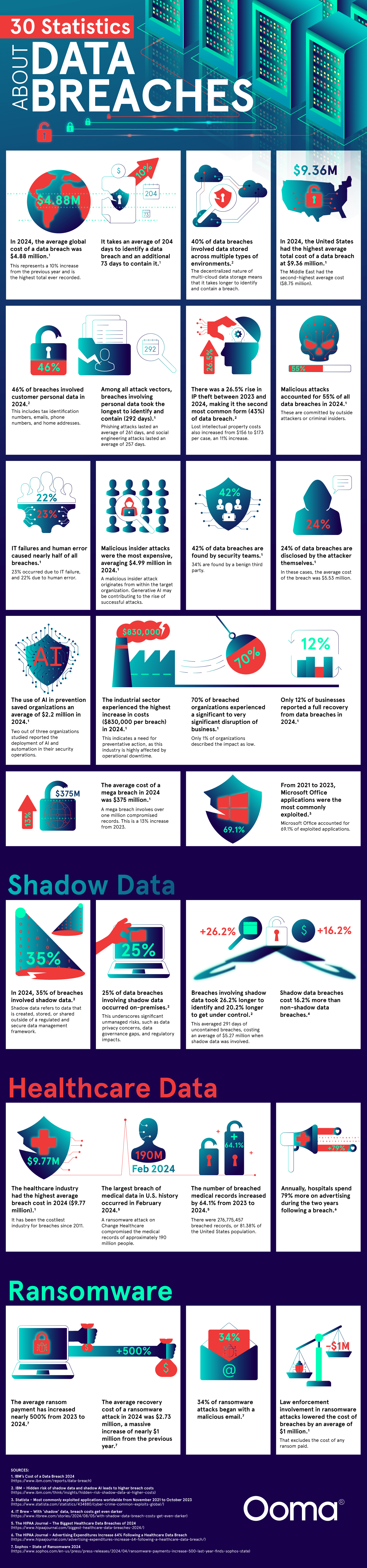
Ooma’s new infographic shows that data breaches are a huge concern and much more common than we would like to think. Their new graphic offers 30 statistic-based facts that show us the harsh reality. Companies have limited time to react to data breaches before they hit the news cycle, and software developers have to stay on their toes to prevent security threats. Data breaches hand over customer contact details, proprietary software, and employee information to bad actors, so taking these threats seriously is of the utmost importance.
Click below to zoom.
Record High Levels of Financial Damage
The financial stakes of data breaches have never been higher. The data shows that in 2024, the average global cost of a data breach reached an all-time high of $4.88 million, a 10% increase. On average, American organizations bear the highest costs, at $9.36 million per breach. The U.S. healthcare industry is hit the hardest, with average data breach costs around $9.77 million.
Mega breaches incur the highest costs and the most damage. A mega breach involves over a million records and costs an enormous $375 million to rectify. The largest data breach was the Change Healthcare attack in February 2024, which exposed 190 million medical records and caused over $2 billion in damages. This was the largest medical data breach in American history.
Human Error Leads to Cyberattacks
55% of all data breaches are malicious attacks, with the remaining attacks split between human error and system failures. This shows that nearly half of breaches are due to internal vulnerabilities instead of being caused by the power of a sophisticated external attack. Out of all applications, Microsoft Office suffers 69.1% of cyberattacks, which means that everyday office tools can become a major target, taking advantage of employee vulnerability.
When someone inside an organization leads the attack, the expenses are highest, averaging $4.99 million. Ransomware is still a big danger, with the costs of attacks increasing by 500% between 2023 and 2024 and the average recovery cost around $2.73 million.
Delays in Detection and Containment
The amount of time it takes for organizations to detect a data breach is a bit shocking. It takes an average of 204 days to discover the breach and then another 73 days to contain it. That’s a nearly 10-month data exposure window. Most distressing is the fact that personal data breaches take the longest to detect and contain – an average of 292 days.
Recovery and Data Breach Prevention
The aftermath of a data breach remains a big challenge. Only 12% of businesses report making a full financial recovery after the breach. 70% of breached organizations have significant disruptions to business, and only 1% describe the breach as low-impact. Healthcare businesses have the longest-lasting effects with major damage to their reputation. They need to spend 79% more on marketing for the two years following a data breach. Strategic investments in cybersecurity offer stronger protection, and using AI in security operations can save around $2.2 million. Overall, this graphic emphasizes the importance of investing in strong cybersecurity.