Charts
Report Examines Languages on the Way to Extinction
When a language disappears, a worldview, history, and culture fade with it. There are thousands of languages at risk of going extinct, as a report from Preply shows. Their Endangered Languages Report gathers data showing where the crises are most acute, while offering hope that extinction isn’t inevitable. They’ve shown areas where revival is working, too. The study highlighted problem areas in vanishing languages, the reasons they are in danger, and hopeful signs that languages can be revived.
Click below to zoom.
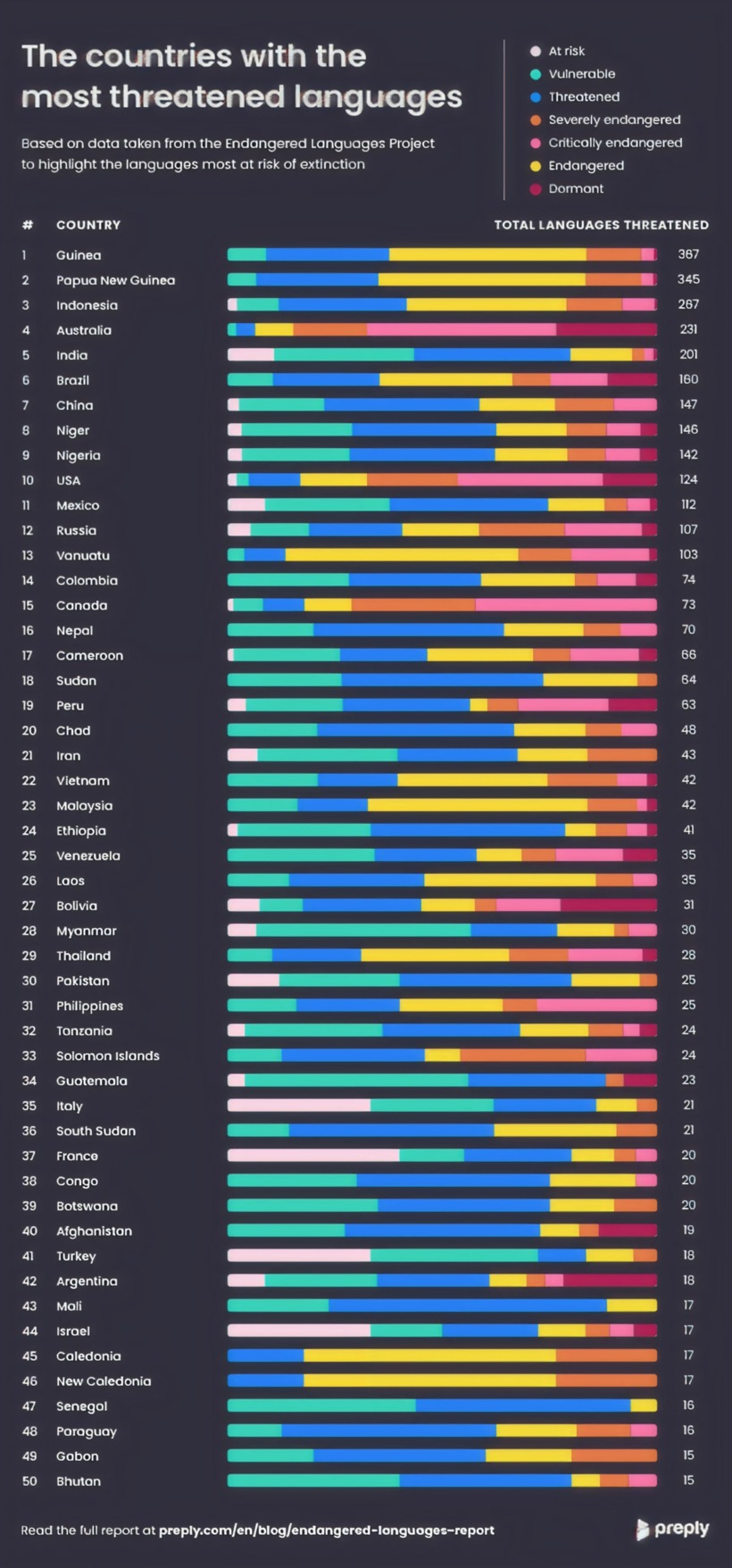
Australia leads the world in the number of critically endangered languages indigenous to its borders (133). In general, the Pacific region and islands have the most endangered languages overall, at 250. Africa has the highest number of threatened languages at 217. In many of these locations, globalization puts pressure on Indigenous and isolated communities. A globalized world pushes young working-age people toward learning a globally dominant language like English or Mandarin, so they have expanded opportunities. It’s worth paying attention to the scale the study creates with at-risk, vulnerable, threatened, endangered, severely endangered, and critically endangered languages. This shows that risk is a spectrum in the world of language, just as it is in plant and animal species.
In the data, a language stands out as a relative success story. Welsh is a vulnerable language, with 19%–20% of the population speaking it. After over 50 years of effort and education, it rose to 30% of children between 3 and 15 years old who spoke it. The nation of Wales set a goal of a million fluent speakers by 2050. If they can meet that goal, it will prove that policy and education can revive a language.
The Lakota language is a cautionary tale of historical oppression. There are only 2,000 speakers today and it’s an endangered language. The United States assimilation policies pushed Indigenous people into residential schools, where children were forced to drop their language and speak English. Today, only 1% of the Lakota population of 170,000 can speak their native language fluently.
Cornish is a rare and unique language brought back from extinction. It officially went extinct in the 1800s, and thanks to a standardized written form revived and adopted in 2008, there are now 557 speakers of a once-dead language.
“Awakening” languages are revivals of once-extinct languages, like Cornish. Kaurna, an Australian language, was nearly lost when the last speaker passed away in 1929. But a program worked to revive it among 50 speakers using dictionaries, songs, and formal education programs. These aren’t the only awakening languages. Wampanoag, Palawa Kani, and Natchez have also awakened back into existence. Revitalization is slow, meticulous work, but these languages show that it’s possible.
Non-native speakers can do their part to support efforts by studying an at-risk language or helping out a revival group. Native speakers carry the heaviest burden and will most effectively save a language by teaching it to their children early. Schools and governments also have a part to play by offering classes in endangered languages. Language survival is possible when ordinary people decide the language is worth speaking.