
Finance Visualizations
How Big of a House Can You Get for $1M Around the United States?

A million dollars is a million dollars, right? Well, it turns out that a million dollars can go a lot further in some U.S. cities than it can in others. This new 3D bar graph map visualization from RoofClaim.com reveals just how far (or not so far) your dollar can go when it comes to buying a house. The results are fascinating:
Click below to zoom
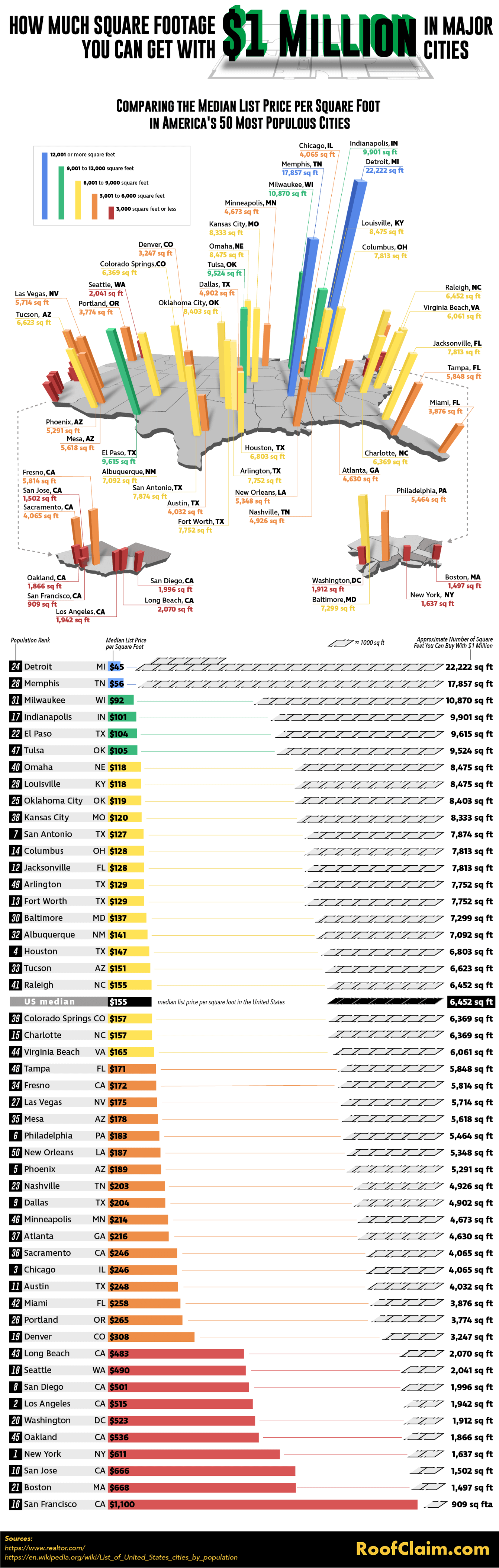
In Detroit, Michigan, you can buy a 22,000-plus square foot mega-mansion for $1 million. That’s nearly half the size of a football field. And in Memphis, Tennessee, you can get a similarly-sized 17,847 sq ft home for the same amount of money. Although, the local market in Memphis seems to be turning around this year.
On the other end of the spectrum, the real estate market in San Francisco is a whole different story. With one million dollars you’d only be able to get about 909 square feet. In Detroit, a home of that size would only run you about $40,905. But, just because housing prices are low, doesn’t mean it’s a good buy. Be sure to do your own research.
So why is it that real estate markets in the same country can be priced so wildly different? Well, that’s a complicated answer. A lot of factors come into play when it comes to real estate value in a specific city. Some include housing availability, crime rate, the job market, waterfront or other favorable views, and more. In San Francisco, it’s emerging that housing prices are so high that even highly paid tech workers can’t afford to live there.
How does your local city or town stack up? Let us know in the comments!
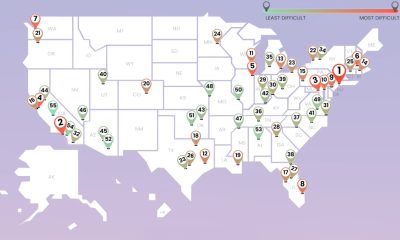
Americans collectively owe $1.863 trillion in student loans spread across roughly 43 million borrowers. A new analysis from Student Choice examines whether a $400 monthly payment is as affordable in every state. The gap between the most and least affordable states paints a picture of the complexities of debt, living expenses, and wages.
Student Choice scored 50 states on five metrics weighted by how directly living there affects student loan affordability. The heaviest metric is the student-loan-to-income ratio (40%), followed by delinquency rate (20%), rent-to-income ratio (15%), household debt-to-income ratio (15%), and cost of living (10%). Each state gets a final score, and a higher score means loans are harder to afford. Monthly payments are estimated from Department of Education data, assuming a 5.99% interest rate and a standard 10-year repayment plan.
Click below to zoom.
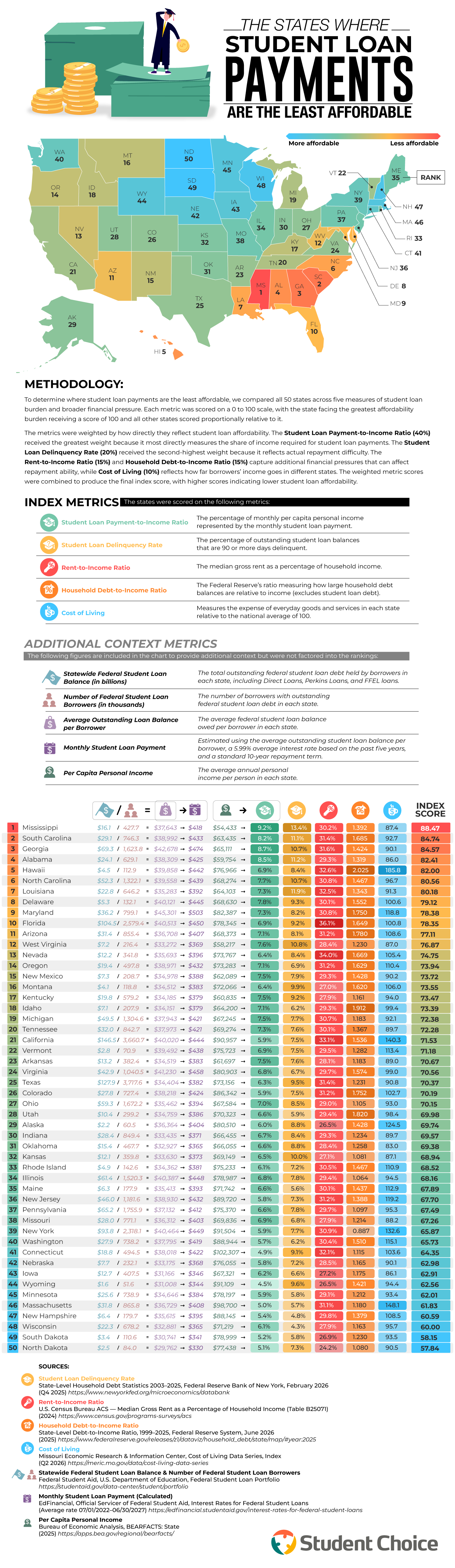
Mississippi is the least affordable state, largely because of low incomes. The per capita personal income in this state is $54,433, the lowest in the country. That means an average loan payment of $418 a month takes up 9.2% of income. Mississippi also has the nation’s highest delinquency rate, with 13.4% of student loan balances at 90 days or more past due.
The article makes a stark comparison with Connecticut borrowers who pay about the same amount each month at $422 but earn twice as much, so that payments take up just 4.9% of their income.
South Carolina, Georgia, and Alabama follow Mississippi, with much of the South clustered at the top of the ranking. Hawaii is the biggest outlier in the top 10. Its cost-of-living index of 185.8 is nearly double the national average, pushing the state to fifth place.
North Dakota is the most affordable state, with the lowest average loan balance at $29,762, the lowest average monthly payment at $330, and the lowest rent-to-income ratio in the nation at 24.2%. South Dakota trails by .31 points and has a lower delinquency rate than its neighbor. The rest of the top 10 most affordable states are Wisconsin, New Hampshire, Minnesota, and, believe it or not, Massachusetts and Connecticut. High incomes in those last two states offset their high costs.
The national average estimated student loan payment is $419 a month. Maryland borrowers pay the most on average at $503, followed by Georgia, Virginia, Florida, and New York. The article offers practical guidance, advising borrowers to keep loans under 10% of their income and to use the 50/30/20 budgeting rule. It also suggests borrowers refinance their loans if payments become unmanageable.
The article includes a detailed table with all the findings and data from all 50 states. You’ll find each state’s rank, federal loan balance, number of borrowers, average balance, estimated monthly payment, and per capita income. Borrowers comparing where to live or wondering whether their location is affecting the affordability of their loan payments can see exactly where their state lands, along with the details in this helpful study.

In some U.S. cities, a night out costs over twice as much as a night in, and in some locations, up to three times as much! A study from Rove Lab gathered data and compared doing the same date-night activity at home versus out across the 50 most populous U.S. cities.
Rove Lab compared the cost of two fixed dates. A night out included dinner for two at a restaurant, four beers at a pub, two five-mile taxi rides, and two movie tickets. A night in included ingredients for a home-cooked steak dinner, four store-bought beers, and a $5.99 stream rental. They used local prices from LivingCost.org and calculated a “premium for going out” in each city, which represents how much more a night out costs than a night in.
Click below to zoom.
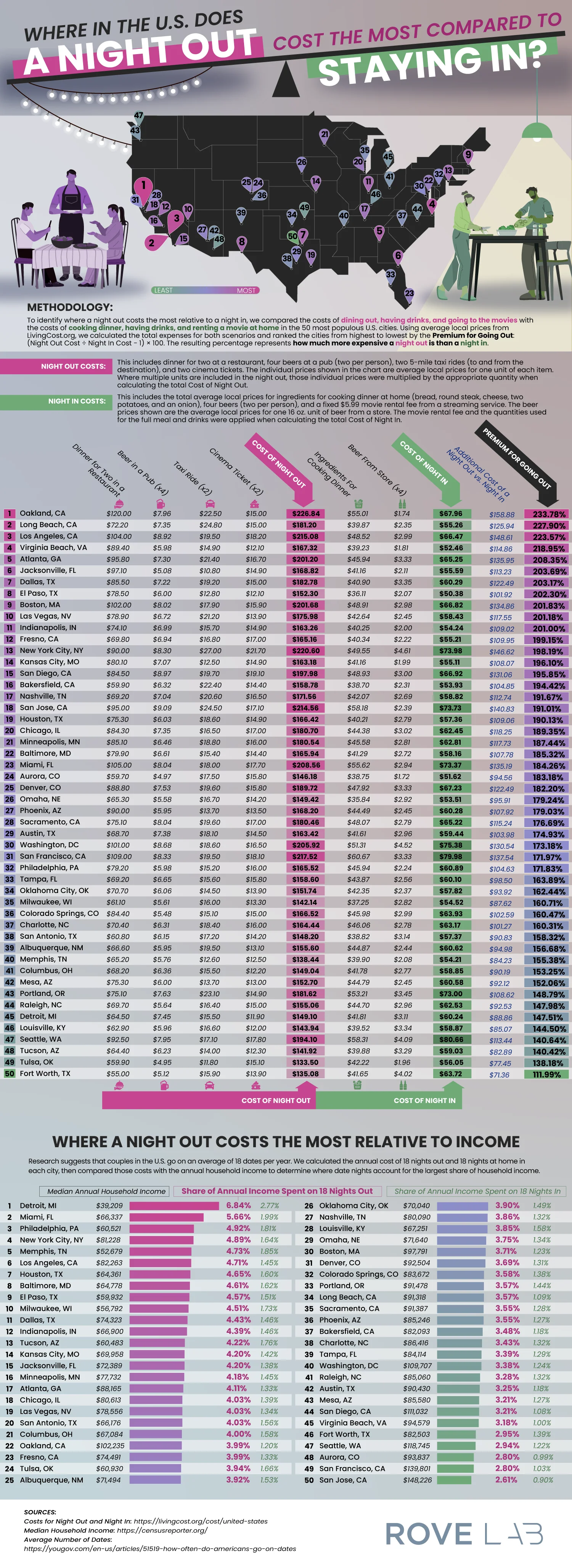
Oakland, California tops the list as the most expensive location for a date night. Dinner, drinks, a movie, and a taxi will cost $226.84 there compared to the $67.96 you’d spend on a night in. That’s a 234% premium for going out. Long Beach and Los Angeles were followed behind with premiums over 220%. Virginia Beach and Atlanta round out the top 5, and Jacksonville, Dallas, El Paso, Boston, and Las Vegas complete the top 10.
Some of the results are a little surprising. You might expect New York City to breach the top ten, and it does have the second-most expensive night out at $220.60, but it ranks only 13th because staying in is expensive there as well, so it has a lower premium. San Francisco and San Jose dropped in ranking for the same reason. At the other end of the list, Fort Worth offers the most affordable night out at a 112% premium.
Another ranking in the study might be even more revealing. Research shows U.S. couples have about 18 dates per year, so Rove Lab calculated what share of each city’s median household income goes to these dates. Detroit residents take the hardest hit. 18 nights out cost about $2,684, or 6.84% of a median income, compared with 2.77% for 18 nights in. Miami, Philadelphia, and New York City also rank highly on this metric.
San Jose is at the opposite end of the spectrum. It has one of the most expensive nights out, but high median incomes mean 18 dates take up only 2.61% of a typical household’s earnings. Local prices and incomes vary dramatically, so a city that looks expensive by one metric can look affordable based on another.
The team’s article included two full tables of data. The first lists all 50 cities with item-by-item prices, totals, the dollar difference, and the premium percentage. The second table shows each city’s median income compared to nights out vs. nights in. A summary of findings includes tips for making the most of an affordable night at home. This data might make couples think twice about how they spend their date nights and whether or not they want to adjust their budgets.

Moving into a first apartment is a rite of passage, but the math behind making it a reality is becoming a bigger obstacle. The metros with the strongest job markets also have the steepest living costs, and over the past few years, rent in these areas has climbed faster than paychecks. Cheap rent isn’t the only solution, though. Thin wages and flat hiring shut young people out of many cities.
Rove Lab’s new analysis identifies the cities in the middle ground with the most to offer young people establishing their lives. The study examined the 100 most populous U.S. metro areas and scored each one on 10 different metrics grouped into three weighted categories.
Click below to zoom.
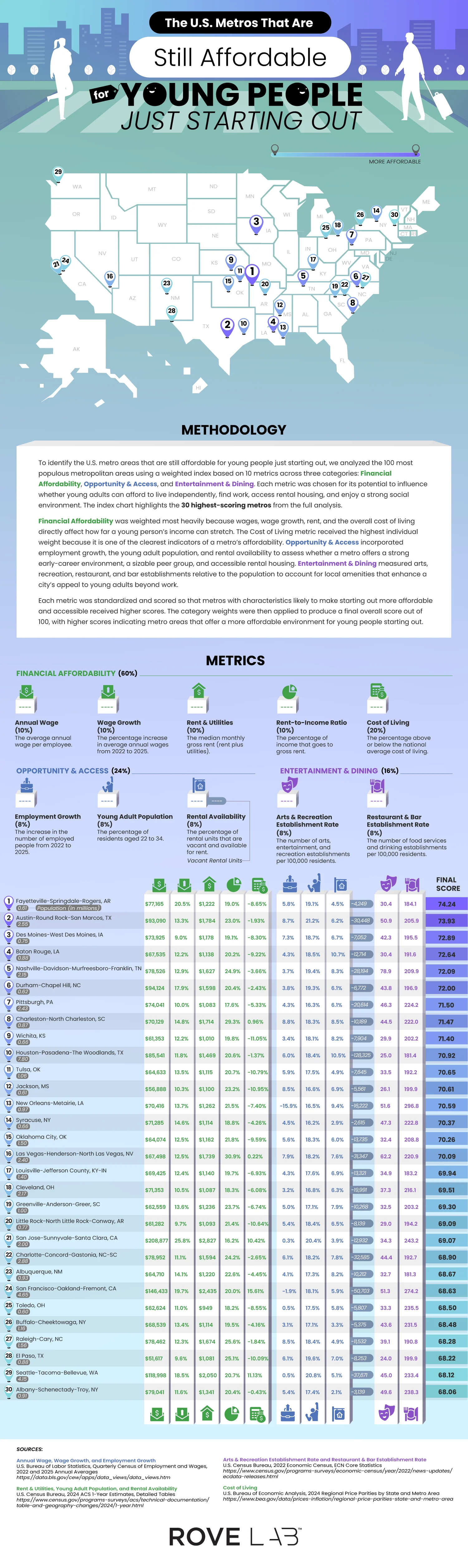
Financial affordability was the most important category, carrying 60% of the weight. This category covers average annual wage, wage growth, median rent and utility costs, rent-to-income ratio, and cost of living relative to the national average. Cost of living alone received 20% of the weight, the heaviest single metric in the study. Opportunity and access accounted for 24% and included employment growth, number of residents between 22 and 34, and amount of rental vacancy. The final 16% went to entertainment and dining, tracking the number of arts and recreation venues and restaurants and bars per 100,000 residents. Each metric was standardized, scored, and weighted into a final number out of 100.
The winning city was Fayetteville-Springdale-Rogers, Arkansas, with a score of 74.24. This isn’t an obvious winner until you look at the numbers. Wages increased by 20.5% from 2022 to 2025, with the average wage at $77,165 and a cost of living that’s 8.65% below the national average. This combination creates a rent-to-income ratio of 19%, leaving young people with money to save, potentially for the elusive dream of homeownership. Fortune 500 companies, Walmart, J.B. Hunt, and Tyson, have a home in the area and likely explain wage strength.
Austin-Round Rock-San Marcos followed with a 73.93 score, driven by a thriving tech sector that’s seen 8.7% employment growth, and the area offers 30,000 vacant rental units for newcomers. Des Moines, Baton Rouge, and Nashville round out the top five.
A few cities earned high rankings thanks to low housing costs. Pittsburgh was seventh overall with a rent-to-income ratio of 17.6%. Wichita, ranked ninth, has low rent and utilities and a low cost of living that’s 11.05% below average. Toledo, number 25 on the list, has the cheapest housing of all cities on the list, with an average of $949 a month.
The most surprising cities on the list are Californian. San Jose-Sunnyvale-Santa Clara ranks 21st, and San Francisco-Oakland-Fremont lands 24th, despite costs of living well above the national average. Salaries do the heavy lifting, averaging $208,877 and $146,433, respectively. This pulls down San Jose’s rent-to-income ratio to 16.2%, the lowest on the list.
-

 Charts6 months ago
Survey Finds the Most Misheard Song Lyrics
-
 Charts6 months ago
Study Shows Where Americans Are Most Open to Age-Gap Dating
-
 Maps6 months ago
New Study Presents a State-by-State Look at Learning Styles
-
 Business Visualizations4 months ago
How the Top 25 College Majors Have Shifted: Student Choice’s 2026 Update
-

 Maps5 months ago
Map Shows 26 Ways to Say “Haha”
-

 Business Visualizations6 months ago
Study Examines Where People Think AI Will Improve Their Work Lives
-
 Maps6 months ago
Study Examines the Power of Phone Calls on Lonely Seniors
-
 Charts7 months ago
The U.S. Cities Where Renting Means Bracing for a Move