
Misc Visuals
Visualizing the Most Famous Phones in Pop Culture

Sometimes, props that could have quietly become part of a film’s scenery stand out as an iconic aspect that adds depth to a setting or character. Nothing illustrates this better than a chart created by Ooma displaying the 45 most famous phones in pop culture. On the chart we can see where and when these phones first appeared on screens, an illustrated rendering of them, and a bit of trivia telling us why this phone made an impact. As a whole, the chart makes us re-think how something as commonplace as a phone can help make a piece of media memorable.
Click below to zoom
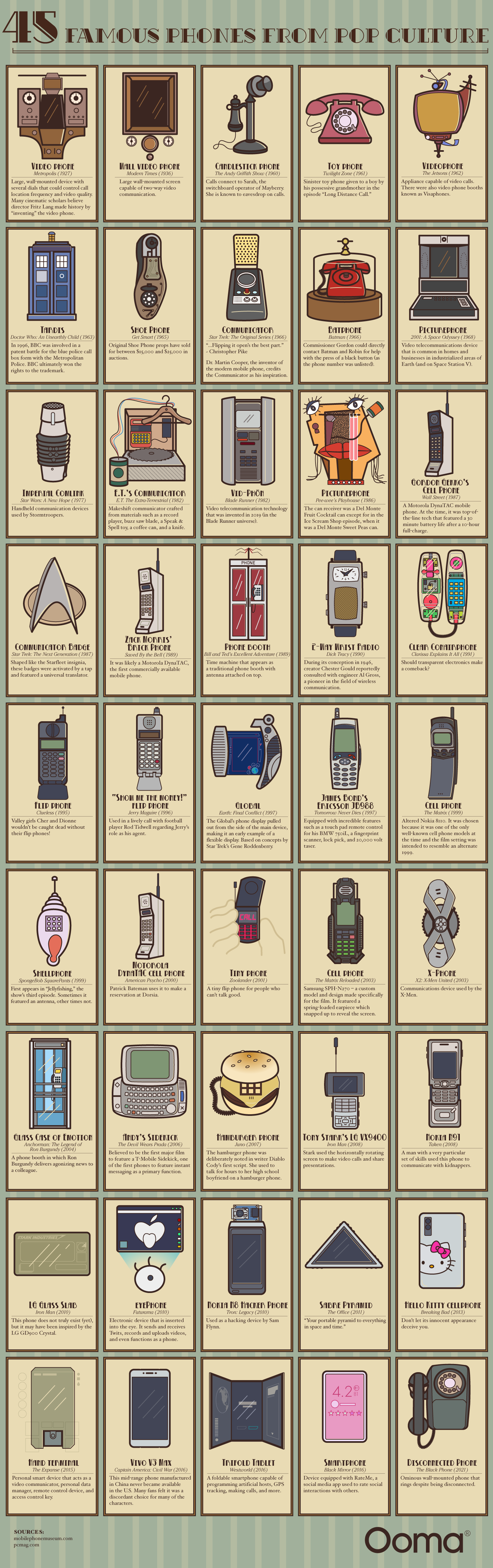
Some phones help form part of our lasting impression of a character. For example, Pee-Wee Herman’s picture phone is a regular part of the show and adds texture to Pee-Wee’s whimsical world. In the film, Juno, the title character is a relaxed teen with a quick wit, who uses a phone shaped like a hamburger to add a sense of humor and childishness to otherwise serious conversations.
Here are some more examples that appear on the chart:
- TARDIS from Doctor Who
- Clear Conairphone from Clarissa Explains it All
- “Show Me the Money!” Flip Phone from Jerry Maquire
- Neo’s Cell Phone from The Matrix
- Shellphone from Spongebob Squarepants
- Glass Case of Emotion from Anchorman: The Legend of Ron Burgundy
How many phones do you remember from this list? Have any of them made you re-think the movie or show they appear in?
Whoever said learning English is difficult and boring hasn’t seen this new study from Preply. It turns out that watching movies can help you improve your English learning, hooray! What better way to learn while having fun than sitting down with a bucket of popcorn and a good movie? Immersing yourself in popular media is a proven way to improve your real-world use of a language. Films can help you practice filling in comprehension gaps using context clues and studying facial expressions and body language for cues. Preply offers us a comprehensive watch guide of the best and worst films for learning English. They analyzed the 150 highest-grossing movies to present popular and enjoyable choices. Their score is based on the average number of words per minute, the difficulty of the vocabulary used, and the ease of watching with subtitles, which makes it easier to follow along.
Click below to zoom.
![Best movies for English language learning [Study]](https://thechartistry.com/wp-content/uploads/2026/04/movies-best-for-English-learning.png)
The team found that the best films for learning English are:
- Dawn of the Planet of the Apes
- Maleficent
- The Hobbit: Battle of the Five Armies
- Spider-Man 3
- The Hunger Games
Dawn of the Planet of the Apes has a low word count per minute and a simple vocabulary. This action-packed film should be easy to follow for those who don’t understand every word. The same is true of the Disney film, Maleficent, a retelling of Sleeping Beauty from the villain’s point of view.
Popular films that will give English language learners the most trouble are:
- The Wandering Earth
- Oppenheimer
- Barbie
- Shrek 2
- Finding Dory
This list has a few surprising results. While it’s no surprise to see the long, heavy, historical drama Oppenheimer on the list, it is funny to see it beside its famous marketing partner, Barbie, a much lighter film that released on the same day. But Barbie is chock-full of banter and musical numbers that add up to a high word count per minute and a frenetic movie for English learners to keep up with. This is the same reason animated films like Shrek 2 and Finding Dory made the list.
The team’s research points to fantasy and adventure films as the best genre for English learning, due to the large, dramatic, action-filled visuals that can help cue the meaning of dialogue. Epic quests and romantic films make for the best storylines. In keeping with these findings, they determined that the franchises best for learning English are The Hobbit films, the Spider-Man series, and the James Bond films. The team also separately emphasized films with high and low word-per-minute rates, which indicate how easy it will be to read the subtitles. Finding Dory is the most difficult to follow (thanks to the chatterbox of a fish in the starring role), and once again, Dawn of the Planet of the Apes comes up on top. This list is a great study tool for English students and one that ESL teachers should bookmark for lesson plans.

Most of us get tired of brands asking for our phone numbers and email addresses because we’re spammed with too many advertisements. But sometimes, providing your contact information will connect you with a brand’s loyalty program, which can offer discounts, free prizes, and cash back. One in ten companies has a loyalty rewards program, so the team at Qualtrics decided to analyze which one gives you the biggest return on investment. They focused only on base-level, free-to-join programs that give customers rewards through regular shopping; that way, the results truly reflect the rewards you earn for the money you spend.
Click below to zoom.
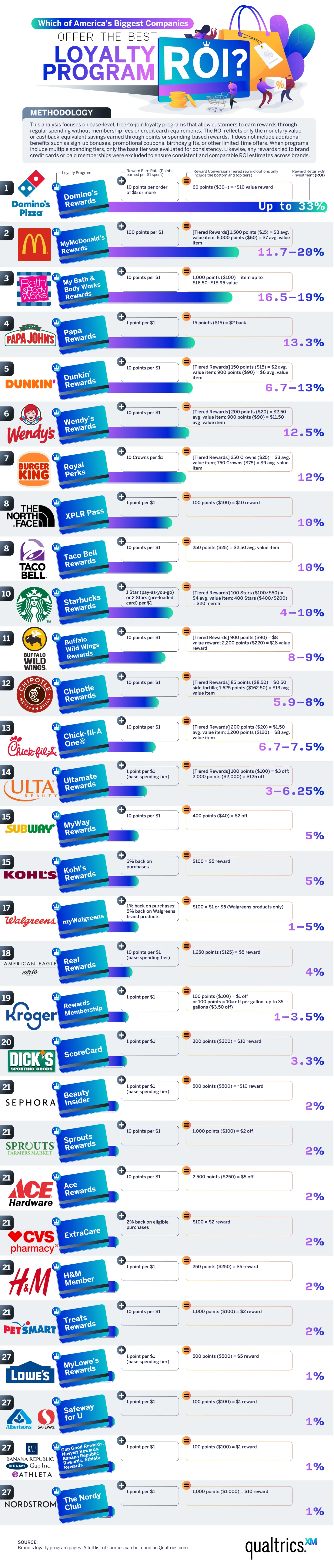
In the food and beverage industry, Domino’s Pizza offers the best ROI. The team calculated an almost 33% ROI for Dominos, which is by far the best offer, even across industries. You’ll receive about $10 of free food for every $30 spent. McDonald’s isn’t far behind at an 11 to 20% ROI with the MyMcDonald’s Rewards app. You’ll earn 100 points for every dollar spent, and you can use these points to purchase menu items. Papa John’s, Dunkin’, Wendy’s, and Burger King also have strong programs, with ROIs between 10% and 13%. The fast-food industry offers some of the best loyalty programs, earning eight out of the ten best rewards programs on the list.
In the retail and beauty space, Bath & Body Works leads with a 16.5%–19% ROI through the My Bath & Body Works Rewards program. The program allows shoppers to redeem points earned through purchases for free items, early access to sales, and an annual birthday gift. Ulta Beauty’s Ultamate Rewards program offers a decent ROI, too, at 3% to 6% for items that are normally on the expensive side. Their competitor Sephora has a Beauty Insider program that offers a lower 2% ROI, but exclusive free samples and early access to new products supplement it.
Brand rewards are weaker among clothing retailers. H&M, Gap Inc., and American Eagle/Aerie offer a 1%–4% ROI. These programs are still useful for loyal shoppers who know they’ll buy from these brands repeatedly.
Pharmacy and grocery store rewards can be a great help for budget-savvy shoppers. These stores have lower ROIs but can still offer decent rewards. Walgreens’ program took the lead, offering 1% back on most purchases and 5% back on Walgreens’ brand products, resulting in significant savings on generics. CVS has an ExtraCare program with a higher 2% ROI and personalized coupons.
In the grocery sector, Kroger and Safeway/Albertsons offer the highest ROIs, between 1% and 3.5%. These chains also offer a fuel rewards program that can be an incredible budget-saving boon. Lowe’s and Ace Hardware offer 1%–2% rewards programs that may be most helpful to frequent shoppers and small business owners who need materials from these stores.
Outdoor lovers and athletes can earn powerful rewards through the North Face’s XPLR Pass, which offers a 10% ROI, and the Dick’s Sporting Goods ScoreCard program offers a 3.3% ROI. The findings on this chart can help you save big the next time you shop!

A survey of over 1,000 Americans revealed that they would rather sit in silence than force out awkward small talk. The Preply team examined a few facets of idle chit chat, especially with strangers, and found that Americans have some interesting and perhaps unexpected preferences. They delved into who Americans prefer chatting with, the topics they loathe and love, and differences in how generations feel about small talk. Whether you’re strong and silent or a social butterfly, the results are sure to interest you!
The most important aspect of conversation just might be the topic. The survey asked Americans what subjects they turn to when they have to make small talk. The most popular answers are weather, plans, and work. Respondents felt that these topics are inoffensive and relatable to anyone they might strike up a conversation with. Americans dread having to speak about family, sports, or politics. These are either too personal, too niche, or too controversial.
Click below to zoom.
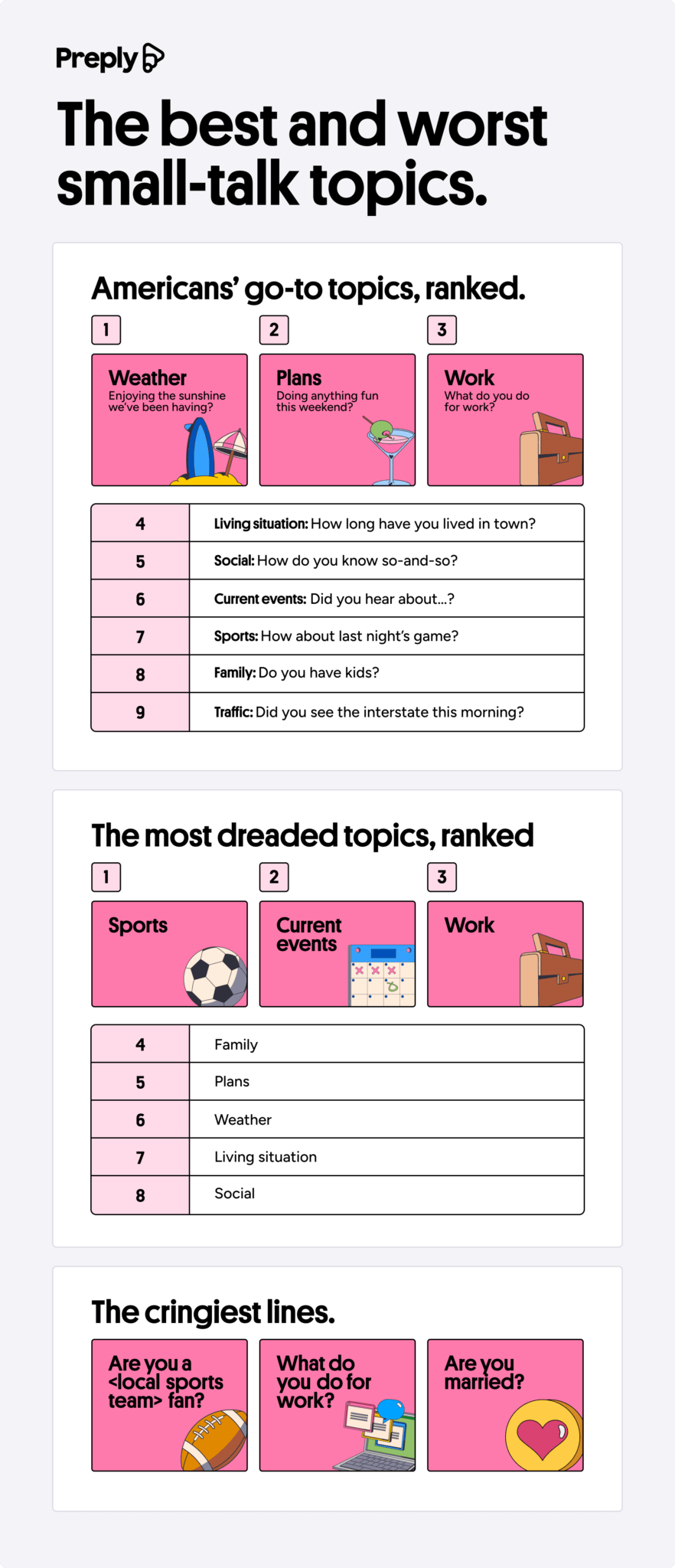 As for the lines, what do Americans hate the most? These are the ones to avoid:
- Are you a (local sports team) fan?
- What do you do for work?
- Are you married?
While work might seem like an easy entry point for a conversation, many Americans find the topic stale or feel embarrassed to talk about what they do for work.
In general, Americans would prefer to avoid small talk altogether and describe it as an awkward experience. Seven in ten survey respondents preferred sitting in silence to chatting. Small talk may be lost to time, as the survey found that 2 in 3 Americans take out their phones to avoid it. Gen Z is the most likely to use this tactic. A whopping 89% of them admitted to using this tactic. Only 30% of Baby Boomers use the see strategy.
If small talk is such a dreaded activity, why do so many Americans start up a chat? It may be because 91% of Americans think small talk will turn into a deeper conversation. Many people believe that first impressions are important, and small talk is often our first interaction with others. Statistics show that older people are more interested in using small talk to learn more about others than younger people. 23% of Baby Boomers report making small talk to get to know others, while only 7% of Gen Zers do the same.
Despite a distaste for small talk, half of Americans say they do it anyway just to be polite. 44% of Gen Z said they used small talk to avoid awkward feelings, while only 21% of Baby Boomers felt the same.
Naturally, Americans vastly prefer making small talk with friends, family, and coworkers. They would prefer skipping it with strangers, restaurant workers, and retail employees. A majority of Americans think their parents are the chattiest people they know, with 37% of people saying mothers make the most small talk. Americans have a reputation for friendliness, but these survey results indicate it may be less genuine and more a matter of politeness.
-
 Business Visualizations2 years ago
Everything Owned by Apple
-
 Business Visualizations1 year ago
America’s Most Valuable Companies Ranked by Profit per Employee
-
 Business Visualizations1 year ago
The Biggest Fortune 500 Company in Every State
-
 Business Visualizations11 months ago
The Biggest Employers by Industry
-
 Timelines1 year ago
Timeline Charts the Development of Communications Technology
-
 Charts2 years ago
How Many Crayola Crayon Colors Are There? A Lot.
-
 Business Visualizations6 months ago
The Largest Companies in America That Are Still Run by the Person Who Founded Them
-
 Maps2 years ago
A Map to Gold and Silver