
Charts
The Most Dangerous Places to Drive on New Year’s

Millions of Americans travel for New Year’s Eve and Day celebrations, but unfortunately, the last night of the year can be one of the most dangerous for drivers. CarInsurance.com analyzed data from the National Highway Traffic Safety Administration to find that certain states and counties have consistently higher fatality rates on December 31 and January 1. The team identified where and when the risks are highest.
Click below to zoom.
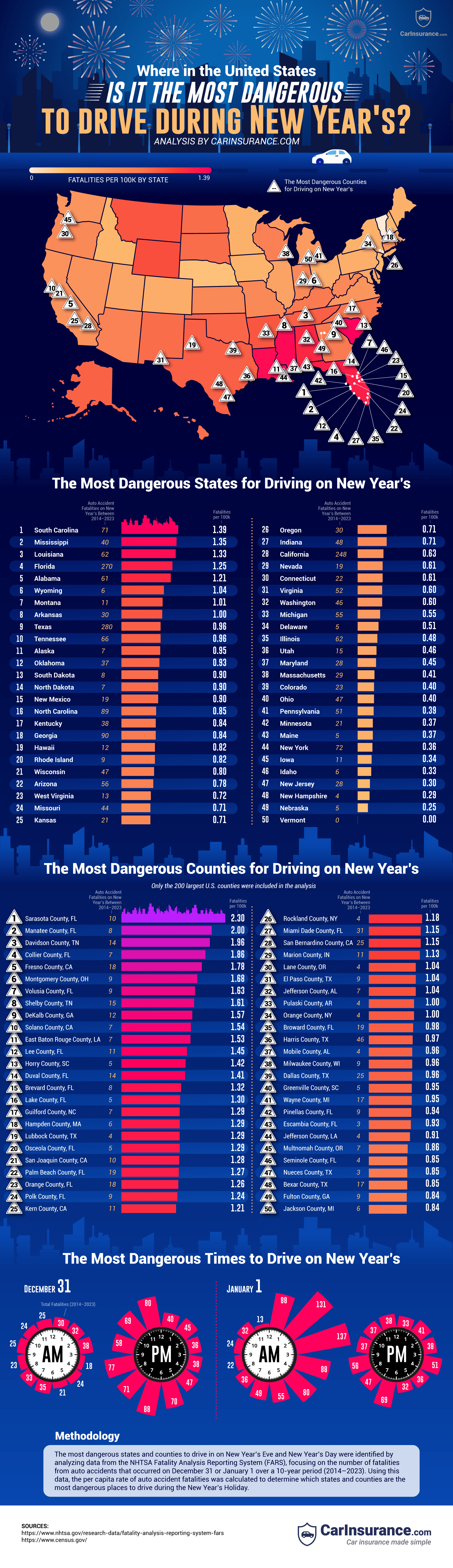
The team’s analysis examined NHTSA fatality numbers between 2014 and 2023, then adjusted this data relative to population to calculate the number of fatalities per 100,000 residents. They discovered that these states had the highest per-capita traffic deaths on New Year’s Eve:
- South Carolina – 1.39 deaths per 100,000 (71 total)
- Mississippi – 1.35 deaths per 100,000 (40 total)
- Louisiana – 1.33 deaths per 1000,000 (62 total)
Florida was also a high-risk location. Its deaths per capita rank fourth on the list, but the total number of New Year’s Eve fatalities are much higher than the top three states, with 270 deaths in total. This is largely due to Florida’s large population and number of dangerous counties.
Focusing on these high-risk counties revealed some especially hazardous locations. The deadliest U.S. counties on New Year’s Eve and Day were:
- Sarasota County, Florida – 2.3 fatalities per 100,000 (10 deaths)
- Manatee County, Florida – 2.0 per 100,000 (8 deaths)
- Davidson County, Tennessee – 1.96 per 100,000 (14 deaths)
Sarasota and Manatee counties are both linked to high rates of DUI-related traffic fatalities, which can help explain their placement at the top of the list.
The danger not only varies by place, but by the time of day. On New Year’s Eve, the deadliest hours occur between 2 a.m. and 3 a.m. for 38 recorded fatalities. On New Year’s Day, the early morning hours are by far the most dangerous, with 137 deaths occurring between 2 a.m. and 3 a.m. and 131 deaths between 1 a.m. and 2 a.m.
Over the decades, we see 1,047 deaths on December 31st and 1,474 on January 1st, so New Year’s Day has the most fatalities overall, which is probably due to partygoers under the influence returning home in the early morning hours.
The largest contributor to New Year’s traffic deaths is certainly alcohol impairment. For example, in 2022, 37% of deadly crashes on New Year’s Day involved an alcohol impaired driver. This number varies year-to-year, but it does highlight how common drunk driving is during holiday celebrations.
This pattern aligns with a broader national trend of alcohol-impaired driving leading to traffic fatalities. In 2023, a third of U.S. traffic deaths involved drunk drivers, prompting campaigns run during the holiday period with slogans like, “Drive sober or get pulled over.”
Understanding the safety facts the team outlined can help drivers make safe decisions over the holidays. We can see from the data that they should avoid driving between 1 a.m. and 3 a.m. on New Year’s Eve and New Year’s Day. They should arrange a sober ride and never drive under the influence. Always wear a seatbelt and be extra alert when driving.
Subtitles were an accessibility feature viewers usually didn’t pay attention to unless they were hearing-impaired. These days, though, subtitles are a popular option when watching TV. Preply’s survey of 1,265 Americans found that half of them watch TV with subtitles on for reasons beyond hearing loss or watching foreign films in another language.
A Generational Trend
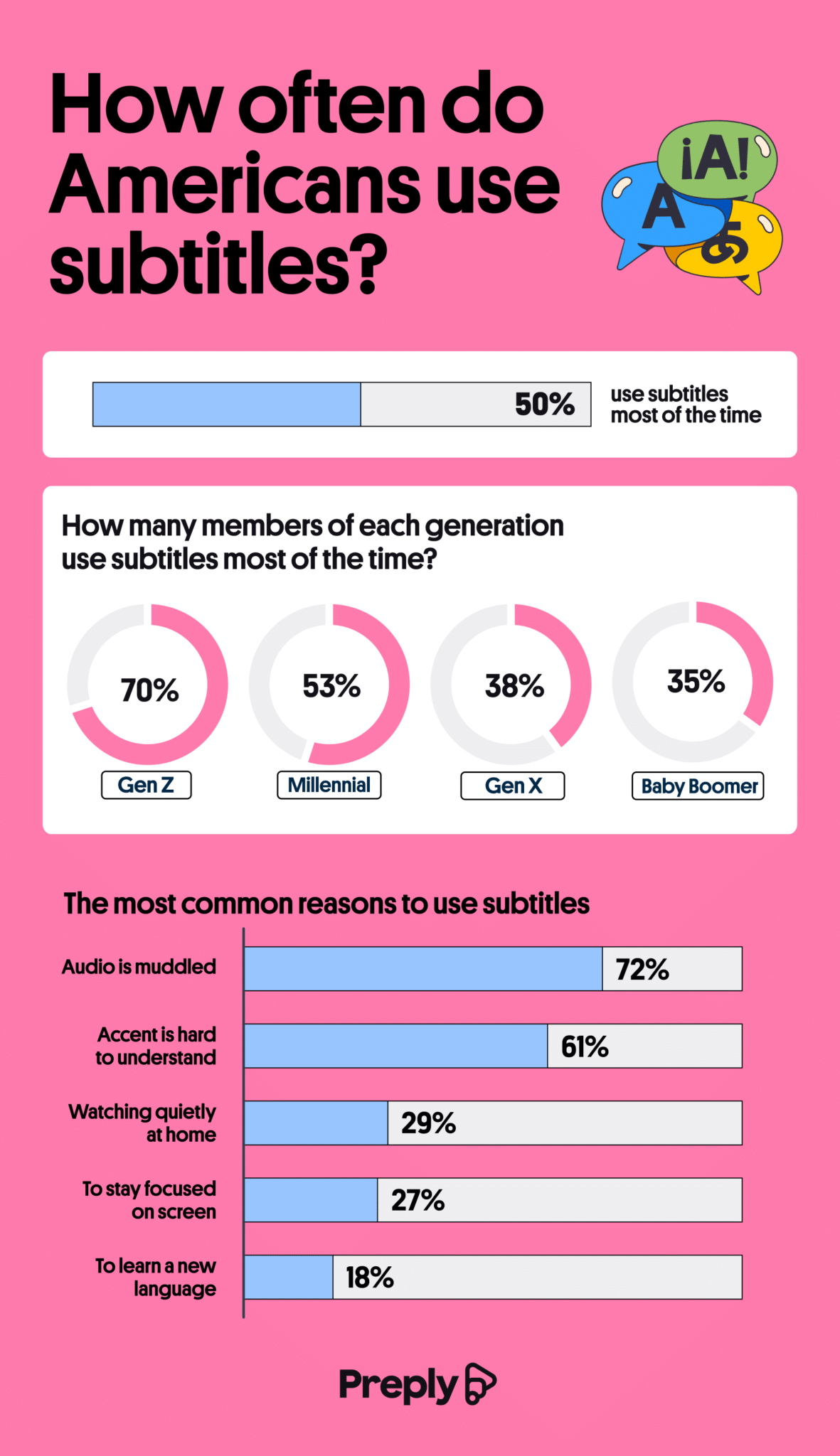
89% of the people surveyed by Preply have used subtitles at some point. Differences emerge when it comes to how often people use subtitles. Gen Z uses them the most. 70% say they have subtitles on 70% of the time, and Millennials are just above the average amount at 53%. Gen X and Baby Boomers are the least likely to use subtitles. The team graphed data on how often each generation uses subtitles.
Click below to zoom.
Sound Mixing Issues Get the Blame
The most common reason respondents said they use subtitles is muddled audio. 78% of people who use subtitles say that loud background music drowns out dialogue. 55% of people believed that dialogue is harder to hear now than it used to be. 61% of people say accents make a film more difficult to understand, so they turn on subtitles. Some people use subtitles to keep the TV volume down or to stay focused while they’re dealing with children, pets, or work.
Click below to zoom.
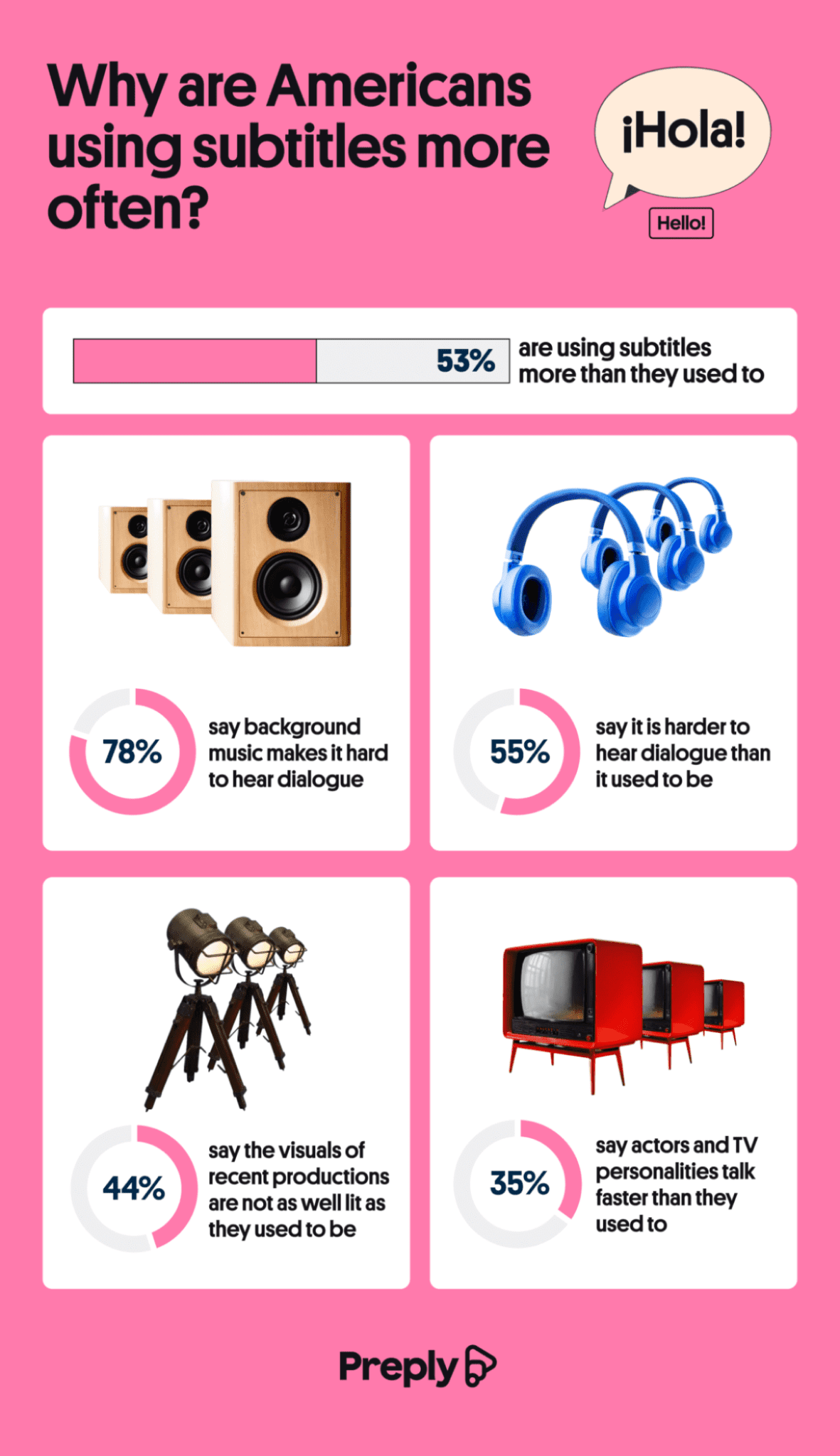
Sound-mixing complaints tie into another emerging opinion about modern television. 44% of viewers think that shows and films are shot in darker tones than in the past. They don’t like the aesthetic, and they think it’s harder to see. Another 35% of people think actors speak faster now than they used to, which also contributes to the use of subtitles.
The Most Subtitled Shows and Stars
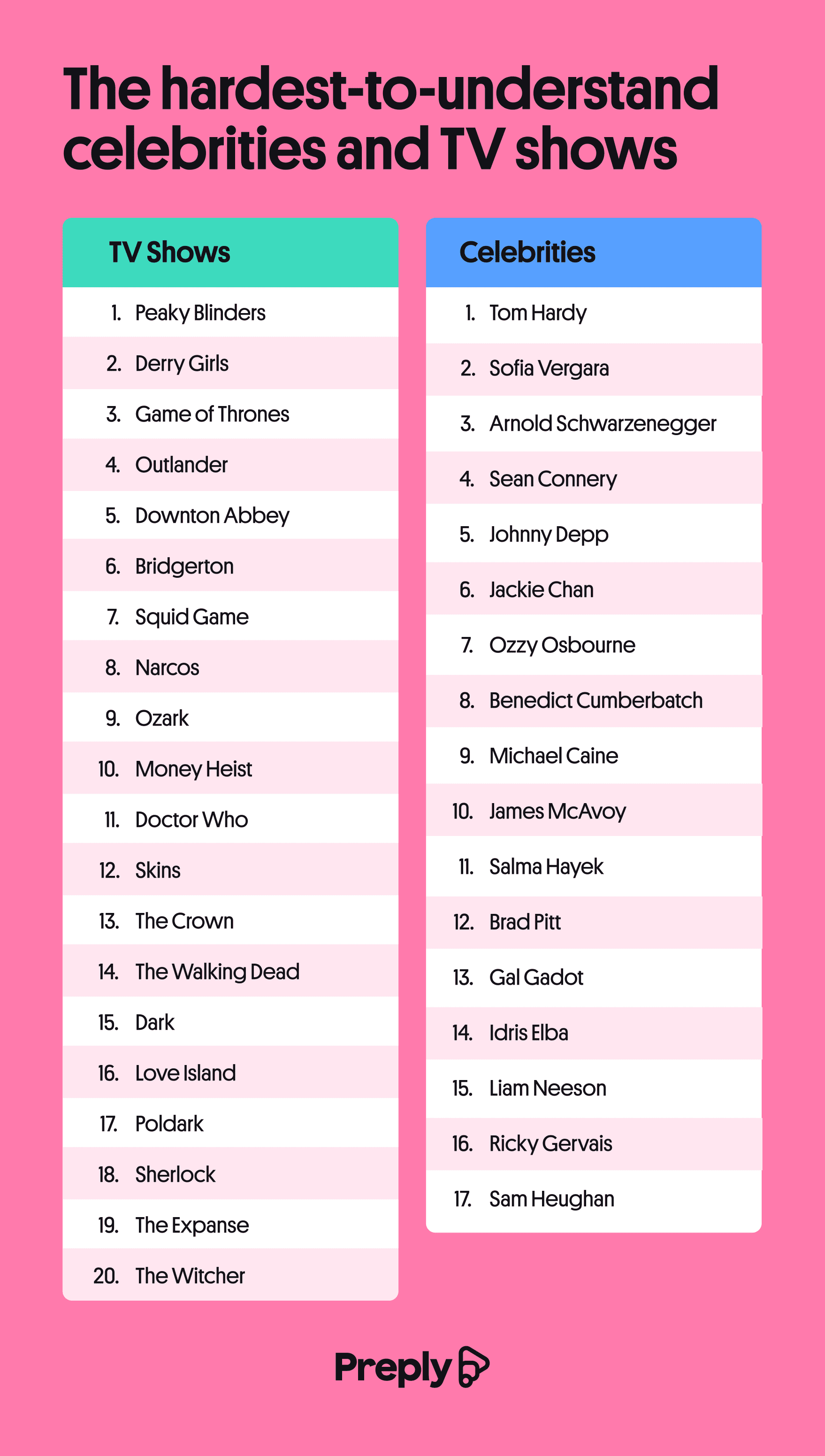
A fun section of the study delves into the shows and stars that get the subtitle treatment the most. The most subtitled shows were Peaky Blinders, Derry Girls, and Game of Thrones. Tom Hardy, Sofia Vergara, and Arnold Schwarzenegger were cited as the most difficult-to-understand celebrities. Over half of viewers say they turn on subtitles to follow dialogue with accents they find hard to understand.
Click below to zoom.
Subtitles While in Public
A big difference in TV viewing now is that many people watch on their devices while out in public. 74% of Gen Z does this, citing that they watch on public transit, at work, and even while walking and driving. Divided attention is probably part of what’s increasing the appeal of subtitles for this group. For those watching online clips on platforms like YouTube and TikTok, 41% turn on subtitles.
Foreign Films and Language Learning
62% of respondents said they use subtitles more for streaming services than regular TV channels. They said that Amazon Prime, Netflix, and Hulu have the best subtitle features. For foreign-language shows, like the popular Korean series Squid Game, 74% preferred watching in Korean with subtitles over the English dub. 26% of respondents say they use subtitles to help them learn a new language.

Translation apps promise to dissolve language barriers with a tap, turning your phone into a pocket interpreter. A new study from Preply suggests that convenience comes at a cost. After surveying 1,200 Americans who have used these tools while traveling abroad, Preply found that 57% considered the apps robotic and unnatural, leaving travelers feeling that something essential was missing from their interactions with locals.
Click below to zoom.
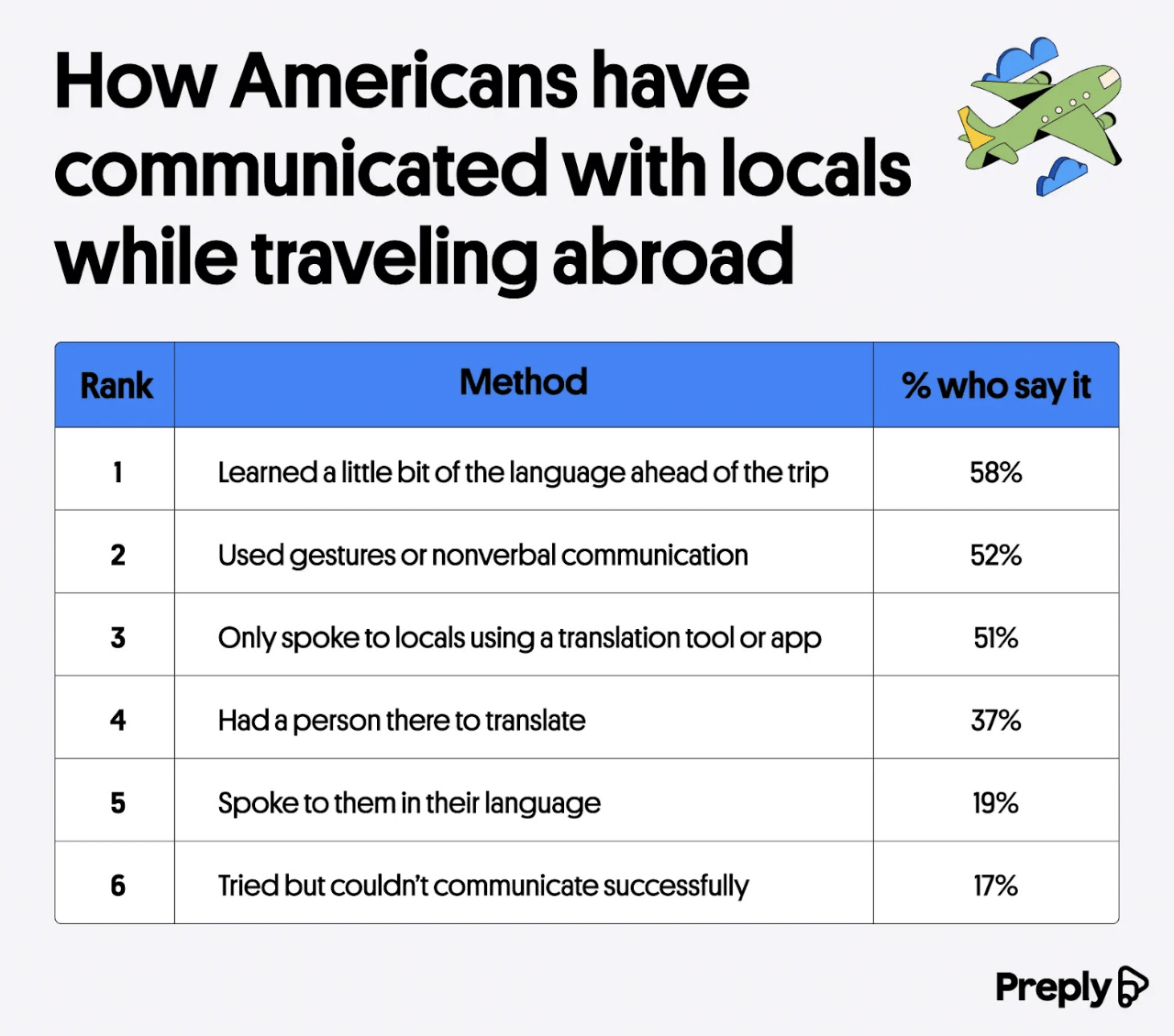 The study’s first graph breaks down how Americans usually communicate when they travel, and the most popular solution is low-tech. Nearly three in five respondents said they learned some of the local language before their trip so they could use it themselves. Gestures and pointing, along with facial expressions, were also popular when asking for food or directions. Half of respondents used a translation app or tool, while two in five used in-person translators. Almost one in five could speak the local language, either from prior knowledge or from efforts to study before the trip. 17% said they still struggled to communicate despite their best efforts.
Click below to zoom.
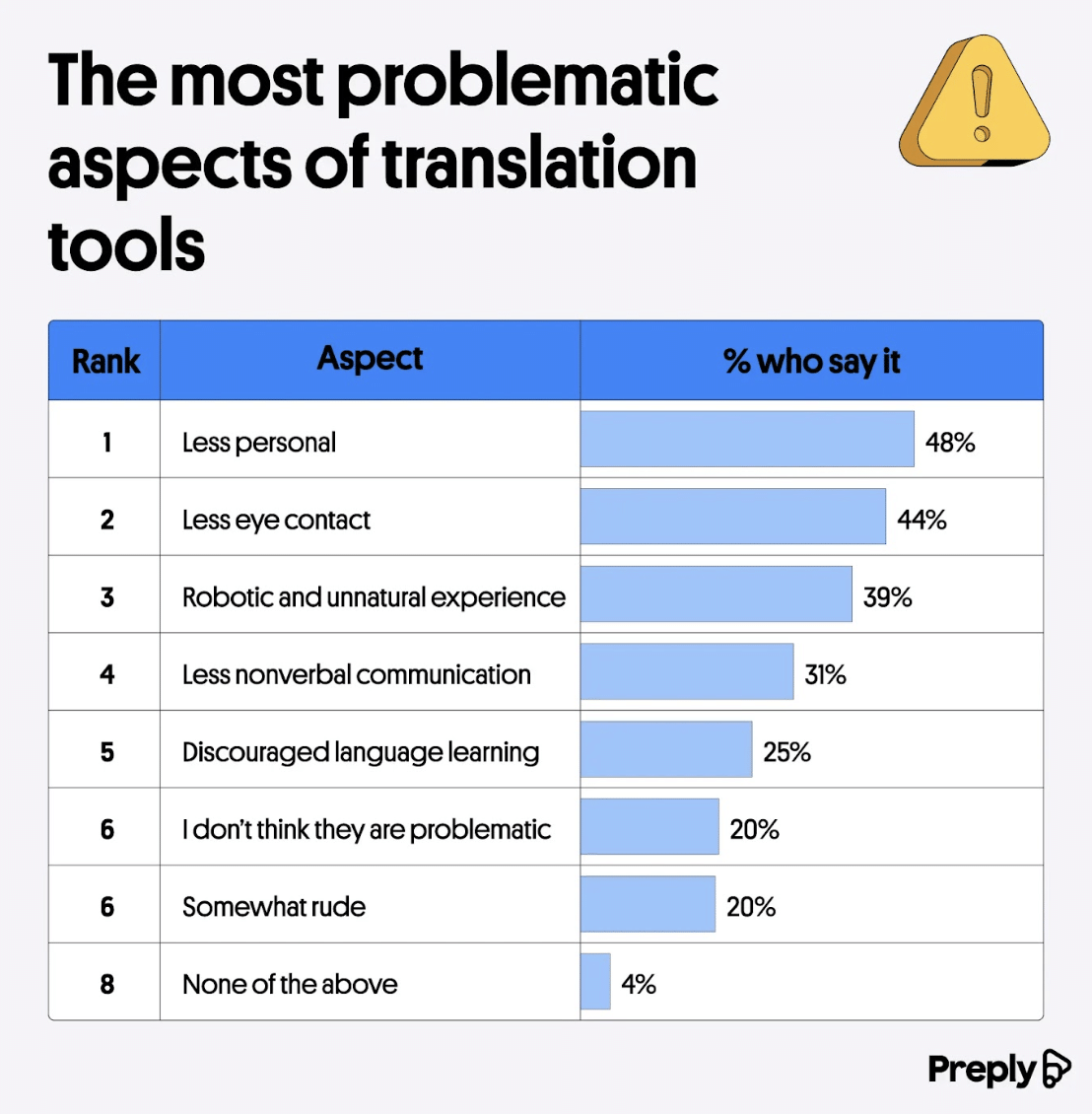 The second visual shows what travelers don’t like about translation apps. Most complaints center around human connection. Nearly half of travelers said technology made interactions less personal, and more than two in five were bothered by the lack of eye contact because the user must watch the screen. Body language and eye contact help people build rapport, but a device in the middle can disrupt this connection. One in five travelers described real-time technology as somewhat rude. A third of respondents reported an awkward moment while using the tool, and nearly one in three said the app made their trip feel less immersive.
The tools might also undercut long-term learning. More than a third of travelers felt translation technology discouraged them from learning more of the language, and 52% were frustrated that an app can’t communicate tone or cultural nuance.
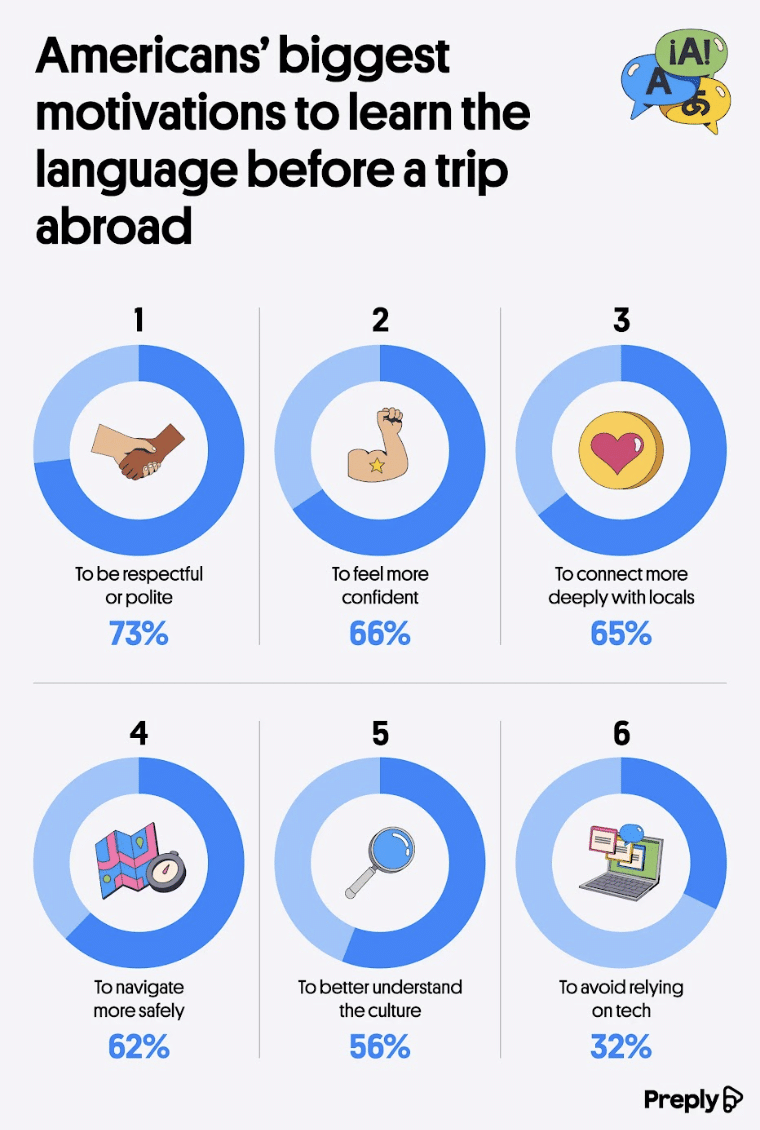
The final visual aid examines what motivates travelers to study a language before setting out on a trip. Half of Americans who traveled abroad took some kind of language class beforehand. The top reason chosen by 73% of respondents was a desire to be polite and respectful. Two-thirds wanted to feel more confident when traveling, and 65% hoped to connect more deeply with locals. Looking ahead, 65% of Americans said they want to learn more of the local language before a future trip.
That doesn’t mean travelers are abandoning their apps. More than two-fifths expect to rely on translation tools more the next time they travel. One in six plan to use these tools less.
Preply offers us a balanced conclusion. Translation apps are a remarkable technology that works best in moderation. Knowing a handful of phrases can transform a transactional exchange into a genuine moment of connection. That connection is something no app has managed to replicate.
As new technologies transform industries and create new skills demand, this analysis from Altium ranks states by how well their workforces are positioned to meet the future and a changing economy. The article, graphs, and maps show that tech readiness doesn’t always match a high-tech reputation.
Click below to zoom.
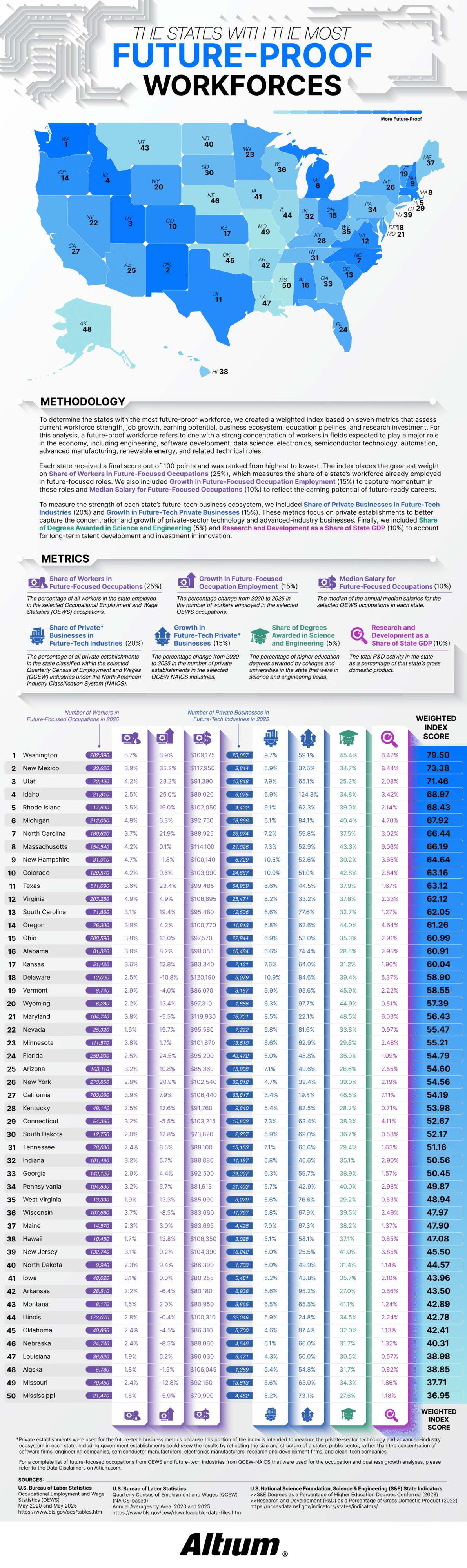
Altium defined a future-proof workforce as one with a large share of workers in fields expected to drive economic growth over the next few decades. The study tracked 30 occupations using data from the Bureau of Labor Statistics, including electrical and computer hardware engineers, software developers, data scientists, solar installers, semiconductor processing technicians, CNC programmers, and wind turbine technicians. The team considered 27 “future-tech” industries from aerospace to renewable energy to semiconductor manufacturing and R&D services.
Each state received a score out of 100 based on seven weighted metrics. The largest factor at 25% was the share of workers already employed in future-focused positions. The share of private businesses in future-tech industries was worth 20%. Employment growth and business growth from 2020 to 2025 counted for 15%. Median salary and research and development as a share of state GDP each accounted for 10%, and the share of science and engineering degrees made up the final 5%.
Washington took first place with a score of 79.50. Nearly 6% of the workforce there holds future-focused jobs and earns a median salary of $109,175. Washington’s future-tech businesses grew 59.1% over five years. The article credits the state’s concentration of software and aerospace employers, noting that Washington leads the nation in aerospace sales, exports, and employment.
The runner-up is more surprising! New Mexico ranked second, thanks to its 35.2% growth in future-focused employment. That’s the fastest growth rate in the country. Thanks to national laboratories and an expanding aerospace sector, it has one of the highest median salaries in the study at $117,950. Utah, Idaho, and Rhode Island round out the top five rankings. Idaho stood out for business expansion, with future-tech businesses growing by an eyebrow-raising 124.3%.
The study’s most confusing findings relate to California. The state employs 703,060 people in future-focused occupations, more than any other state, yet it only ranks at #27. Although California is strong in engineering education and R$D investment, future-tech industries make up only 3.4% of its private businesses. Its five-year business growth rate of 19.8% is the lowest in the nation.
Smaller states benefited when technology made up a larger slice of their economies. Rhode Island’s future-tech businesses represent 9.1% of its private sector and grew 62.3%. New Hampshire ranked ninth with the highest future-tech business share in the top ten at 10.5%. Rounding out the top ten were Michigan, North Carolina, Massachusetts, and Colorado.
Mississippi finished last with a score of 36.95, followed by Missouri, Alaska, Louisiana, and Nebraska. Several of these states saw a decline in future-focused occupations. The key takeaway is that a state’s headcount or Silicon Valley reputation alone doesn’t define its readiness for the future. A growing technical workforce and a dense base of tech businesses best position a state for the future.
-
 Charts2 years ago
Map Uncovers Countries with Most Powerful Passports
-
 Business Visualizations2 years ago
The Biggest Fortune 500 Company in Every State
-
 Business Visualizations1 year ago
The Biggest Employers by Industry
-
 Business Visualizations1 year ago
The Largest Companies in America That Are Still Run by the Person Who Founded Them
-
 Charts2 years ago
Study Highlights Disparity Between Homelessness Rates and Empty Housing
-
 Misc Visuals2 years ago
Exploring Science Fiction Technology That Became a Reality
-
 Charts1 year ago
New Study Reveals Details About American Intimacy
-
 Charts2 years ago
Study Determines Cities with Biggest Home Price Increases After COVID-19