
Misc Visuals
Study Examines American Slang Trends and What Words We Want to Revive

Words that were once at the cutting edge of language and culture are quickly dumped into a bin of corny, outdated phrases that might get a chuckle if you use them in earnest. Slang is meant to reflect the times, but it’s also intended to express a feeling we don’t have other words for. Preply examined the ins and outs of slang culture in their new study that asked Americans their favorite slang terms, their slang use habits, and which words they would love to see make a comeback.
Click below to zoom.

Words that were once at the cutting edge of language and culture are quickly dumped into a bin of corny, outdated phrases that might get a chuckle if you use them in earnest. Slang is meant to reflect the times, but it’s also intended to express a feeling we don’t have other words for. Preply examined the ins and outs of slang culture in their new study that asked Americans their favorite slang terms, their slang use habits, and which words they would love to see make a comeback.
Words are ever-evolving, and sometimes retro slang makes a big comeback. For example, “cool” is a slang term we’ve used for decades, but there are also countless examples of slang that offer us another way to say “cool” without seeming cliché. It might surprise you to learn which phrases were the most popular choices to revive.
Here’s the list of top terms:
- Baloney
- Take a chill pill
- Bogus
- Cruisin’ for a bruisin’
- Groovy
- Spiffy
- Heebie-jeebies
- Gnarly
- Knuckle sandwich
- Rad
- Wassup?
- Chillax
- The bee’s knees
- Da bomb
- Mellow out
- Keep on truckin’
- Booyah!
- As if!
- Made in the shade
- Snafu
Over 50% of respondents chose those top three terms. Each term comes from a different decade, and “bogus” and “baloney” mean more or less the same thing. But bogus and baloney give a cheeky flair and a sense of outrage to the alternative, which is to say, “that’s absolute nonsense.” Slang usually sounds informal and adds another layer of emotion to what the speaker tries to express.
The respondents said that ‘90s slang was their favorite of all time, except for baby boomers, who all prefer slang from the 1960s. Interestingly, men preferred ‘70s slang and women preferred ‘90s slang. Gen X is the most nostalgic about slang from their childhood, which might account for the popularity of ‘90s and ‘80s slang.
Gen Z is most likely to use old slang as a joke or ironically. They’re also the quickest to flinch over outdated slang, and their slang changes quickly as it’s based on social media trends and memes that feel passe within a few weeks. Gen Z is also the most unfamiliar with older slang, with 80% having had to Google the meaning of a slang word from the past.
Slang captures who we are in cultural moments, whether we’re talking about the pre- or post-Internet age. Slang unites us with phrases that allow us to share humor, rebellion, or a sense of identity. The study shows fascinating patterns of language, too. We can say something is rad, lit, or fire, and they all generally mean the same thing (“cool”), but the people using those words are probably from different generations. People who feel nostalgia for slang are reminded of what they saw as a simpler past, or they yearn for the pop culture that spawned these phrases. Preply’s work is a true celebration of language and culture!
Words are ever-evolving, and sometimes retro slang makes a big comeback. For example, “cool” is a slang term we’ve used for decades, but there are also countless examples of slang that offer us another way to say “cool” without seeming cliché. It might surprise you to learn which phrases were the most popular choices to revive.
Here’s the list of top terms:
- Baloney
- Take a chill pill
- Bogus
- Cruisin’ for a bruisin’
- Groovy
- Spiffy
- Heebie-jeebies
- Gnarly
- Knuckle sandwich
- Rad
- Wassup?
- Chillax
- The bee’s knees
- Da bomb
- Mellow out
- Keep on truckin’
- Booyah!
- As if!
- Made in the shade
- Snafu
Over 50% of respondents chose those top three terms. Each term comes from a different decade, and “bogus” and “baloney” mean more or less the same thing. But bogus and baloney give a cheeky flair and a sense of outrage to the alternative, which is to say, “that’s absolute nonsense.” Slang usually sounds informal and adds another layer of emotion to what the speaker tries to express.
The respondents said that ‘90s slang was their favorite of all time, except for baby boomers, who all prefer slang from the 1960s. Interestingly, men preferred ‘70s slang and women preferred ‘90s slang. Gen X is the most nostalgic about slang from their childhood, which might account for the popularity of ‘90s and ‘80s slang.
Gen Z is most likely to use old slang as a joke or ironically. They’re also the quickest to flinch over outdated slang, and their slang changes quickly as it’s based on social media trends and memes that feel passe within a few weeks. Gen Z is also the most unfamiliar with older slang, with 80% having had to Google the meaning of a slang word from the past.
Slang captures who we are in cultural moments, whether we’re talking about the pre- or post-Internet age. Slang unites us with phrases that allow us to share humor, rebellion, or a sense of identity. The study shows fascinating patterns of language, too. We can say something is rad, lit, or fire, and they all generally mean the same thing (“cool”), but the people using those words are probably from different generations. People who feel nostalgia for slang are reminded of what they saw as a simpler past, or they yearn for the pop culture that spawned these phrases. Preply’s work is a true celebration of language and culture!

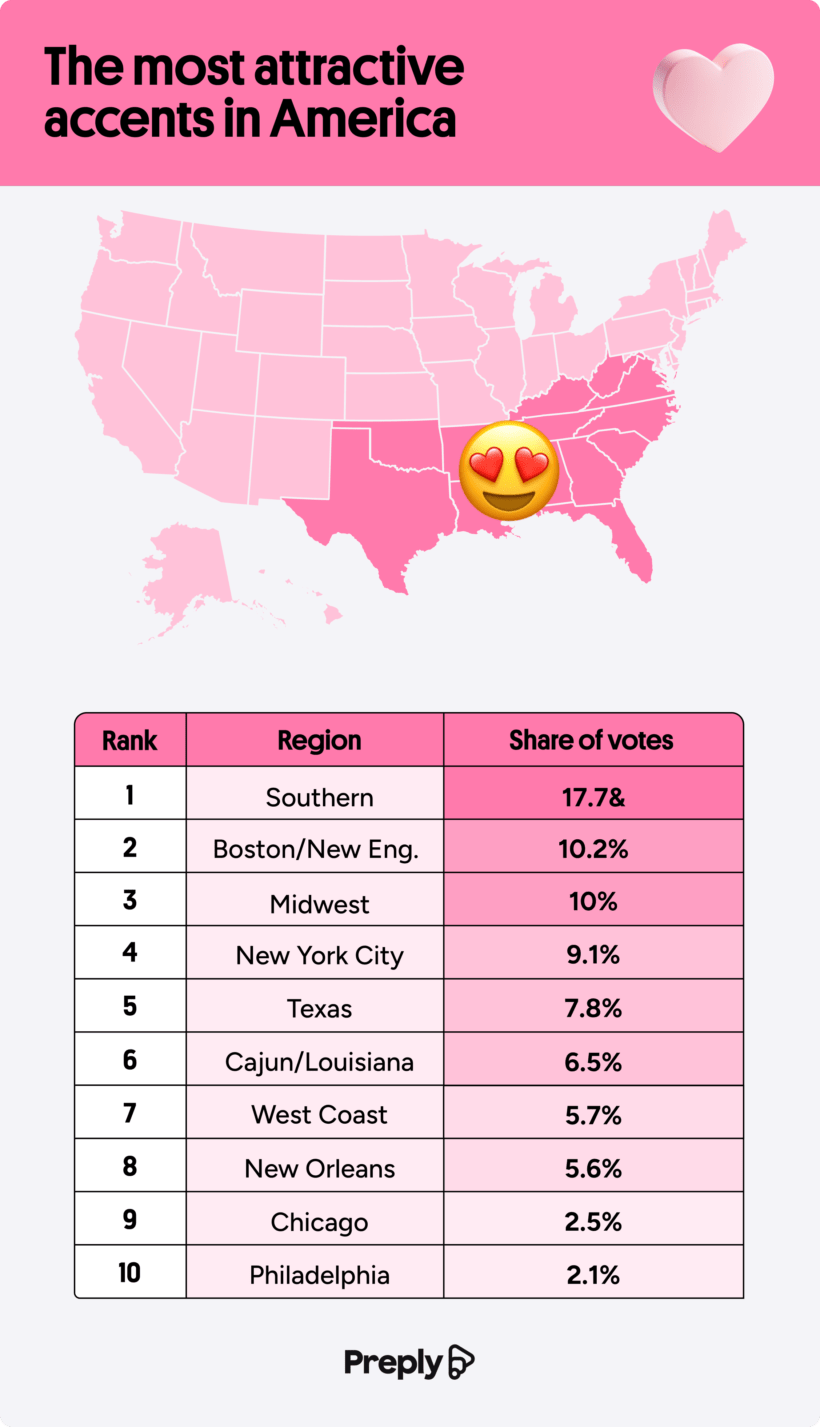
Ask an American to name the most attractive accent in the country, and you’ll get a surprisingly consistent answer, though not the one internet memes might lead you to expect. Preply surveyed 2,551 adults across all 50 states, and the Southern drawl was the winner with a healthy lead.
At 17.7%, Southern accents drew the largest share of “most attractive” votes, well ahead of Boston and New England (10.2%), the Midwest (10%), and New York City (9.1%). Respondents used words like friendly, authentic, and warm to describe the Southern drawl. One described a Southern drawl as sounding unhurried and genuinely welcoming, like a creek flowing over smooth rocks.
Click below to zoom.
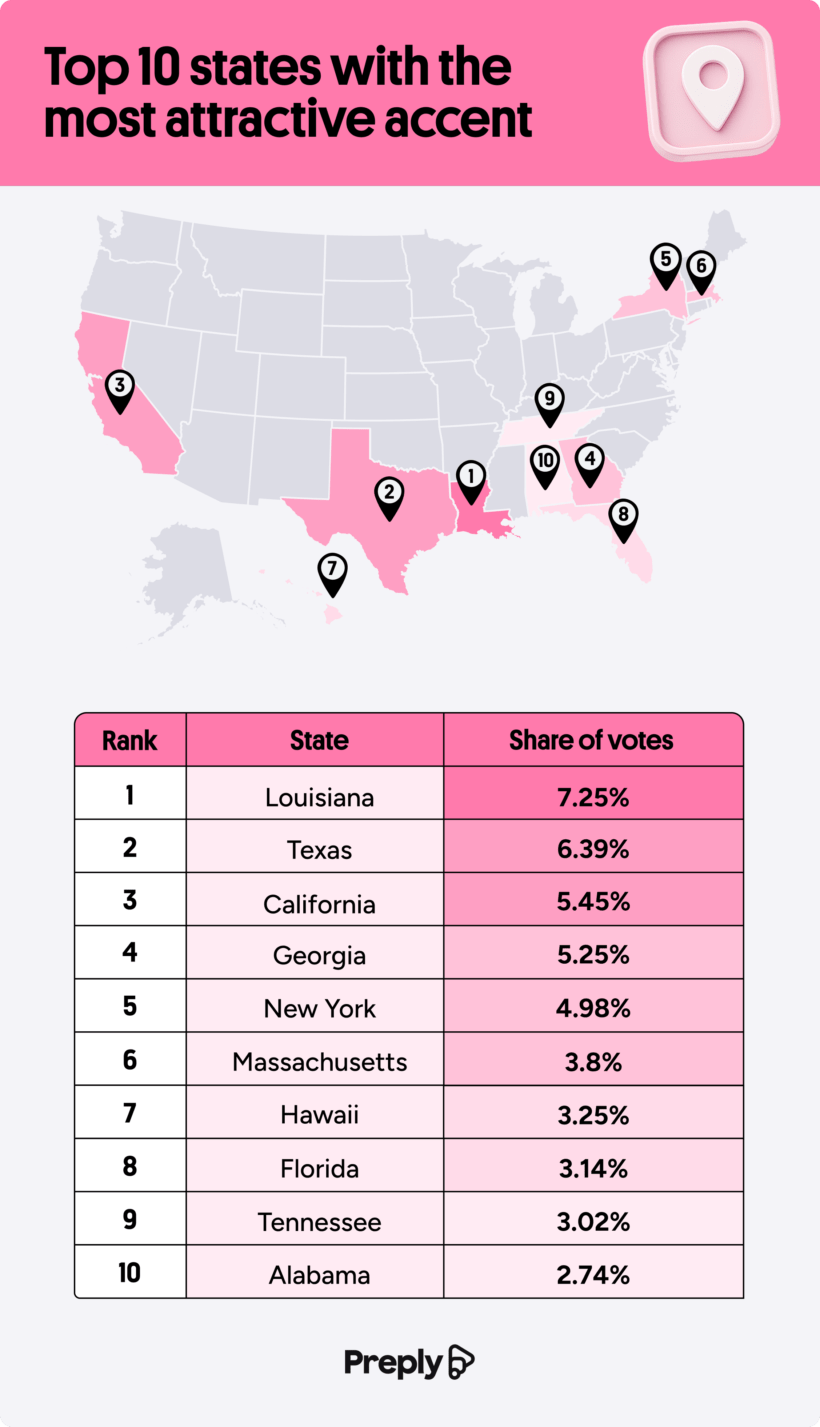
At the state level, Louisiana was crowned king of Southern accents with 7.3% of votes, followed by Texas (6.4%), California (5.4%), Georgia (5.3%), and New York (5%). Louisiana pulled off an unusual double win. It also ranked first as the hardest accent to understand, which sounds like a contradiction, but maybe it’s exactly the point.
Click below to zoom.
Worth noting is that 16.4% of respondents said no region in particular has the most attractive accent. Accent preference isn’t universal and a meaningful share of Americans don’t rank them.
Gen Z and Boomers are attracted to accents on opposite sides of the map. 19.9% of Boomers picked Southern accents versus 9.8% of Gen Z respondents. The split reverses on NYC accents, with 11.4% of Gen Z selecting it and only 5.6% of Boomers. The slang divide is even more dramatic. 82.5% of Boomers have never heard “delulu,” 76.1% didn’t recognize “sus,” and 74.1% weren’t familiar with “rizz.” Even the self-explanatory “cringe” raised confusion among 43.5%.
Some local slang doesn’t travel well. 67.7% of Americans didn’t recognize Pittsburgh’s “yinz.” Philadelphia’s “jawn” drew blank stares from 63.4% of Americans, New England’s “packie” puzzled 63.2%, the Midwestern “ope” is mysterious to 58.8%, and the Mid-Atlantic’s “water ice” is meaningless to 51.7%. There is one clear exception. Over half of Americans say “y’all,” which means this Southern term has gone national.
Are regional slang and accents fading? The team examined opinions on this too. Respondents had theories on what could eliminate slang and accents. 32.8% think it could be due to population, while 28.4% blame social media like TikTok for flattening speech, a similar opinion to the 27.8% who think that internet slang displaces local expressions. Others (23.9%) blame older generations for not passing terms down, 20.2% blame streaming and TV for affecting accents, and 18.5% think professional pressure pushes people to adopt neutral speech.
When Americans were asked why they take pride in their regional speech, 21.9% said it was a sense of connection to their home. 20.5% said their accent reminds them of home. 17.2% of respondents said their accent gave them a sense of identity, and 13.5% tied their accent to their heritage and culture.
25.1% of Americans reported having no pride in their accent, rising to 31.5% among Boomers and falling to 18.9% among Gen Z. The youngest generation is the proudest even as accents reportedly blur over time.
Student Choice has published the 2026 updated version of its study, ranking the most popular college degrees by return on investment after five years in the workforce. The team’s premise is timely as they examine a hot topic: the cost of higher education. The average cost of college now exceeds $43,000 per year, so entering the workforce with these student loans became a high-stakes game. The analysis pairs the top 25 majors in 2026, based on a previous Student Choice study, with earnings data from the U.S. Bureau of Labor Statistics to calculate how much a graduate earns in their first five years relative to their four-year tuition investment. They illustrated their findings by ranking 20 degree types compared to 40 common occupations.
Click below to zoom.
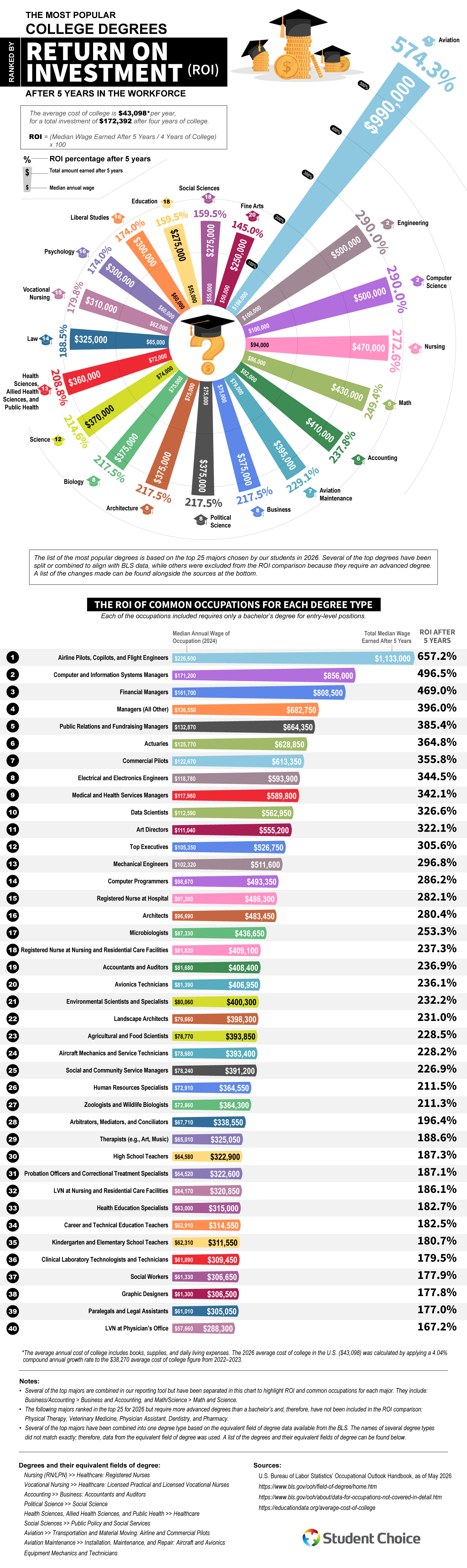
The team used a simple methodology. The average cost of college is $43,098 per year for a total investment of $172,392 for four years, with ROI calculated as median wages earned over five years divided by the four-year college cost. Majors that require advanced degrees like physical therapy, veterinary medicine, physician assistant, dentistry, and pharmacy were excluded from the ROI comparison even though these majors rank in the top 25.
Aviation tops the rankings chart, claiming the leading spot by a wide margin because of its astounding 574.3% ROI after five years, boosted by the median annual wage of $198,000. The field’s popularity is likely due to high pay and a looming pilot shortage as veteran airline workers retire. Engineering and computer science tied for second place at 290% each with median wages of $100,000 a year.
Healthcare and quantitative fields round out the upper tier. Nursing ranks fourth with an ROI of 272.6%, followed by math at 249.4% and accounting at 237.8%. Business, political science, architecture, and biology all tie for eighth at 217.5%, based on a $75,000 median wage. Education and social sciences sit near the bottom of the list at 159.5%, and fine arts at the bottom at 145%.
The study’s most helpful section might be the table that shows how career choice within a major can dramatically outperform the degree’s baseline. Aviation graduates who became airline pilots, copilots, or flight engineers reached a 652.7% return on a median wage of $226,600. Computer and information systems managers hit 496.5%, financial managers reached 469%, and public relations and fundraising managers reached 385.4%. Even lower-ranked majors can have exceptions. For example, fine arts majors who become art directors have a 322.1% return with a median salary of $111,040. Math majors working as actuaries earn 364.8%.
Overall, though, this study shows us that getting a degree pays off. Even accounting for student debt, the data suggests that degrees can double or triple the initial investment within five years. While most people will work for about four decades after student life, the returns will continue to compound. There is a growing preference for specialized, career-focused degrees with clear pathways into established professions so students can enjoy the ROIs we see here.

Why do some people absorb new information like a sponge while others labor for hours over a textbook? According to a study by Preply, the answer lies in their learning style. The team set out to map which styles dominate across the United States. Preply emphasizes the importance of its study by citing research showing that more than half of Americans spend under two hours a day studying, with teenagers reporting feeling distracted. At the same time, the majority of Americans believe that different learning styles exist. To identify which styles are most common and where, Preply analyzed a year of Google Trends data across 50 states to map the dominant learning style in each.
Click below to zoom.
A Nation of Social Learners
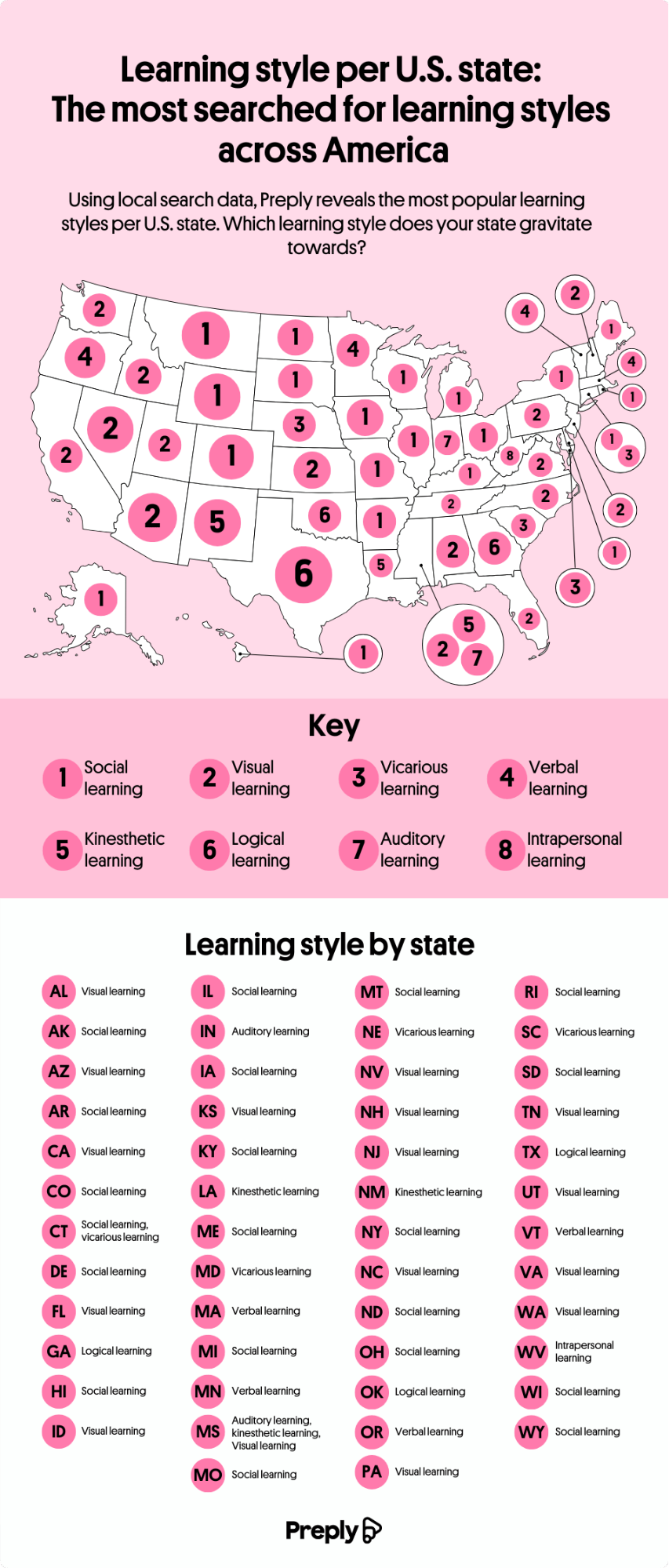
The study’s standout finding is that 40% of Americans are social learners, making it the single most common learning style in the country. Social learners take in information through interaction and conversation. According to the map, 20 states favor the study-buddy approach, including Connecticut and New York.
Visual learning came in second place. These learners thrive on aids like flowcharts, maps, doodles, and color-coded notes. Preply found that visual learners are concentrated in California, Florida, and Washington. Together, social and visual learners account for more than 70% of Americans.
The Less Common Learning Styles
The remaining six styles in Preply’s study, verbal, vicarious, kinesthetic, logical, auditory, and intrapersonal, are much less prevalent, making up just 34% of preferences combined. Verbal and vicarious learning tie as the third most popular style, but together account for only about 8%. The map reveals some notable patterns. While the West skews heavily toward visual learners, the eastern half of the country shows more variance. Massachusetts and Vermont residents lean toward verbal learning, while Connecticut and New Yorkers favor social learning.
A few individual states stand out as outliers. Auditory learning, which is learning through hearing information, leads in only two states: Mississippi and Indiana. West Virginia is the only state in the country that favors intrapersonal, solitary learning. This is the least preferred learning style nationwide.
What We Can Learn from These Findings
Preply began their study with a seed list of widely recognized learning styles drawn from educational resources, then measured popularity using Google Trends data from 12 months across 50 states. Where multiple styles ranked equally in a state, the team treated them as equally popular. The point Preply drew from this data is the recognition that how you learn is a useful step toward more effective studying, particularly in a country where study time is short and distractions are plentiful.
What emerges from the team’s map is a portrait of a country that isn’t uniform. No single learning style dominates everywhere, and neighboring states can be quite different from one another. This study serves as a reminder that study habits are shaped by geography, culture, and personal preference. The Preply study is another in a long line of ideas about how people learn, drawing on theories from Aristotle to Howard Gardner, to Neil Fleming.
-
 Business Visualizations2 years ago
Everything Owned by Apple
-
 Business Visualizations2 years ago
America’s Most Valuable Companies Ranked by Profit per Employee
-
 Business Visualizations2 years ago
The Biggest Fortune 500 Company in Every State
-
 Business Visualizations1 year ago
The Biggest Employers by Industry
-
 Charts2 years ago
Map Uncovers Countries with Most Powerful Passports
-
 Business Visualizations11 months ago
The Largest Companies in America That Are Still Run by the Person Who Founded Them
-
 Timelines2 years ago
Timeline Charts the Development of Communications Technology
-
 Timelines2 years ago
The Evolution of Baby Names: A Century of Trends