
Charts
These States Have the Cleanest Homes in the U.S.

The Oxi Fresh team has revealed the state of home cleanliness across the United States with a map ranking states by their score on the custom-made Oxi Fresh Home Cleanliness Index. Cleanliness can vary by cultural definitions and factors like busy lives can make our homes less clean than we would like. Studies have found that Americans spend about eight hours a month cleaning their homes. The team offers us a more in-depth look at the state of American cleanliness in their maps.
Click below to zoom.
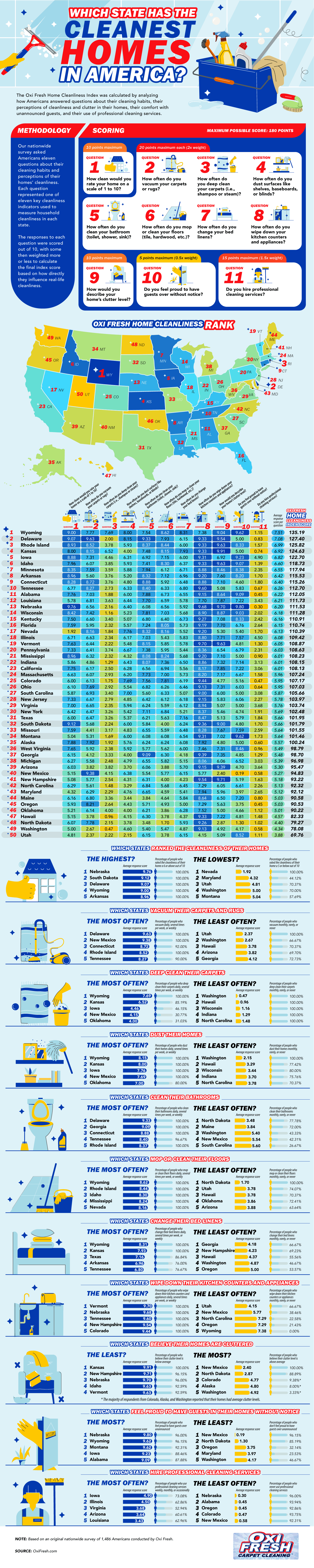
The team formed the Home Cleanliness Index based on responses to survey questions. Five questions assessed how often residents perform specific cleaning tasks, like vacuuming, dusting, cleaning bathrooms, and changing bed sheets. They were also asked to rate their home’s cleanliness, the amount of clutter in their home, and how comfortable they would be with unexpected guests seeing their home in its current state. Lastly, the team asked whether residents in these states use a professional cleaning service.
These 10 states had the highest scores on the index:
- Wyoming
- Delaware
- Rhode Island
- Kansas
- Iowa
- Idaho
- Minnesota
- Arkansas
- Connecticut
- Tennessee
Wyoming residents are the cleanest, and they know it! 96% of them would be proud to have unexpected guests over who see the state of their home as it is. Wyoming homeowners deep-clean their carpets the most, mop the most, and change their bed linens the most often. It seems Wyoming homemakers prioritize cleaning and take great pride in their homes.
On the other side of the coin, these were the states with the lowest scores:
- New Hampshire
- North Carolina
- Maryland
- Maine
- Oregon
- Oklahoma
- Hawaii
- North Dakota
- Washington
- Utah
Utah had the lowest score overall at 69.76 out of 180 points. Utah residents reported the lowest scores for home cleanliness, but their data lends some credence to this. They dust, vacuum, and mop the least frequently. Utah may struggle with cleanliness due to its poor air quality. It has some of the worst air quality in the United States, with dust drifting in from the Great Salt Lake playa, as well as high emissions from gasoline vehicles and wood-burning stoves. Utah residents may feel they’re fighting a losing battle against dust, dirt, and grime and have lowered their standards.
There are many fun and interesting facts to glean from the team’s data. Delaware residents vacuum and mop the most, while Vermont residents maintain the cleanest kitchens with the highest number of kitchen counter wipe-downs. People in Iowa are the most likely to hire a professional cleaner. Arizona residents mop the least, maybe because the dry environment keeps out mud. Georgia and Arizona residents vacuum their carpets the least, but perhaps carpets and rugs aren’t as popular in these warm states. The data gathered here provide numerous opportunities to reflect on how various state factors may influence cleaning standards and norms.

Translation apps promise to dissolve language barriers with a tap, turning your phone into a pocket interpreter. A new study from Preply suggests that convenience comes at a cost. After surveying 1,200 Americans who have used these tools while traveling abroad, Preply found that 57% considered the apps robotic and unnatural, leaving travelers feeling that something essential was missing from their interactions with locals.
Click below to zoom.
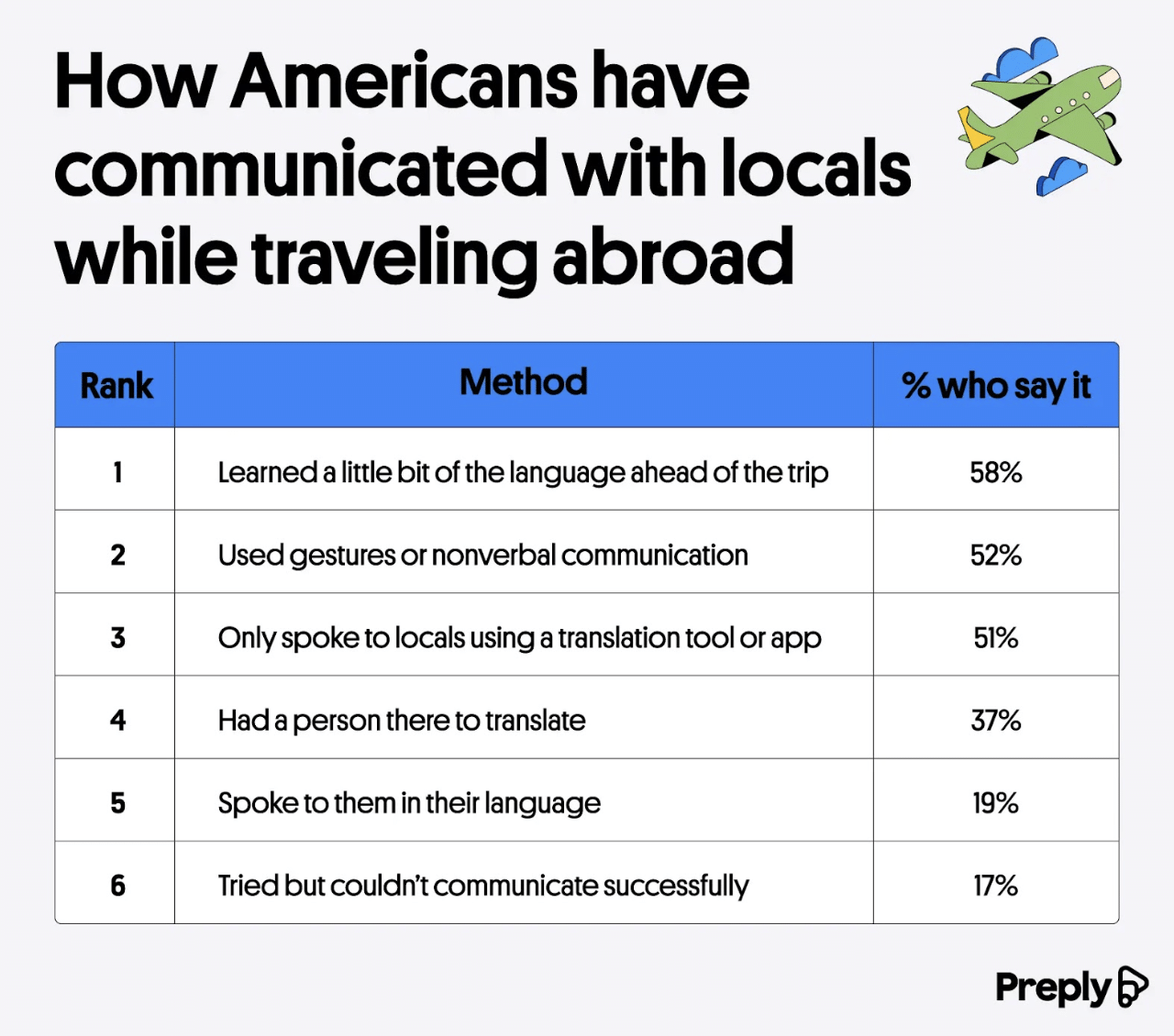 The study’s first graph breaks down how Americans usually communicate when they travel, and the most popular solution is low-tech. Nearly three in five respondents said they learned some of the local language before their trip so they could use it themselves. Gestures and pointing, along with facial expressions, were also popular when asking for food or directions. Half of respondents used a translation app or tool, while two in five used in-person translators. Almost one in five could speak the local language, either from prior knowledge or from efforts to study before the trip. 17% said they still struggled to communicate despite their best efforts.
Click below to zoom.
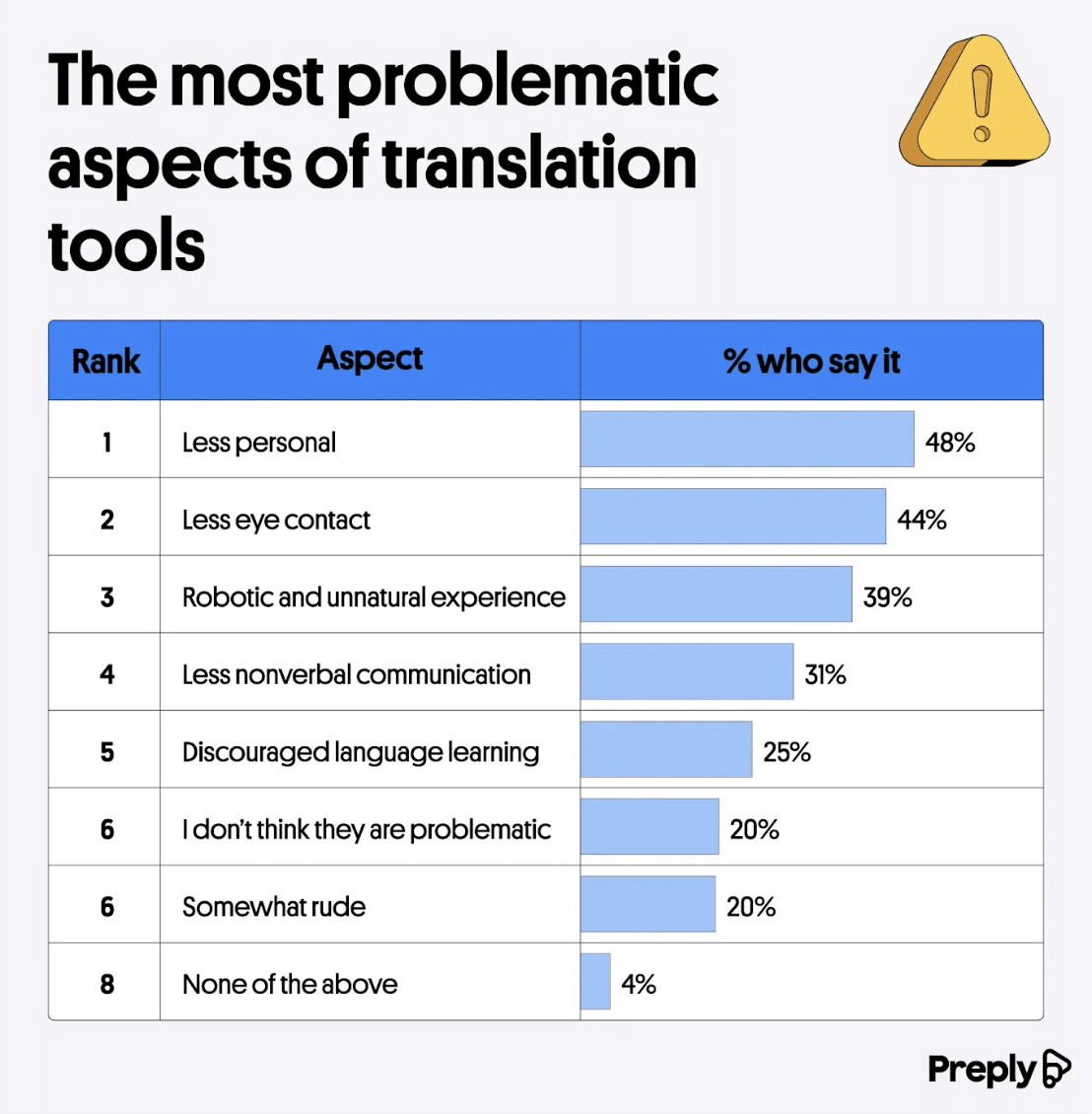 The second visual shows what travelers don’t like about translation apps. Most complaints center around human connection. Nearly half of travelers said technology made interactions less personal, and more than two in five were bothered by the lack of eye contact because the user must watch the screen. Body language and eye contact help people build rapport, but a device in the middle can disrupt this connection. One in five travelers described real-time technology as somewhat rude. A third of respondents reported an awkward moment while using the tool, and nearly one in three said the app made their trip feel less immersive.
The tools might also undercut long-term learning. More than a third of travelers felt translation technology discouraged them from learning more of the language, and 52% were frustrated that an app can’t communicate tone or cultural nuance.
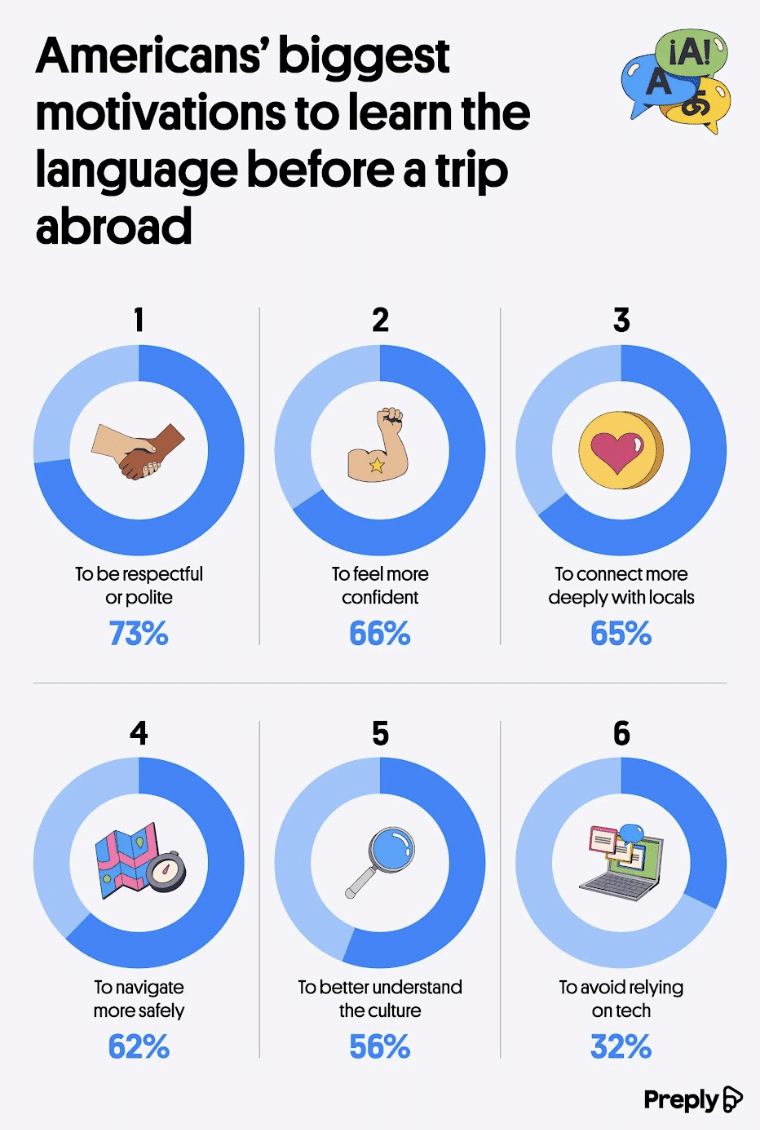
The final visual aid examines what motivates travelers to study a language before setting out on a trip. Half of Americans who traveled abroad took some kind of language class beforehand. The top reason chosen by 73% of respondents was a desire to be polite and respectful. Two-thirds wanted to feel more confident when traveling, and 65% hoped to connect more deeply with locals. Looking ahead, 65% of Americans said they want to learn more of the local language before a future trip.
That doesn’t mean travelers are abandoning their apps. More than two-fifths expect to rely on translation tools more the next time they travel. One in six plan to use these tools less.
Preply offers us a balanced conclusion. Translation apps are a remarkable technology that works best in moderation. Knowing a handful of phrases can transform a transactional exchange into a genuine moment of connection. That connection is something no app has managed to replicate.
As new technologies transform industries and create new skills demand, this analysis from Altium ranks states by how well their workforces are positioned to meet the future and a changing economy. The article, graphs, and maps show that tech readiness doesn’t always match a high-tech reputation.
Click below to zoom.
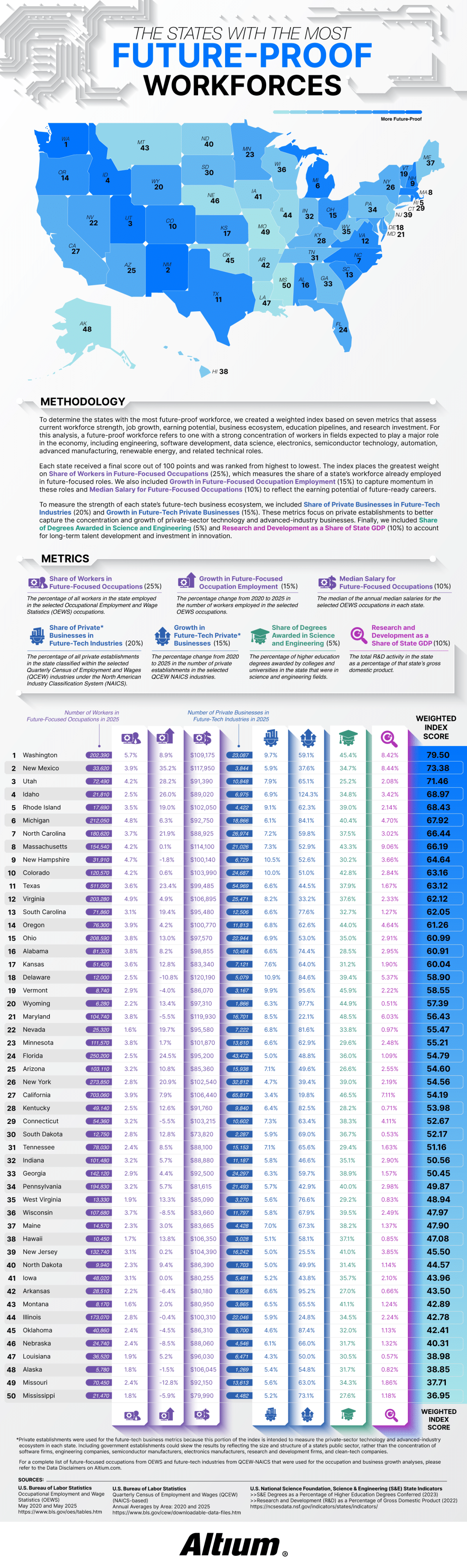
Altium defined a future-proof workforce as one with a large share of workers in fields expected to drive economic growth over the next few decades. The study tracked 30 occupations using data from the Bureau of Labor Statistics, including electrical and computer hardware engineers, software developers, data scientists, solar installers, semiconductor processing technicians, CNC programmers, and wind turbine technicians. The team considered 27 “future-tech” industries from aerospace to renewable energy to semiconductor manufacturing and R&D services.
Each state received a score out of 100 based on seven weighted metrics. The largest factor at 25% was the share of workers already employed in future-focused positions. The share of private businesses in future-tech industries was worth 20%. Employment growth and business growth from 2020 to 2025 counted for 15%. Median salary and research and development as a share of state GDP each accounted for 10%, and the share of science and engineering degrees made up the final 5%.
Washington took first place with a score of 79.50. Nearly 6% of the workforce there holds future-focused jobs and earns a median salary of $109,175. Washington’s future-tech businesses grew 59.1% over five years. The article credits the state’s concentration of software and aerospace employers, noting that Washington leads the nation in aerospace sales, exports, and employment.
The runner-up is more surprising! New Mexico ranked second, thanks to its 35.2% growth in future-focused employment. That’s the fastest growth rate in the country. Thanks to national laboratories and an expanding aerospace sector, it has one of the highest median salaries in the study at $117,950. Utah, Idaho, and Rhode Island round out the top five rankings. Idaho stood out for business expansion, with future-tech businesses growing by an eyebrow-raising 124.3%.
The study’s most confusing findings relate to California. The state employs 703,060 people in future-focused occupations, more than any other state, yet it only ranks at #27. Although California is strong in engineering education and R$D investment, future-tech industries make up only 3.4% of its private businesses. Its five-year business growth rate of 19.8% is the lowest in the nation.
Smaller states benefited when technology made up a larger slice of their economies. Rhode Island’s future-tech businesses represent 9.1% of its private sector and grew 62.3%. New Hampshire ranked ninth with the highest future-tech business share in the top ten at 10.5%. Rounding out the top ten were Michigan, North Carolina, Massachusetts, and Colorado.
Mississippi finished last with a score of 36.95, followed by Missouri, Alaska, Louisiana, and Nebraska. Several of these states saw a decline in future-focused occupations. The key takeaway is that a state’s headcount or Silicon Valley reputation alone doesn’t define its readiness for the future. A growing technical workforce and a dense base of tech businesses best position a state for the future.
Around 80% of Americans believe that learning a few words of the local language matters before they travel abroad. Only 58% of those Americans actually go so far as to learn some words. That twenty-two-point gap is the basis of Preply’s report on language anxiety and travel, supplemented by visuals to support the data on this anxiety.
The report opens on this contradiction between belief and action and sharpens the data. It shows that 40% of travelers admit to cramming language lessons at the airport or on the plane. Only 25% begin practicing the language of their destination months ahead of time. 32% side-step the problem entirely by choosing destinations where English is the dominant language or prevalent enough to carry travelers through.
Two ranked charts are the center of the report and comparing their results offers eye-opening details. The first chart shows that in 2026, Italy topped the wish list of American travel destinations. Australia, Ireland, the UK, and France followed.
Click below to zoom.
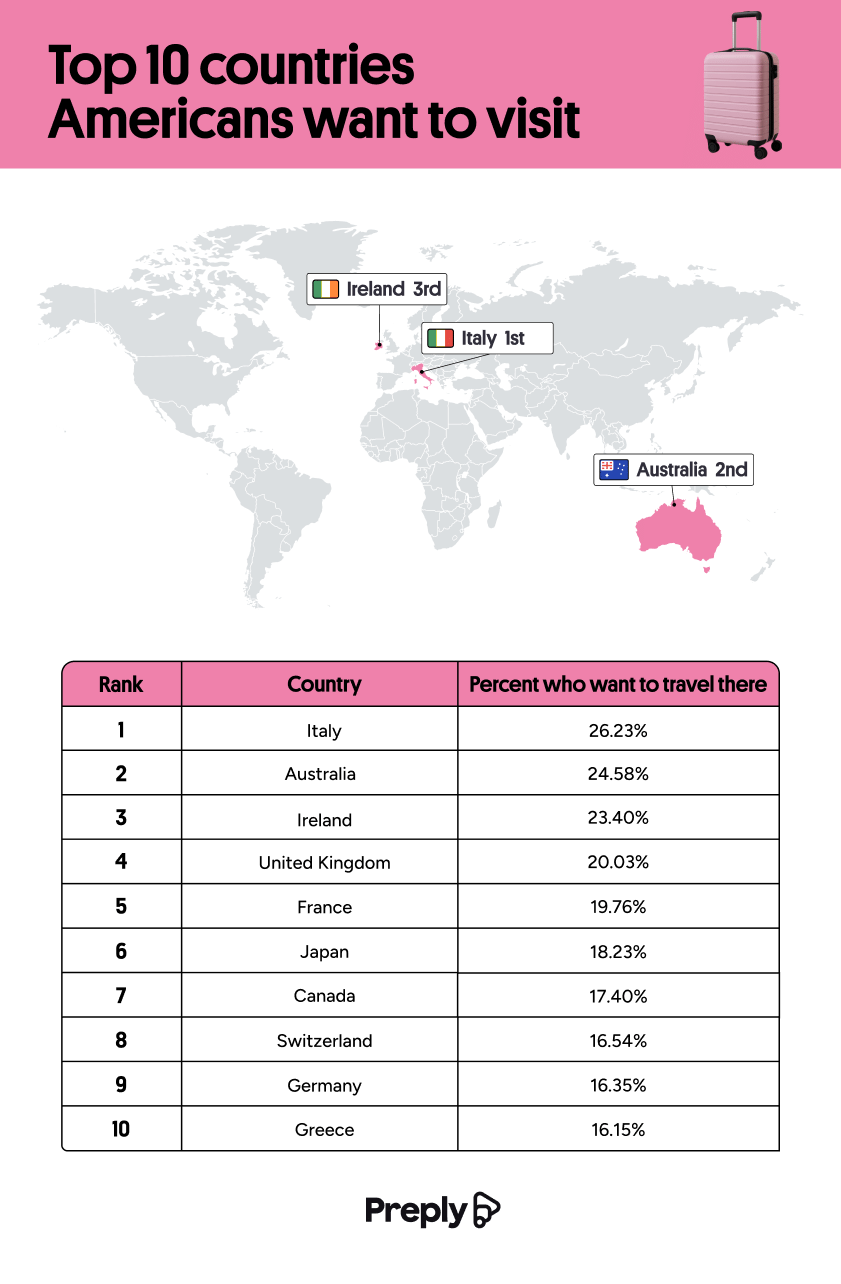 The second chart ranked where Americans would consider living. Australia and the UK tie at 20% of the answers, and Canada follows closely at 19%. Three of the top five travel destinations are largely English-speaking, and the relocation list you’ll note was entirely English-speaking.
Japan demonstrates this split dramatically. 18% of Americans would like to visit Japan, but only 10% would consider living there. Comfort clearly wins out over desire when it comes to relocation.
The demographic section shows even more interesting trends. Gen Z is nearly three times as likely as Boomers to want to visit Japan (24.4% versus 8.6%). They’re also more than twice as likely to consider living there (13.4% versus 5.3%). Ireland runs the opposite direction, with 26.2% of Boomers wishing to visit and only 9.8% of Gen Z. This is the biggest generational gap in the survey.
The pattern suggests that Boomers gravitate toward English-speaking destinations, while Gen Z showed stronger interest in places like Japan, Korea, Brazil, Colombia, and Thailand. Gender splits emerged too, with women favoring Italy, Ireland, and Greece, and men dreaming of Japan at 24% versus women’s 14%.
A horizontal bar graph ranks the barriers to visiting non-English-speaking destinations. 37% of Americans assume the native language is too difficult to learn. 35% believe English is understood well enough to get by without learning. 33% of respondents said they’re bad at learning languages, 32% cite lacking the time to learn, and 31% fear offending a native speaker by mistake. When ranking language intimidation by country, China led at 37%, Japan followed at 34%, then Korea at 24%, and Thailand at 13%.
A graphic on language faux pas showed that 35% of Americans point to menu items rather than attempting pronunciation, 23% speak louder and slower, and 17% buy American fast food for familiarity—only 15% attempt to mimic the local accent, which the Preply team gently discouraged.
The big takeaway seems to be that 45% of Americans would travel more if they spoke another language.
-
 Business Visualizations2 years ago
America’s Most Valuable Companies Ranked by Profit per Employee
-
 Business Visualizations2 years ago
The Biggest Fortune 500 Company in Every State
-
 Business Visualizations1 year ago
The Biggest Employers by Industry
-
 Charts2 years ago
Map Uncovers Countries with Most Powerful Passports
-
 Business Visualizations1 year ago
The Largest Companies in America That Are Still Run by the Person Who Founded Them
-
 Charts2 years ago
Study Highlights Disparity Between Homelessness Rates and Empty Housing
-
 Misc Visuals2 years ago
Exploring Science Fiction Technology That Became a Reality
-
 Charts1 year ago
New Study Reveals Details About American Intimacy