
Charts
Ranking the Best U.S. Cities for Pet-Friendly Vacations

Many Americans are devoted to their pets and consider their furry friends a part of the family. That means they want to include them in travel plans and vacations. A pet sitter or pet boarding can be pricey, plus pet parents will miss their pet companions while they’re away. The team at FloridaRentals.com created a valuable map for traveling pet owners, ranking U.S. cities by pet friendliness.
Click below to zoom.
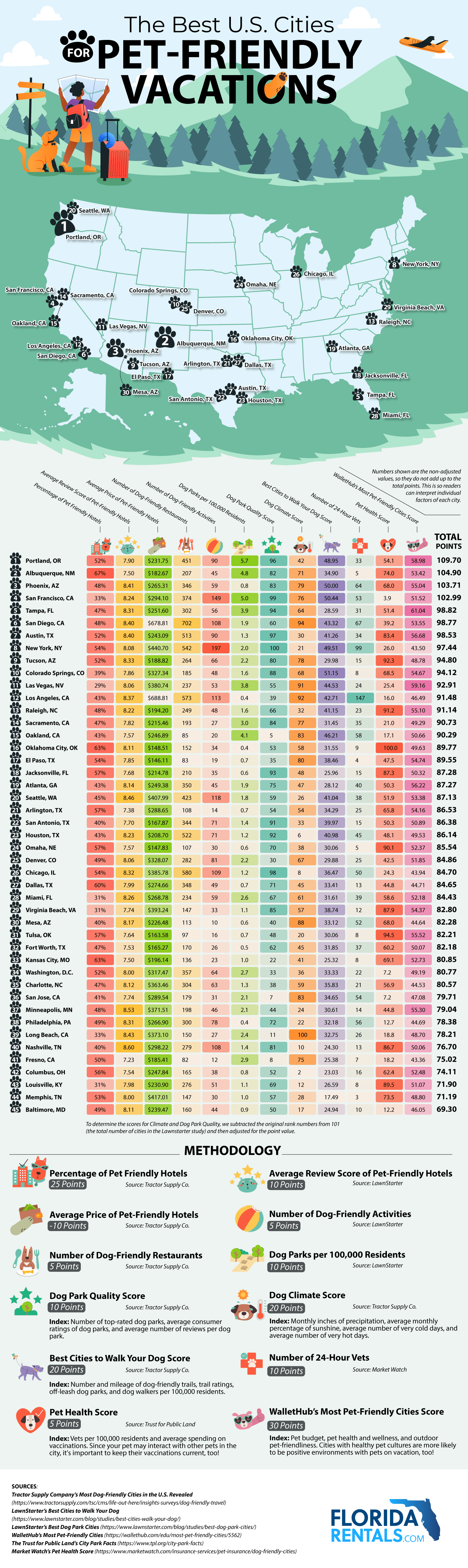
The team considered several crucial factors when creating the ranking’s scoring system. Here are the factors considered:
- Percentage of pet-friendly hotels
- Average price of pet-friendly hotels
- Number of dog-friendly restaurants
- Dog park quality score
- Best cities to walk your dog score
- Pet health score
- Average review score of pet-friendly hotels
- Number of dog-friendly activities
- Dog parks per 100,000 residents
- Dog climate score
- Number of 24-hour vets
- WalletHub’s most pet-friendly cities score
All of these factors combine to help pet owners decide whether a city offers what they need. Many pet owners feel that the number, quality, and cost of pet-friendly hotels and restaurants are the most important factors. In contrast, others want to know they can have fun with their dog while vacationing with decent weather and plenty of walking trails and parks to explore. Others might put safety first and consider the presence of plenty of vet clinics to be most important.
After all scores were considered, a handful of cities rose above the others with the highest scores in the nation. Here are the ten cities with the highest scores:
- Portland, Oregon
- Albuquerque, New Mexico
- Phoenix, Arizona
- San Francisco, California
- Tampa, Florida
- San Diego, California
- Austin, Texas
- New York, New York
- Tucson, Arizona
- Colorado Springs, Colorado
Portland earned the top spot with high scores in nearly every category. The city has an abundance of beautiful parks and walking trails, paired with a strong pet-friendly culture. Albuquerque and Phoenix earned their high ranking thanks to plenty of affordable pet-friendly hotels and restaurants, paired with ample outdoor space. San Francisco, Tampa, and San Diego are great destinations for travelers seeking warm weather, walkable cities, and plenty of restaurants that welcome pets. In fact, many cities in Florida scored well, likely due to the warm climate and tourist-heavy culture.
We can see that cold-weather cities scored lower, like Boston, Milwaukee, and Detroit. Though accommodation prices are higher there and there may be fewer dog parks, there are still plenty of dog-friendly activities to enjoy in these bustling cities, especially if you don’t mind the cold.
Overall, this map shows that pet-friendly travel is not only possible but also a lot of fun, with many options for destinations. A great pet-friendly stay will combine affordability with comfort, safety, and fun for both you and your furry friend. As pet travel booms, these cities might even expand the accommodation they already offer.

Compatibility is usually our biggest driver in the search for a romantic partner, but it turns out that age is still a major part of that compatibility. Tawkify’s matchmaking service surveyed about 98,798 Americans over two years, asking whether they’d date someone older and younger and how far outside their own age range they’d go. The data reveal both geographic and dating patterns, with a recurring pattern: smaller dating pools push singles to date across wider age ranges.
Click below to zoom.
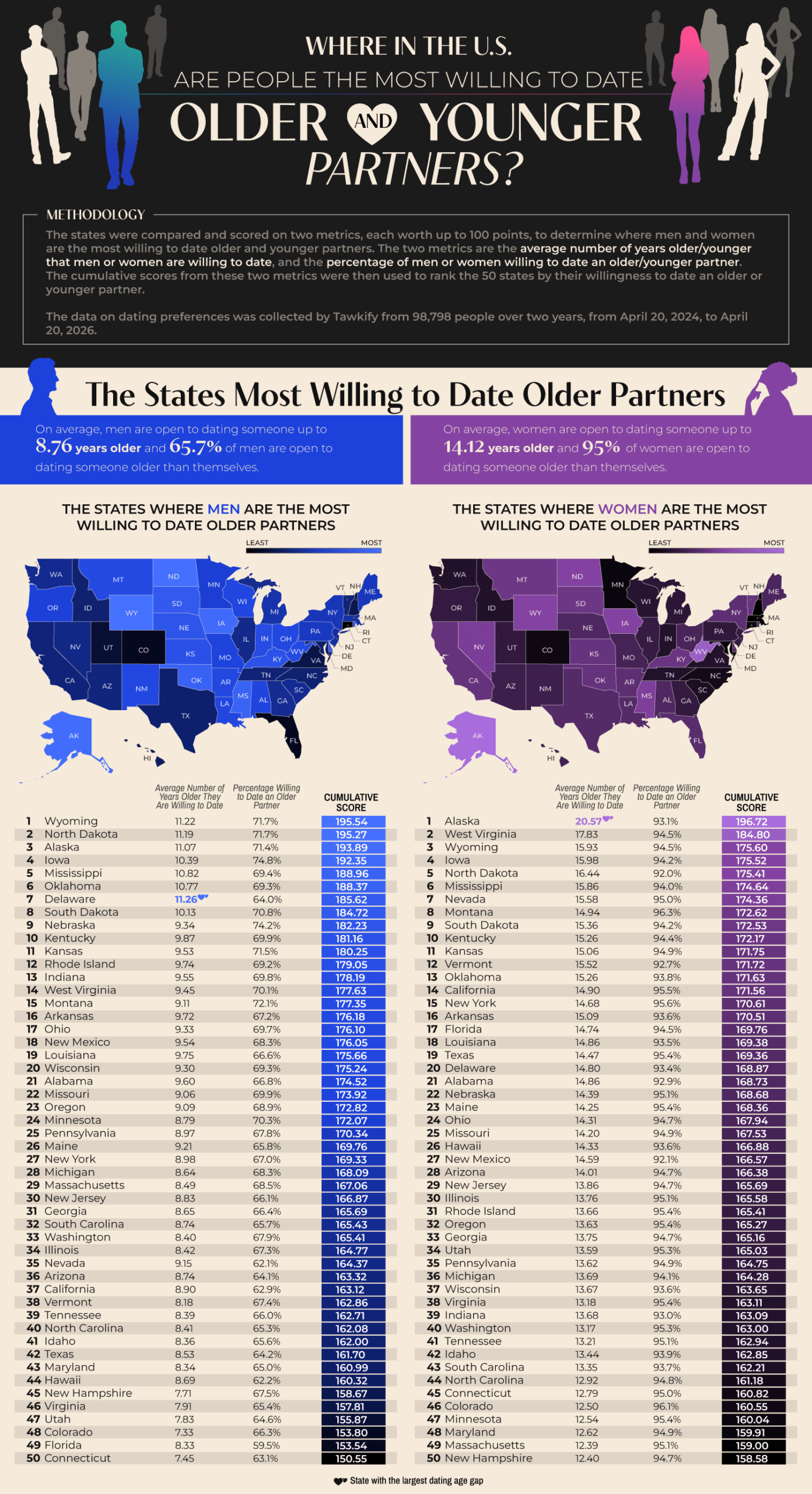
Wyoming tops the list of states with men willing to date outside their age range. 71.1% of Wyoming singles are willing to date an average of 11.22 years older than they are. North Dakota and Alaska also appeared in the top three. Delaware emerged as an interesting outlier. They have the largest average age gap in dating among men, at 11.26 years. 93.1% of Alaskan women are open to dating older partners, and they have the nation’s largest age gap by far at 20.57 years. West Virginia and Wyoming women follow in second and third. It seems that less-populated states show greater willingness to date outside their age range, which could be a very simple explanation. A smaller dating pool means singles widening their options.
As for willingness to date younger partners, Hawaii leads for both genders. 96.8% of Hawaiian men are willing to date someone younger, with 18.59 years as an acceptable age gap. This is the widest that appears in the study. 92% of Hawaiian women are open to dating younger, but their average age gap is only 9 years. Hawaii has an older-than-average population, with a median age of 41.5 years, so this limited island dating pool makes dating younger people more common. The runners-up for willingness to date younger were Nevada, Idaho, and Maine.
According to the data, women are dramatically more open to dating older than men are. 95% of women would date an older partner, compared with 65.7% of men. This pattern flips with dating younger. 96.5% of men would date someone much younger, with a national average age difference of 14.7 years. 88.1% of women would date younger men, but at a much smaller average age gap of 7.14 years. This shows that across the country, men tend to date younger partners, while women tend to date older partners. Women are consistently willing to tolerate a wider gap when dating up.
The team threw us a little fun fact from the Guinness Book of World Records, which lists Gertrude and John Janeway, married in 1927, as the largest spousal age gap of 63 years. Age-gap relationships can succeed but face challenges like judgment and assumptions about power dynamics and differing life stages. Strong communication, shared values, and aligned goals matter most in relationships, more than the number of years lived. Geography and gender seem to shape who Americans date, but the data also suggest that openness to age-gap romances often comes down to opportunity.
Sometimes you confidently belt out a song and discover years later that you misheard the lyrics and sang it wrong this whole time. We’ve been there. Preply unveiled a fun, often humorous study showing the most misheard song lyrics, some of which verge on ridiculous. For example, in Manfred Mann’s “Blinded by the Light,” many people hear the lyric “revved up like deuce” as “wrapped up like a douche.” That would be an embarrassing one to unleash at karaoke. The team’s data reveals that mishearing lyrics is a predictable outcome of speed, vocabulary, and accents skewed in audio mixing.
Click below to zoom.
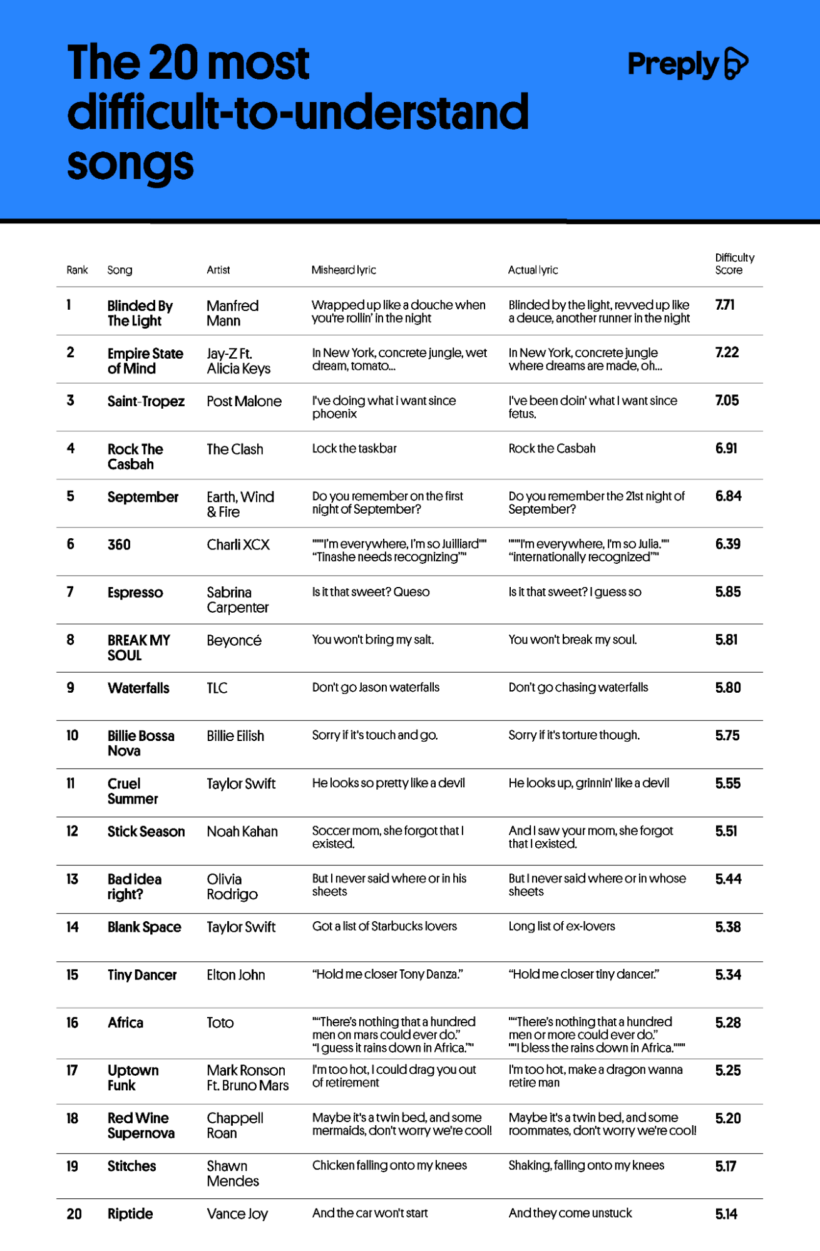 The article introduces us to an interesting word, “mondegreen.” This word was coined in 1954 to describe a misheard lyric that can completely change a song’s meaning. Preply lists the most common causes of mondegreen as tricky vocabulary, unfamiliar accents, sound-alike words, fast tempos, unclear pronunciation, and background music that obscures vocals. Language educators love to use mondegreens as teaching moments on the importance of pronunciation and clear vocabulary.
A chart lists the most commonly misheard lyrics. As we mentioned, Alfred Mann’s “Blinded by the Light” tops the list as the most difficult to understand. AI correctly transcribed only 61% of the lyrics, and the song earned a readability score of 85 despite the song’s even pace of 80 words per minute. Jay-Z and Alicia Keys’ “Empire State of Mind” was number two on the list. The lyrics move fast at 158 words per minute, and the most famous mishearing is a hilarious mistake. The true lyric is “concrete jungle where dreams are made, oh,” but listeners believe they’re hearing “concrete jungle, wet dream, tomato.” The third on the list is Post Malone’s “Saint Tropez.” AI failed to correctly transcribe 32% of the lyrics, and, believe it or not, the real lyrics “since fetus” appear in the song, but listeners, perhaps understandably, think the lyric is “since Phoenix.” You’ll see two famously misheard songs on the list that have been the subject of memes. A lyric from Sabrina Carpenter’s summer hit “Espresso” has an “I guess so” that listeners thought was “queso.” Taylor Swift is often misheard, too, as we can see on the chart. Everyone loves to bring up the “Starbucks lovers” from “Blank Space.” (She’s saying, “long list of ex-lovers.”)
The team’s data also revealed that Lady Gaga is one of the most difficult artists to understand. She had 306 misheard lyric submissions. She tends to use unconventional pronunciation in the song “Poker Face,” which alone ranks 81st in misheard lyric reports. Taylor Swift had 300 submissions across her extensive catalog, and Kelly Clarkson rounds up the top three most misheard artists list, with “Since U Been Gone” and “Because of You” having the most misheard lyric reports.
In general, the Preply team found that strong regional accents and faster genres like rap make individual words harder to understand. Mishearing lyrics is a normal function of our brain, filling in gaps in our understanding.
AI is embedded in workplaces worldwide by this point, and yet workers’ feelings about it vary dramatically. A study by Qualtrics examined how geography was related to feelings about AI in the workplace. They found that only 37% of workers globally believed that AI would improve their jobs. That average hides a 45-point difference between the most optimistic country, which is China, and the most skeptical, Japan.
Click here to zoom.
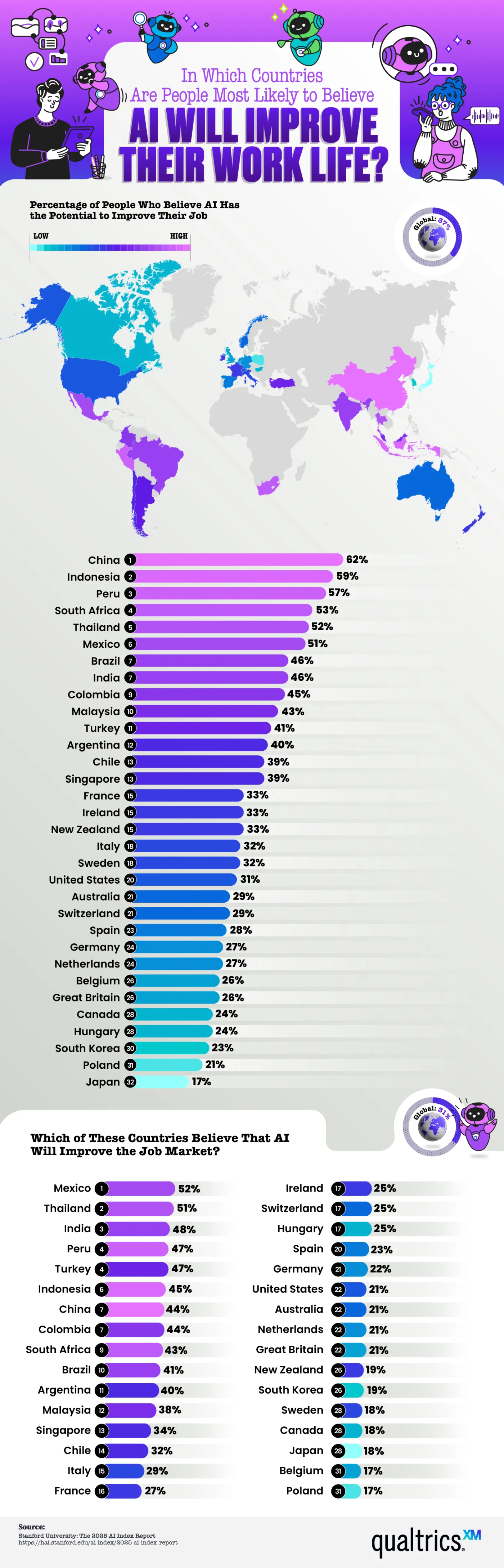
Nearly 80% of global companies report using AI in some capacity, and research indicates productivity gains, with lower-skilled workers benefiting the most. Even if this is the case, employee sentiment isn’t nearly as unified. The numbers the team shows here indicate a healthy level of AI skepticism. In fact, more than half of workers think AI will improve their lives in just 6 out of 32 countries studied. That means there are more skeptics than people excited about what AI will bring to the workplace. But why does optimism cluster in some regions while most remain skeptical?
Here are a few of the countries where optimism runs high:
- China – 62% of workers are optimistic
- Indonesia – 59%
- Peru – 57%
- South Africa – 53%
- Thailand – 52%
There is a mid-tier region with fewer optimistic workers, but still a healthy percentage. This includes Mexico, Brazil, India, Colombia, and Malaysia. Many of these countries have developing economies or a heavy state investment in AI infrastructure, as is the case in China. Workers in these places view AI as a tool to close skill gaps, raise wages, and improve living standards. These regional differences are easy to spot thanks to the map Qualtrics created, which color codes the level of optimism/skepticism.
At the other end of the spectrum, we find the highest number of skeptics in Western Europe and English-speaking countries. Here are the countries with the least faith in AI:
- United States – 31% of workers are optimistic
- Australia – 29%
- Great Britain – 26%
- Canada – 24%
- Japan – 17%
- Poland – 21%
The media narratives in these countries frame AI as a risk of automation-driven job loss, which shapes people’s perceptions even when AI adoption in their workplaces is the same as in optimistic locations. These nations are the same that rank lowest on the belief that AI will improve the job market.
Economic research suggests that AI tends to reshuffle tasks within a role rather than eliminate that job outright. New skills will be required to work with AI, and some positions will shift, but historically, new digital tools have created more roles than they’ve erased. The gap between the hard data and public sentiment in skeptical countries is definitely worth examining and tells a story.
As AI rolls out unevenly across the world’s workforce, it’s important for employers to understand where their employees actually stand on the issue. Beyond regional stereotypes or headline-driven assumptions, employers must look at facts like the data presented here to make thoughtful AI adoption decisions.
-

 Business Visualizations2 years ago
Everything Owned by Apple
-

 Business Visualizations2 years ago
America’s Most Valuable Companies Ranked by Profit per Employee
-
 Business Visualizations1 year ago
The Biggest Fortune 500 Company in Every State
-

 Business Visualizations1 year ago
The Biggest Employers by Industry
-
 Timelines2 years ago
Timeline Charts the Development of Communications Technology
-
 Business Visualizations8 months ago
The Largest Companies in America That Are Still Run by the Person Who Founded Them
-
 Charts2 years ago
Map Uncovers Countries with Most Powerful Passports
-
 Maps2 years ago
A Map to Gold and Silver