
Business Visualizations
America’s Most Valuable Companies Ranked by Profit per Employee

Ever wonder how much money major corporations make per employee? Profit Per Employee (PPE) is determined by dividing the company’s profit by the company’s quantity of full-time employees. The most profitable companies may not necessarily be the most profitable by number of employees—and vice versa. Whenever the economy is uncertain, this formula is usually one of the metrics companies will monitor to determine the efficiency and productivity of their staff. Using data over profit and company size from 2023, our team at The Chartistry has ranked the top 50 companies with the highest profit per worker.
Click below to zoom
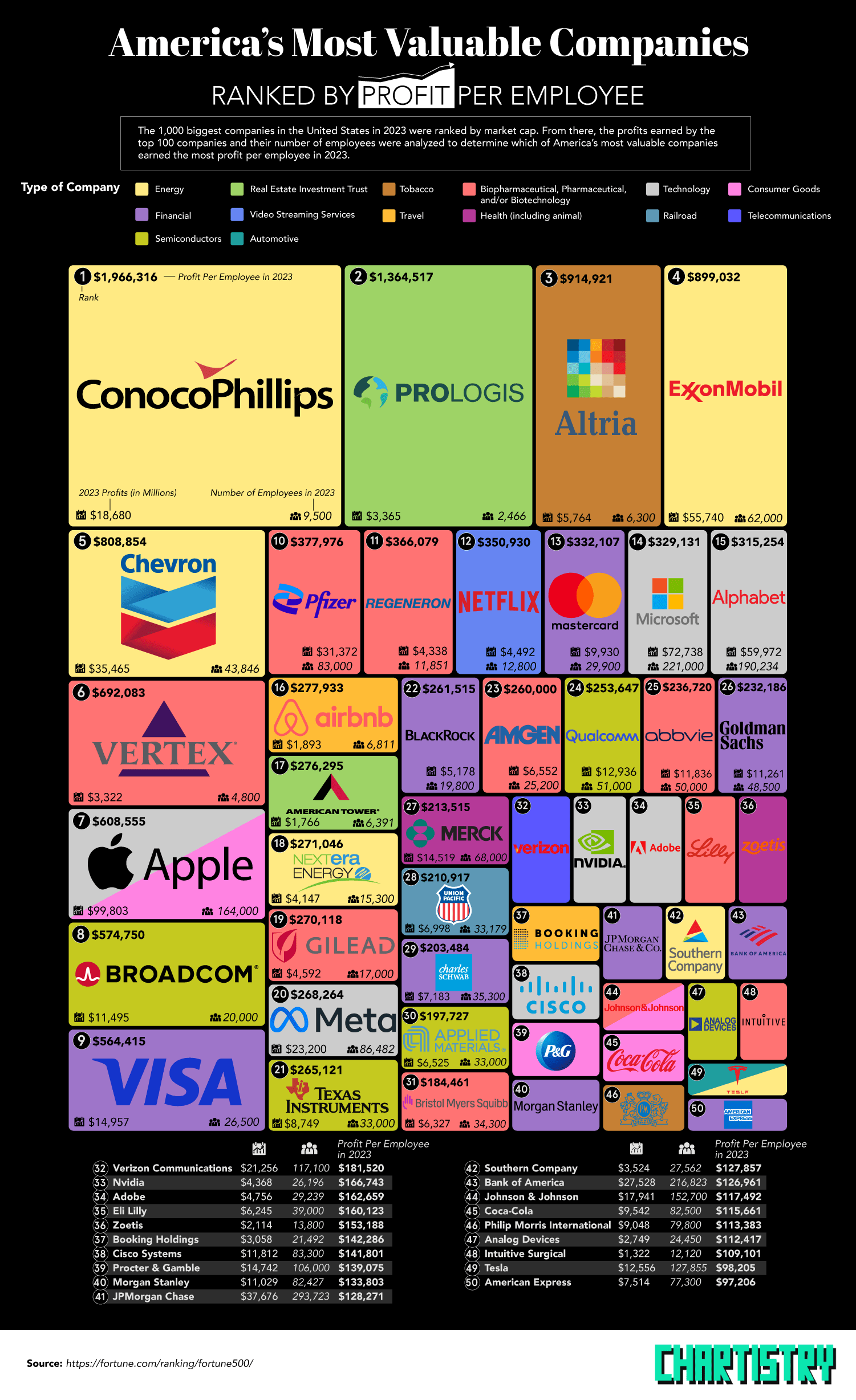
With a profit of nearly $2 million for each of their 9,500 employees, ConocoPhillips ranks first for highest profit per employee by quite the large margin. ConocoPhillips, an American oil and gas producer, saw a total profit almost $18.7 billion in 2023. Since oil and gas are two of the most valuable energy commodities in the world, it is not uncommon for an energy company to rank high in terms of PPE since their net profit is typically quite expansive. Of the top 50 companies with the highest profit for every employee, six of them can be categorized under the energy sector.
Coming in second place, Prologis is an investment trust company that saw a total profit of $3.4 billion in 2023. This profit was divided by their 2,466 employees to end with a profit of $1.36 million per employee.
In third, there is the tobacco company Altria Group. Altria Group’s 2023 profit of $5.8 billion was divided by 6,300 employees to result in a profit per employee of $915 thousand. Tobacco is yet another commodity product, with only one other tobacco company making the top 50 ranking.
Exxon Mobil is another oil and gas company with high profit per employee, coming in fourth place. Out of their profit of $55.7 million in 2023, their 62,000 employees averaged a profit of $899 thousand each.
Rounding out the top 5 companies is Chevron, the third oil and gas energy company in the top companies by profit per employee. With a total profit of $35.3 million, their PPE comes out to $809 thousand for each of their 43,846 employees.
Some companies land rank in both the most profitable in the world overall as well as in profit per worker. Apple, for example, brought in a 2023 profit of nearly a $100 billion. The company itself is valued at a total of $2.1 trillion. They managed a PPE of $609 thousand for their 164,000 employees, making them seventh among all companies.
Why is Profit per Employee Important?
For every company with an impressive profit per employee, there are tens, hundreds, even thousands of people working at the front line and behind the scenes to keep operations running as smoothly and efficiently as possible. PPE, not to be confused with Revenue per Employee, is a way for the company to measure the performance and productivity of the average employee in any given workforce to judge their added value. In other words, a way to know if their investment in hiring, retaining, and training their employees returned desirable results. Of course, it isn’t and shouldn’t be the only method to judge the value of an employee. When used in combination with other metrics, however, it can be a helpful tool to see the what employees have brought to the company.
For the majority of situations, a healthy profit per employee will be a good indicator of the health of the company at large. It shows that the business is properly maximizing the streamlining of their operations and utilizing the talent of each employee. This performance can mean that an underwhelming PPE may lead to cost-cutting measures for the company. Oftentimes, this is in the form of employee layoffs in areas that may not be contributing to the overall profit.
Did You Enjoy this Original Visualization by The Chartistry?
If you enjoyed this visualization and analysis by The Chartistry, check out the other original visualizations we’ve created. For even more great content, check out our collection of curated business and finance visualizations. If you love this visual content so much that you want your own, let us know; We design custom visual content for customers too!
The Profit per Employee of the Largest Companies in the U.S. By Market Cap (The Full List)
Which corporations have the highest revenue per employee? Companies that are able to do more with less:
| Rank | Name | Type of Company | 2023 Profits (in Millions) | Number of Employees in 2023 | Profit per Employee in 2023 |
| 1 | ConocoPhillips | Energy | $18,680 | 9,500 | $1,966,316 |
| 2 | Prologis | Real Estate Investment Trust | $3,364.9 | 2,466 | $1,364,517 |
| 3 | Altria Group | Tobacco | $5,764 | 6,300 | $914,921 |
| 4 | Exxon Mobil | Energy | $55,740 | 62,000 | $899,032 |
| 5 | Chevron | Energy | $35,465 | 43,846 | $808,854 |
| 6 | Vertex Pharmaceuticals | Biopharmaceutical, Pharmaceutical, and/or Biotechnology | $3,322 | 4,800 | $692,083 |
| 7 | Apple | Technology, Consumer Goods | $99,803 | 164,000 | $608,555 |
| 8 | Broadcom | Semiconductor | $11,495 | 20,000 | $574,750 |
| 9 | Visa | Financial | $14,957 | 26,500 | $564,415 |
| 10 | Pfizer | Biopharmaceutical, Pharmaceutical, and/or Biotechnology | $31,372 | 83,000 | $377,976 |
| 11 | Regeneron | Biopharmaceutical, Pharmaceutical, and/or Biotechnology | $4,338.4 | 11,851 | $366,079 |
| 12 | Netflix | Video Streaming Services | $4,491.9 | 12,800 | $350,930 |
| 13 | Mastercard | Financial | $9,930 | 29,900 | $332,107 |
| 14 | Microsoft | Technology | $72,738 | 221,000 | $329,131 |
| 15 | Alphabet | Technology | $59,972 | 190,234 | $315,254 |
| 16 | Airbnb | Travel | $1,893 | 6,811 | $277,933 |
| 17 | American Tower | Real Estate Investment Trust | $1,765.8 | 6,391 | $276,295 |
| 18 | NextEra Energy | Energy | $4,147 | 15,300 | $271,046 |
| 19 | Gilead Sciences | Biopharmaceutical, Pharmaceutical, and/or Biotechnology | $4,592 | 17,000 | $270,118 |
| 20 | Meta Platforms | Technology | $23,200 | 86,482 | $268,264 |
| 21 | Texas Instruments | Semiconductor | $8,749 | 33,000 | $265,121 |
| 22 | BlackRock | Financial | $5,178 | 19,800 | $261,515 |
| 23 | Amgen | Biopharmaceutical, Pharmaceutical, and/or Biotechnology | $6,552 | 25,200 | $260,000 |
| 24 | Qualcomm | Semiconductor | $12,936 | 51,000 | $253,647 |
| 25 | AbbVie | Biopharmaceutical, Pharmaceutical, and/or Biotechnology | $11,836 | 50,000 | $236,720 |
| 26 | Goldman Sachs Group | Financial | $11,261 | 48,500 | $232,186 |
| 27 | Merck | Health (Including Animals) | $14,519 | 68,000 | $213,515 |
| 28 | Union Pacific | Railroad | $6,998 | 33,179 | $210,917 |
| 29 | Charles Schwab | Financial | $7,183 | 35,300 | $203,484 |
| 30 | Applied Materials | Semiconductor | $6,525 | 33,000 | $197,727 |
| 31 | Bristol-Myers Squibb | Biopharmaceutical, Pharmaceutical, and/or Biotechnology | $6,327 | 34,300 | $184,461 |
| 32 | Verizon Communications | Telecommunications | $21,256 | 117,100 | $181,520 |
| 33 | Nvidia | Technology | $4,368 | 26,196 | $166,743 |
| 34 | Adobe | Technology | $4,756 | 29,239 | $162,659 |
| 35 | Eli Lilly | Biopharmaceutical, Pharmaceutical, and/or Biotechnology | $6,244.8 | 39,000 | $160,123 |
| 36 | Zoetis | Health (Including Animals) | $2,114 | 13,800 | $153,188 |
| 37 | Booking Holdings | Travel | $3,058 | 21,492 | $142,286 |
| 38 | Cisco Systems | Technology | $11,812 | 83,300 | $141,801 |
| 39 | Procter & Gamble | Consumer goods | $14,742 | 106,000 | $139,075 |
| 40 | Morgan Stanley | Financial | $11,029 | 82,427 | $133,803 |
| 41 | JPMorgan Chase | Financial | $37,676 | 293,723 | $128,271 |
| 42 | Southern Company | Energy | $3,524 | 27,562 | $127,857 |
| 43 | Bank of America | Financial | $27,528 | 216,823 | $126,961 |
| 44 | Johnson & Johnson | Biopharmaceutical, Pharmaceutical, and/or Biotechnology | $17,941 | 152,700 | $117,492 |
| 45 | Coca-Cola | Consumer Goods | $9,542 | 82,500 | $115,661 |
| 46 | Philip Morris International | Tobacco | $9,048 | 79,800 | $113,383 |
| 47 | Analog Devices | Semiconductor | $2,748.6 | 24,450 | $112,417 |
| 48 | Intuitive Surgical | Biopharmaceutical, Pharmaceutical, and/or Biotechnology | $1,322.3 | 12,120 | $109,101 |
| 49 | Tesla | Automotive, Energy | $12,556 | 127,855 | $98,205 |
| 50 | American Express | Financial | $7,514 | 77,300 | $97,206 |







Logos are among the most dramatic and important aspects of marketing, shaping how consumers view a brand in ways that aren’t always visible. Logo designs are based on psychology, which informs us how shapes and colors make us feel, and how they can shape a brand’s trustworthiness and credibility. If a brand changes its logo, it must be done with care and intention, and with a clear reason to justify the switch. The team at LogoMaker displays the most effective logo switches and rebrands in a graphic based on increased web traffic.
Click below to zoom.
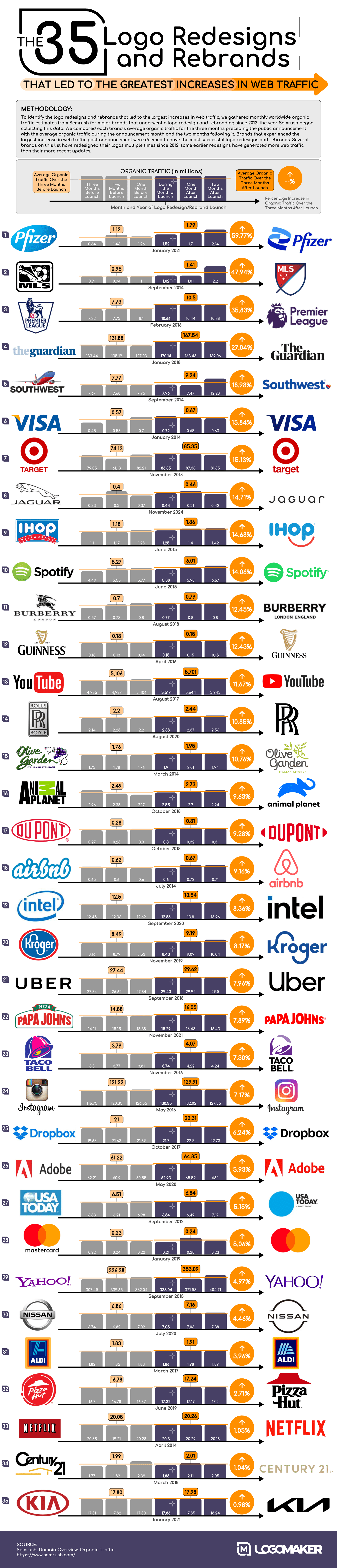
The team chose web traffic as an indicator of a successful logo because in the world of marketing, clicks and traffic are closely linked with sales and brand awareness. It’s a quantifiable way to measure customer behavior. The team used SEMrush traffic data to estimate traffic changes in the three months leading up to their rebrand announcement, compared with the two months after the launch. Their graph isolates traffic rates to the time of the rebrand to get the most accurate depiction of the effects. The team also helpfully included the old and new logos so readers can form their own opinions about changes.
According to the team’s results, these were the brands with the biggest traffic increases after their new logo launched:
- Pfizer
- MLB
- Premier League
- The Guardian
- Southwest
- VISA
- Target
- Jaguar
- IHOP
- Spotify
We see a wide range of industries represented in these results. Pfizer takes the lead after redesigning its logo from a pill shape to a double helix. This is also a good example of other factors, in addition to the rebrand, causing the traffic spikes. The rebrand occurred in 2021, the height of the COVID-19 pandemic, when the world was hoping for a company like Pfizer to develop an effective vaccine.
After Pfizer, we see a few sports leagues on the chart. Major League Soccer, or MLS, is in second place, followed by the UK’s Premier League in third. Both of them dramatically simplified their logos, making them clearer and possibly more memorable, as the increased traffic indicates. In fact, many of the companies on the list seem to have opted for simpler logo designs. This is quite possibly so the logos are more visible when they’re small, like on a phone screen. This could also reflect a changing aesthetic, shifting from the more stylized and classical designs of the 90s and 00s to today’s more bold, minimalist style.
The trend toward minimalist logo redesign reflects evolving consumer preferences and the demands of digital media. Companies across diverse industries, from pharmaceuticals to sports and retail, are embracing simpler, more impactful designs that enhance brand recognition and visibility in an increasingly mobile world. These changes not only boost traffic but also demonstrate how branding adapts to cultural shifts and technological advancements, helping organizations stay relevant and competitive in today’s fast-paced landscape.

Job searching is stressful and the current employment market isn’t the strongest. The Bureau of Labor Statistics (BLS) says that the average job search lasts 23.3 weeks. That’s a long haul. The World Economic Forum does see the market becoming more dynamic soon with new and emerging job opportunities. Qualtrics added to this top with a new map showing where we’ll find the most active job seekers in the U.S. They drew on data from the BLS’s American Time Use Survey.
Click below to zoom.
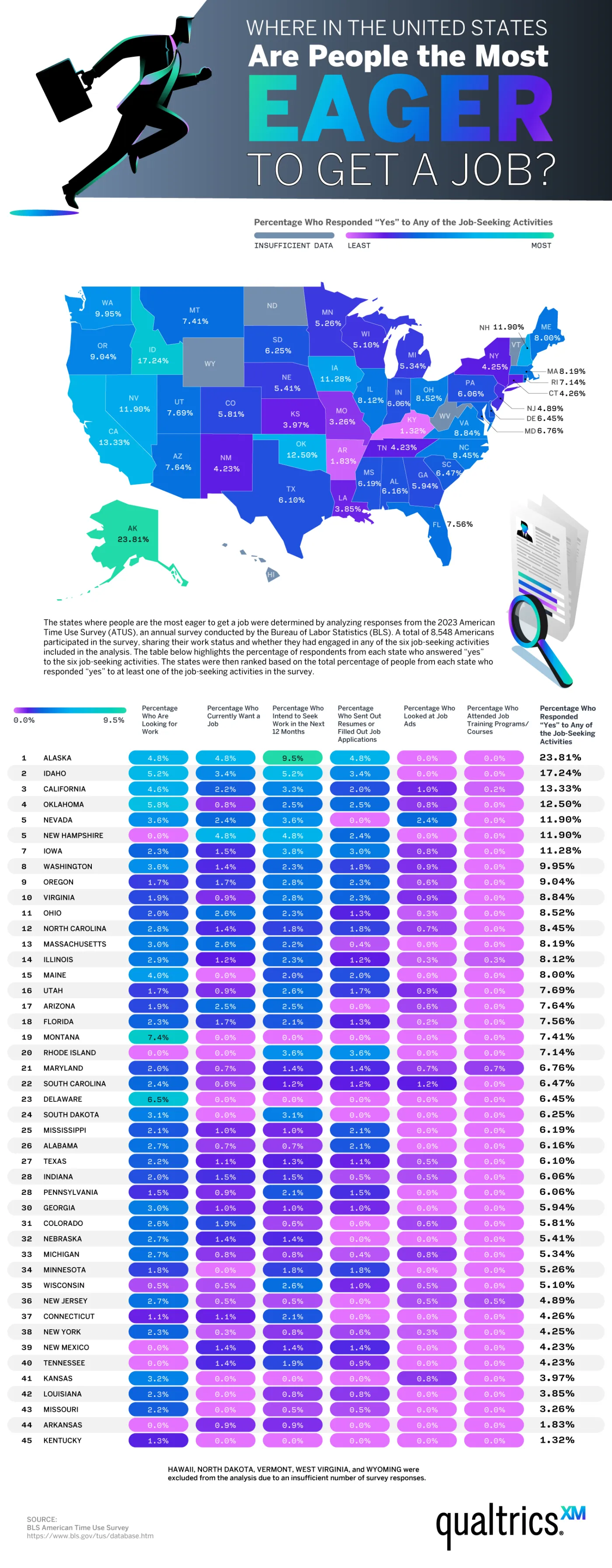
The team’s main visual for their data is a color-coded map of the 50 states, ranked by the percentage of residents who reported engaging in job-seeking activities. These could include looking for work, wanting a job, submitting applications, intending to seek work soon, looking at job ads, or attending job training. Five states had to be excluded from the ranking because of insufficient survey data. This included Hawaii, Vermont, North Dakota, West Virginia, and Wyoming.
These states were found to have the most people wanting new jobs:
- Alaska — 23.81% (standout leader)
- Idaho — 17.24%
- California — 13.33%
- Oklahoma — 12.5%
- Nevada & New Hampshire — tied at 11.9%
- Iowa — 11.28%
- Washington — 9.95%
- Oregon — 9.04%
- Virginia — 8.84%
This list shows Western and Pacific states dominating the top. Alaska as a standout leader might come as a surprise because it’s not due to a job shortage. There is actually a workforce shortage in Alaska. In 2024, Alaska created 5,400 new jobs with more expected in 2025. $20 billion in infrastructure development is expected to generate 20,000 more jobs by 2030. So, Alaska’s high job-seeking activity reflects a growing, dynamic economy with ample room for pivots and career changes.
States with the lowest rankings were Kentucky (1.32%), Arkansas (1.83%), and Missouri (3.26%). These states may have lower unemployment rates, different market conditions, or demographic factors that influenced their ranking. The data make it clear that job-seeking activity varies widely by state, tied to local economic conditions, perhaps more so than national trends. Job seekers should take advantage of training programs, the federal jobs board, and role-specific job search sites. It also shows that securing talent is only one step toward building a loyal, long-term workforce. Only 42% of workers feel engaged, which is a major reason they may seek new jobs.
Beyond a snapshot of where Americans are currently looking for work, these data points to a bigger reality: labor-market “energy” is uneven, and high job-seeking activity can signal opportunity as much as instability. In states like Alaska, movement may reflect an expanding, restructuring economy in which workers feel empowered (or required) to pivot as new roles and industries emerge. For job seekers, the practical takeaway is to align search strategy with local conditions. Prioritize skills-building and credentials that travel across employers, use targeted boards and training pipelines, and treat mobility as a long-term advantage rather than a short-term disruption. Organizations and individuals that read these regional signals early and invest accordingly will be best positioned to thrive as the economy continues to evolve.
Business Visualizations
Research Uncovers the Industries with the Highest Turnover Rates in the U.S.
The Qualtrics research team examined the employee turnover rates across American industries to identify which sectors struggle the most with workforce retention and which offer the greatest stability. The team defined a turnover rate as the percentage of hires, layoffs, and quits among an industry’s workforce. Turnover rates can vary widely across industries and can indicate a range of conditions for workers, from economic instability to dangerous jobs with high injury rates. High turnover can also be very costly for the businesses within those industries.
Click below to zoom.
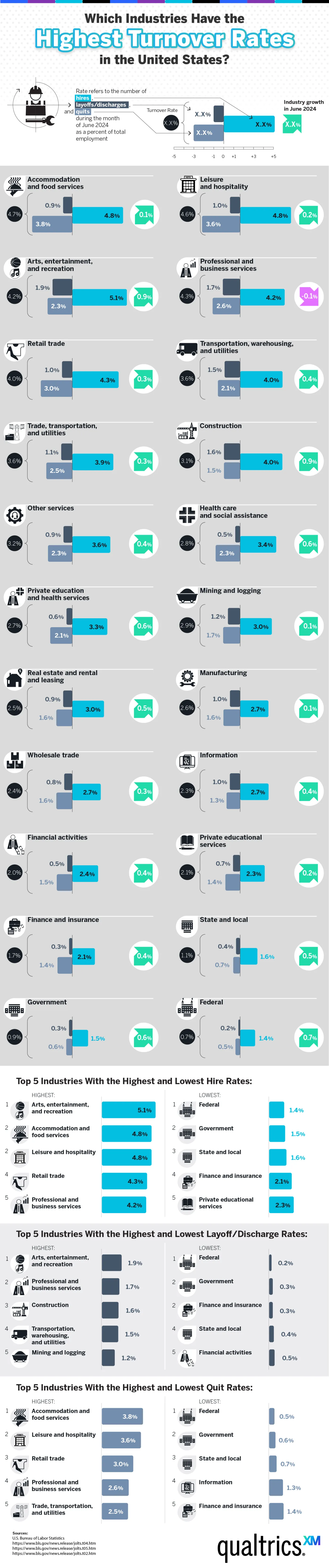
The team created a chart to visualize data from the Bureau of Labor Statistics. They measured hire rates, layoff/discharge rates, and quit rates. Here are the top 5 results from each category:
The highest hiring rates: Arts, entertainment, and recreation; accommodation and food services; leisure and hospitality; retail trade; and professional and business services.
The highest layoff/discharge rates: Arts, entertainment, and recreation; professional and business services; construction; transportation, warehousing, and utilities; and mining and logging.
The highest quit rates: Accommodation and food services; leisure and hospitality; retail trade; professional and business services; trade, transportation, and utilities.
Arts and entertainment stand out as a highly unstable industry with high hiring and layoff rates, meaning it has by far the highest turnover. On the low end of these measures, we find the federal government and finance sectors.
High turnover rates should concern more than employees. They don’t favor businesses either. Hiring new workers can be very expensive, as the business must cover job advertising, recruitment agency fees, training costs, and other onboarding expenses. According to Cornell University, it costs an average of $5,864 to replace an employee. If we examine the high-turnover food service industry, we find that a restaurant with 50 employees would need to replace two employees per month at a 4.7% turnover rate. Over the course of the year, replacing two employees a month would cost the restaurant $150,000. Setting aside the costs, high turnover can disrupt workflow and add workload and stress for staff, lowering morale, quality, and brand reputation. We saw this happen in another high-turnover industry. Both the Screen Actors’ Guild and the Writers’ Guild have made headlines for massive strikes that delayed film projects for years.
The team pointed out that a report from the Society for Human Resource Management identified the top three reasons for turnover as employee dissatisfaction with compensation, lack of career development, and workplace inflexibility. These are all common factors in the industries with the highest rates. Industries like food service, retail, and hospitality all have high levels of burnout, employees who feel they’re in stagnant careers, and demanding schedules that require work on weekends and holidays. These factors create unsatisfied workers who don’t stick around in the industry.
The COVID-19 pandemic led many people to consider the importance of workplace safety and a work culture that makes employees feel the company takes their health seriously. There were high turnover rates during this time across industries, and we learned that many companies fell short in protecting workers from illness. The Qualtrics study is packed full of data points with far-reaching implications like these.
-
 Business Visualizations2 years ago
Everything Owned by Apple
-
 Business Visualizations1 year ago
The Biggest Fortune 500 Company in Every State
-
 Business Visualizations12 months ago
The Biggest Employers by Industry
-
 Timelines2 years ago
Timeline Charts the Development of Communications Technology
-
 Business Visualizations7 months ago
The Largest Companies in America That Are Still Run by the Person Who Founded Them
-
 Maps2 years ago
A Map to Gold and Silver
-
 Timelines2 years ago
The Evolution of Baby Names: A Century of Trends
-
 Misc Visuals1 year ago
Exploring Science Fiction Technology That Became a Reality